Follow us



Buying a property on the Costa del Sol is an exciting investment, but understanding the taxes involved is essential. Whether you are purchasing a holiday home, investing in a rental property or planning to sell in the future, knowing your tax obligations can help you budget with confidence and avoid unexpected costs.
At Keys Property Group, we understand that buying property in Spain can raise many questions, particularly for international buyers who do not live here permanently. In this guide, we explain the main taxes non-residents may need to pay when buying, owning, renting out or selling a property in Spain.
Non-residents generally pay the same property purchase taxes as Spanish residents. The main difference is whether you are buying a newly built property or a resale home.
When purchasing a second-hand property, buyers normally pay Property Transfer Tax (ITP). The applicable rate depends on the autonomous community where the property is located, along with any relevant special rules or reductions.
For buyers purchasing in Andalucía, it is important to check the current regional tax rate and whether any exemptions or reduced rates apply to their circumstances.
When purchasing a newly built property directly from a developer, buyers generally pay:
These taxes can represent a significant part of your initial purchase costs, so it is advisable to calculate them before committing to a property.
Remember that additional expenses, including notary fees, Land Registry fees and legal fees, should also be included in your budget.
Once you own a property in Spain, you will generally need to pay Impuesto sobre Bienes Inmuebles (IBI), the annual local property tax.
IBI is calculated using the property’s cadastral value and the tax rate established by the local council. The amount therefore varies depending on the municipality and the property itself.
Whether your property is a permanent home, a holiday home or an investment, IBI is an ongoing expense to consider.
Other ownership costs may include community fees, insurance, utilities, maintenance and, where applicable, local waste collection charges.
One of the most important tax obligations for non-resident property owners is Impuesto sobre la Renta de No Residentes (IRNR), or Non-Resident Income Tax.
The rules depend on how you use your property. Even if you do not rent it out, you may still have a tax declaration obligation.
If you own a property in Spain for your own use, or leave it empty for part or all of the year, Spanish tax rules generally require you to declare imputed property income.
This does not mean that you have actually earned rental income. Instead, the tax system calculates a deemed income based on the property’s cadastral value.
The taxable amount is generally calculated using:
The amount is adjusted according to the period during which the property was available for personal use or remained unlet.
The applicable tax rate is generally 19% for qualifying residents of the EU, Iceland, Norway and Liechtenstein, and 24% for other non-residents.
For example, if the applicable deemed income is €2,000, the tax would be €380 at 19% or €480 at 24%, before considering any applicable adjustments.
This is an important detail for international buyers who purchase a holiday home on the Costa del Sol and only use it for a few weeks or months each year.
If you rent your property to holidaymakers or long-term tenants, you must generally declare the rental income in Spain.
The applicable rules depend on your country of tax residence:
For non-EU owners, the treatment of deductible rental expenses has been the subject of legal proceedings, so it is particularly important to obtain up-to-date tax advice before calculating your liability.
If you rent your property for only part of the year, you may need to declare the rental income for the rental period and imputed income for the remaining period when the property is available for personal use.
It is also worth remembering that rental income tax and any tourist accommodation registration or licensing requirements are separate matters.
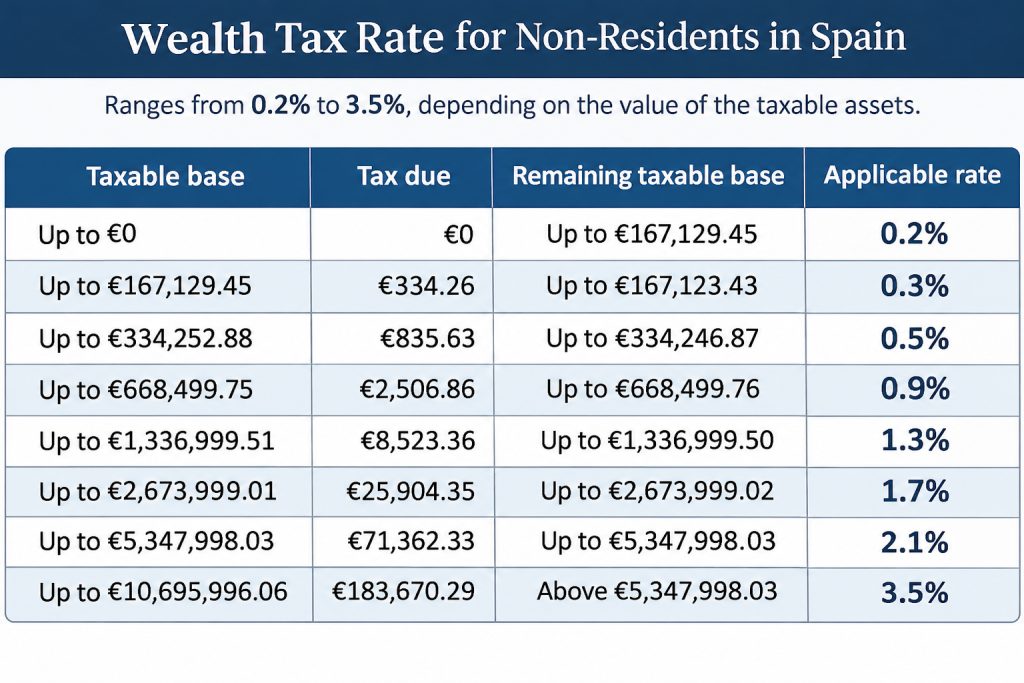
Depending on the value of your Spanish assets and your individual circumstances, you may also be liable for Wealth Tax (Impuesto sobre el Patrimonio).
For non-residents, Wealth Tax generally applies to net assets located in Spain rather than worldwide assets. The calculation can include Spanish property and other relevant assets, taking account of applicable deductions and liabilities.
A general €700,000 personal allowance applies to non-residents subject to tax under the real-obligation rules, although the final calculation depends on the relevant legislation and circumstances.
The applicable rates and regional rules must also be considered. Andalucía has its own Wealth Tax framework, so non-resident owners should check the rules applicable to their situation rather than assuming that the national rates alone determine the amount payable.
Owners of higher-value properties, particularly those with several Spanish assets, should seek professional advice to establish whether a Wealth Tax declaration or payment is required.
If you decide to sell your Spanish property, there are two important taxes to consider.
If you sell your property for more than its tax-adjusted acquisition cost, you may generate a taxable capital gain.
For non-resident individuals, the general rates are:
The taxable gain is not necessarily the difference between the original purchase price and the selling price. Eligible acquisition and selling expenses, as well as qualifying improvement costs, may affect the calculation under the applicable rules.
There is also an important practical point: the buyer is generally required to withhold 3% of the agreed sale price and pay it to the Spanish Tax Agency on account of the non-resident seller’s tax liability.
This withholding is not necessarily the final amount of tax due. The seller must calculate the actual liability and can generally claim a refund if the withholding exceeds the tax payable.
The seller may also be liable for the municipal tax known as Plusvalía Municipal.
This tax relates to the increase in the value of urban land during the period of ownership. The amount depends on the applicable municipal rules and the circumstances of the sale.
Where the seller is a non-resident, the buyer generally acts as the substitute taxpayer for this municipal tax under Spanish law, without prejudice to the parties’ rights and obligations under the sale agreement.
It is advisable to clarify these responsibilities with your lawyer before completing the transaction.
If you own property in Spain but are tax-resident in another country, you may also have tax reporting obligations in your country of residence.
Spain can generally tax income and gains arising from Spanish property. However, a double taxation agreement between Spain and your country of residence may help prevent the same income from being taxed twice, subject to the applicable rules.
The treatment depends on your country of tax residence, the type of income and the relevant agreement. It is therefore important to check both your Spanish obligations and any reporting requirements in your home country.
Understanding the tax implications before purchasing a property can help you make a more informed decision and plan for the ongoing costs of ownership.
Here are some practical steps to consider:
Owning a property on the Costa del Sol can be a wonderful lifestyle choice and a potential long-term investment. However, understanding the taxes involved is an essential part of making the right decision.
From purchase taxes and annual IBI to rental income, Wealth Tax and the costs of selling, each stage of property ownership can involve different obligations.
At Keys Property Group, we help international buyers explore property opportunities across the Costa del Sol and understand the practical considerations involved in purchasing a home in Spain.
If you are considering buying a holiday home, relocating to the area or investing in Spanish property, our team is here to help you find a property that suits your needs.
Thinking of buying a property on the Costa del Sol? Contact Keys Property Group to discuss your plans and explore the properties currently available.
Please note: This article provides general information and is not intended as tax or legal advice. Tax rules, rates and eligibility conditions can change, and individual circumstances vary. Capital gains on property sales by non-residents are generally taxed at 19%; this rate should not be confused with the 24% rate that generally applies to rental income for non-residents outside the qualifying EU/EEA categories. Always consult a qualified Spanish tax adviser to confirm your individual obligations.
Remember that we offer a variety of real estate services such as legal services, mortgage services, after-sales service, home staging, and property maintenance.