
Hidden Fees When Buying Property in Spain: The 2026 Investor’s Checklist
Your ideal Spanish home doesn’t actually cost the price on the listing; it costs at least 12% more. Most international investors are blindsided by hidden fees when buying property in Spain, often discovering too late that regional taxes and legalities can swell a budget by over €50,000 on a luxury purchase. It’s a frustrating reality that turns a moment of triumph into a series of stressful, unexpected invoices.
You’ve worked hard to secure your bespoke sanctuary in the sun, and you deserve a transaction that feels as refined as the lifestyle you’re pursuing. We believe that absolute transparency is the only way to ensure your investment remains a source of pride rather than a financial burden.
Our expert guide will help you master the complete financial landscape by detailing the 12% to 15% margin of additional costs required for a 2026 purchase. You’ll gain a clear, curated checklist covering everything from notary variables to currency exchange strategies, providing the confidence you need for a seamless, no-surprise transition into Spanish homeownership.
Key Takeaways
- Master the essential “12-15% Rule” to create a bespoke budget that accurately reflects the total investment required for your Spanish sanctuary.
- Navigate the intricate tax landscape, including ITP and the Reference Value trap, to ensure you are never surprised by hidden fees when buying property in Spain.
- Secure your legal and administrative peace of mind by understanding the fixed costs associated with Notaries and the Land Registry.
- Protect your capital from the “Foreigners Premium” by learning to manage currency exchange shifts and localized banking fees during completion.
- Plan for the seamless continuity of your lifestyle with an expert overview of ongoing community fees and annual property taxes.
The 12-15% Rule: Understanding the True Cost of Spanish Property in 2026
The allure of a Mediterranean sanctuary often begins with a captivating listing price. However, seasoned investors understand that the sticker price is merely the opening chapter of a much larger financial narrative. To secure a seamless acquisition in the current market, we advocate for the 12-15% Rule. This bespoke budgeting framework ensures your capital is protected against the often overlooked hidden fees when buying property in Spain.
This percentage isn’t a mere suggestion; it’s a strategic buffer. By 2026, regulatory shifts and updated valuation methods, such as the Reference Value (Valor de Referencia) used by the Spanish Tax Agency, have made precise budgeting more complex. This rule covers everything from mandatory regional levies to the professional fees required to curate a secure transaction. It transforms a potentially stressful purchase into a predictable, high-end investment experience.
Distinguishing between unavoidable government costs and the price of expert guidance is the first step toward clarity. While taxes are non-negotiable, the fees paid to a curated team of lawyers and surveyors act as insurance for your lifestyle. High-net-worth buyers don’t just buy bricks and mortar; they invest in the certainty that their new asset is legally sound and financially transparent.
Resale vs. New Build: The Initial Financial Fork
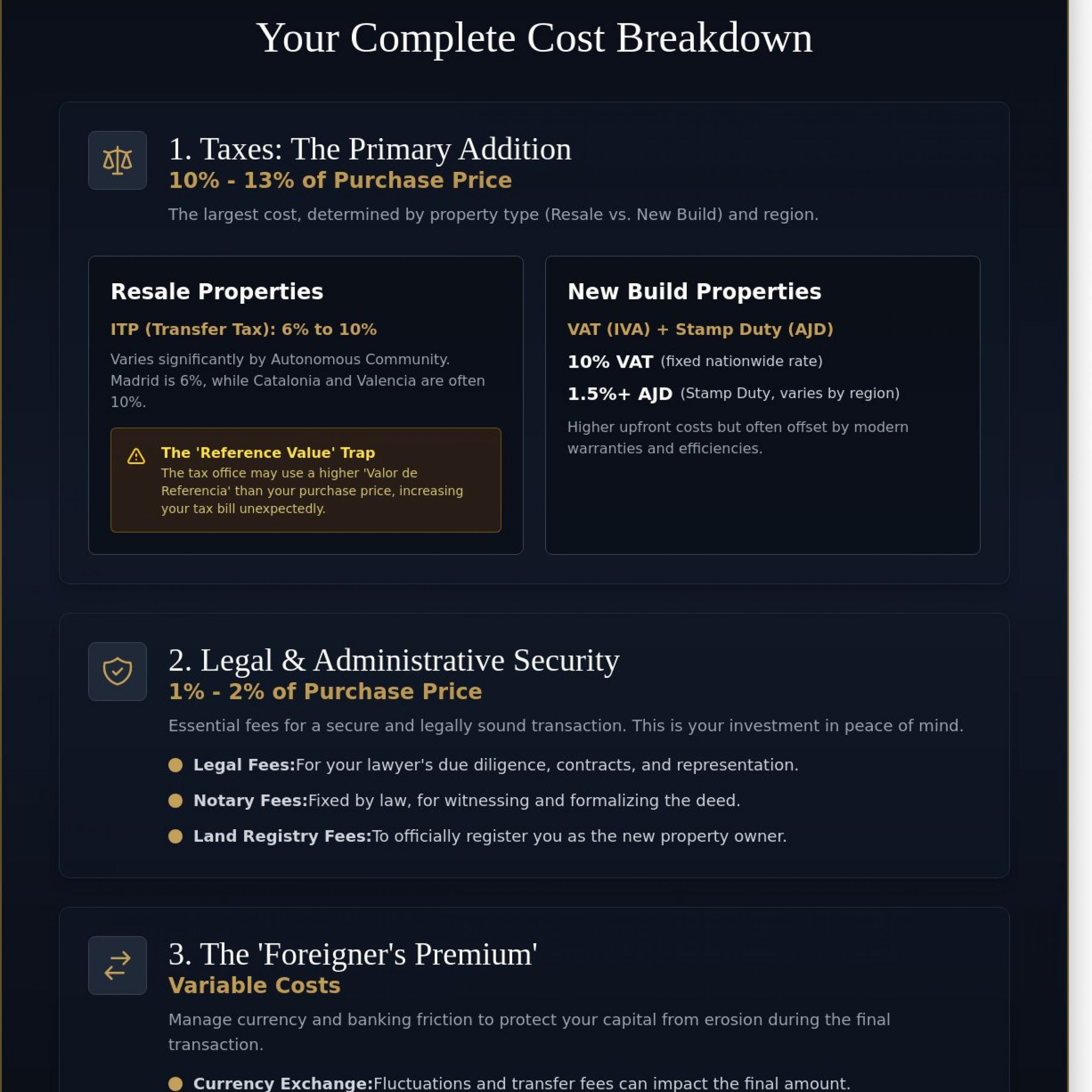
Choosing between a historic villa and a contemporary masterpiece creates a distinct financial fork in the road. Resale properties typically attract the Transfer Tax (ITP), which fluctuates between 6% and 10% depending on the location. For a detailed Overview of Spanish Taxation, it’s clear that regional autonomy plays a massive role in your final bill.
New-build properties present a different structure. You’ll face a flat 10% VAT (IVA) across the country, but the hidden sting often lies in the Stamp Duty (AJD). By 2026, some regions have adjusted AJD rates to 1.5% or higher. Buying from a developer often involves these higher upfront costs, yet it provides the unparalleled benefit of modern warranties and energy efficiencies that older homes lack.
The Psychology of the Safe Buffer
Transparency is the ultimate luxury in real estate. For the discerning investor, prioritizing a comprehensive budget over the lowest possible entry cost prevents the administrative friction that stalls momentum. A fully pre-funded transaction allows you to move with the confidence and speed that the competitive Spanish market demands.
Engaging a curated team of experts is the key to unlocking this peace of mind. When your legal and financial advisors are integrated from day one, you avoid the “hidden fees when buying property in Spain” that catch less-prepared buyers off guard. This proactive approach ensures your journey to a Spanish sanctuary is as refined and effortless as the lifestyle that awaits you.
The Tax Landscape: Navigating ITP, VAT, and the Reference Value Trap
Securing a Mediterranean sanctuary requires more than just an eye for exquisite design. It demands a sophisticated understanding of the Spanish fiscal framework. Taxes represent the most significant portion of the hidden fees when buying property in Spain, often adding between 10% and 13% to the final cost of your investment.
As we move through 2026, the tax environment remains a patchwork of regional regulations. Your total liability is dictated almost entirely by the location of your chosen estate. Whether you are eyeing a penthouse in Madrid or a coastal villa in Marbella, the fiscal nuances will shape your acquisition strategy.
Recent shifts in the legislative climate suggest that tax planning is no longer optional. As highlighted in this analysis of Potential Tax Changes for Foreign Buyers, non-resident investors must remain vigilant. Regional shifts in 2026 continue to target high-value transactions with progressive scales that can surprise the unprepared buyer.
Mastering the Property Transfer Tax (ITP)
For those acquiring a resale property, the Impuesto de Transmisiones Patrimoniales (ITP) is your primary consideration. This tax is managed by Spain’s Autonomous Communities, leading to wide variations. In Madrid, investors enjoy a competitive 6% rate, while regions like Catalonia, Valencia, and Galicia often apply a standard 10%.
The real danger lies in the Valor de Referencia, or Reference Value. Introduced by the Catastro, this is the value the tax office assigns to a property regardless of the price you actually paid. If you negotiate a brilliant deal for €800,000 but the official reference value is €900,000, you are legally required to pay ITP on the higher figure.
Failing to account for this discrepancy can trigger an automatic tax audit and subsequent penalties. We recommend requesting a formal valuation report before completing the transaction to ensure your capital is protected. Securing a bespoke property strategy ensures these technical variables are accounted for long before you reach the notary’s office.
VAT and Stamp Duty for New Developments
New-build properties follow a different fiscal path. Instead of ITP, buyers pay Value Added Tax (VAT), known locally as IVA. In 2026, the standard rate for residential properties remains fixed at 10%. This is a direct cost paid at the time of each installment or upon completion.
If your investment includes commercial premises or a plot of land without a finished dwelling, the VAT rate climbs significantly to 21%. This jump can drastically alter the feasibility of a development project if not factored into the initial pro forma.
Accompanying the VAT is the Actos Jurídicos Documentados (AJD), or Stamp Duty. This tax covers the legal documentation of the deed. Rates currently fluctuate between 0.5% and 1.5% depending on the region. While it seems minor, on a multi-million euro villa, a 1.5% AJD fee is a substantial line item that qualifies as one of the essential hidden fees when buying property in Spain.
Professional Fees: Investing in Legal and Administrative Security
Securing a Mediterranean sanctuary requires more than a keen eye for coastal architecture. It demands a curated team of experts to navigate the administrative landscape. While some investors overlook these costs, understanding the hidden fees when buying property in Spain is the key to a seamless transition. These professional services provide the legal scaffolding for your investment, ensuring your peace of mind is as enduring as the Spanish sun.
Professional fees are the essential bridge between a verbal agreement and a secured asset. In Spain, these costs are predictable but require careful budgeting to avoid surprises at the closing table. Each specialist plays a distinct role in protecting your capital from unforeseen legal encumbrances.
The Role of the Independent Solicitor
A bespoke legal advisor is your most vital ally in the Spanish market. They verify the Nota Simple from the Land Registry to ensure the property is free of undisclosed debts or liens. This document confirms the legal owner and any existing charges. Your lawyer also handles the Arras contract with precision. This deposit agreement typically involves a 10% payment. It’s a crucial step that secures the transaction and defines the terms of the sale. Expect to pay approximately 1% of the purchase price plus 21% VAT for these legal services.
Notary and Registry: The Final Pillars of Ownership
The final signing of the Escritura or Title Deed happens before a Notary Public. Notary fees are regulated by the Spanish government under Royal Decree 1426/1989. While the scale is fixed by law, the final invoice varies based on the complexity of the deed. For a property valued at €1,000,000, Notary fees often range between €800 and €1,200. Once signed, the property must be recorded in the Registro de la Propiedad. Registry fees typically represent about 60% of the notary cost. Immediate registration is vital to prevent third-party claims or unexpected legal issues.
The Gestoria acts as the administrative engine room for your property transaction. These professionals handle the heavy lifting of tax filings and ensure all documents reach the registry correctly. They bridge the gap between the notary’s office and the tax authorities. Their fees are generally modest, often between €300 and €600. However, their role in preventing administrative delays is invaluable for international buyers.
Investing in these professional services isn’t just a requirement. It’s a strategy. By engaging a dedicated team, you transform a complex international purchase into a curated experience. This approach ensures that the hidden fees when buying property in Spain are accounted for early, allowing you to focus on the lifestyle your new home provides. Each fee represents a layer of protection for your Spanish sanctuary.
Expert guidance ensures your investment remains a source of joy rather than a source of stress. The Spanish market rewards those who prioritize legal clarity and administrative precision. With the right professionals by your side, the process becomes as clear and inviting as the waters of the Balearic Sea.
The Foreigners Premium: Managing Currency and Banking Friction
Acquiring a luxury residence abroad involves more than just the sticker price. It requires a sophisticated approach to the logistical friction that accompanies moving wealth across borders. These administrative nuances represent some of the most frequent hidden fees when buying property in Spain, where small percentages can lead to significant capital leakage.
Managing these elements with precision ensures your investment remains sound. From the moment you apply for your NIE to the final signature at the notary, every financial move should be curated to protect your interests. It’s about maintaining the integrity of your budget through every stage of the transaction.
Seamless Currency Strategies
Market volatility is a silent predator in international real estate. A 1% shift in the exchange rate can instantly add €10,000 to the cost of a €1,000,000 villa. High-street banks rarely offer the most competitive rates. They often hide their margins in the spread between the interbank rate and the rate they offer you, which can cost thousands in unnecessary premiums.
Bespoke currency brokers provide a more refined solution. Through forward contracts, you can lock in a favorable exchange rate for up to 12 months in advance. This strategy provides a financial sanctuary, ensuring that the price you agreed to pay remains stable regardless of global market shifts. It’s a vital tool for those who value predictability in their investment journey.
Banking and Mortgage Logistics
The Spanish banking system operates with a unique fee structure that often surprises global investors. One notable cost is the Banker’s Draft, or cheque bancario, which is the standard method for completion payments. Many banks charge between 0.5% and 1% of the total draft amount just to issue this document. On a high-value luxury purchase, this represents a substantial and often unexpected expense.
- NIE Number Costs: While the government tax is under €15, professional legal assistance to secure this essential ID typically costs between €150 and €300.
- Property Valuations (Tasación): Mandatory for all mortgage applications, these appraisals generally range from €400 to €1,200 for premium residences.
- Mortgage Arrangement Fees: Lenders often charge an “apertura” or opening fee, which typically lands between 1% and 1.5% of the loan value.
Opening a Spanish bank account also carries recurring maintenance fees that are often higher for non-residents. Professional guidance helps you identify these hidden fees when buying property in Spain early in the process. This allows you to navigate the banking landscape with the confidence of a local expert and the prestige of a global investor.
Experience an unparalleled level of service and transparency in your property search. Connect with our expert advisors today to secure your Spanish sanctuary with absolute precision.
Post-Purchase Continuity: Budgeting for Your Sanctuary Upkeep
Securing the keys to a Mediterranean villa or a sophisticated Madrid penthouse is a milestone that deserves celebration. However, the journey doesn’t end at the notary’s office. To maintain the prestige and value of your investment, you’ll need to account for recurring costs that often surprise international buyers. Identifying these hidden fees when buying property in Spain early allows you to preserve your lifestyle without financial friction.
Ongoing expenses fall into two distinct categories: statutory obligations to the Spanish state and the bespoke costs of maintaining a high-end residence. Proper budgeting ensures your home remains a sanctuary of peace, ready for your arrival at any moment.
Annual Tax Obligations
The IBI (Impuesto sobre Bienes Inmuebles) is the local property tax paid annually to the town hall. It’s calculated based on the cadastral value of the land and the building. Rates typically fluctuate between 0.4% and 1.1% depending on the municipality. For a luxury property in a prime coastal area, this can represent a significant annual commitment.
Non-resident owners face a specific levy known as Imputed Income Tax. Even if you don’t rent out your home, the Spanish Tax Agency assumes you derive a benefit from owning it. This tax is usually calculated as 1.1% or 2% of the cadastral value, then taxed at a flat rate of 19% for EU/EEA residents or 24% for those outside the EU. It’s a common oversight that can lead to unexpected penalties if ignored.
Wealth Tax (Patrimonio) remains a vital consideration for high-value assets in 2026. While regional exemptions exist, individuals with Spanish assets exceeding €700,000 may be subject to this progressive tax. It’s essential to consult with a fiscal expert to understand how these thresholds apply to your specific portfolio.
Bespoke Management and Maintenance
Community fees (Cuota de la Comunidad) are the price of excellence in shared living. In exclusive urbanizations, these fees fund unparalleled amenities such as heated infinity pools, professional gymnasiums, and 24-hour manned security. Depending on the level of service, monthly costs can range from €250 to well over €1,200 for elite developments.
- Professional Key Holding: This is a vital insurance policy for your investment. Local experts provide weekly inspections, humidity checks, and emergency response services while you’re abroad.
- Private Upkeep: Maintaining private gardens and infinity pools requires specialized contractors. Expect to budget for professional cleaning and landscaping to ensure your sanctuary stays pristine.
- Security Systems: High-end properties often integrate advanced alarm monitoring and smart home surveillance, requiring monthly subscription fees for 24/7 peace of mind.
Your Spanish retreat should be a place of total relaxation. Engaging a bespoke property management team ensures that every detail, from the climate control to the wine cellar temperature, is perfect before you step through the door. This proactive approach protects the long-term value of your investment while providing a seamless transition into the local lifestyle.
Your Secure Path to Spanish Ownership
Navigating the 12% to 15% additional cost margin is vital for any serious investor looking to avoid hidden fees when buying property in Spain. Proper planning for the 2026 Reference Value system ensures your capital is protected. It’s about turning a financial transaction into a secure lifestyle investment that stands the test of time.
With over 20 years of local expertise, we offer a boutique approach that bridges the gap between international standards and Spanish regulations. Our end-to-end support includes legal facilitation and mortgage coordination, removing the friction often found in foreign acquisitions. We don’t just find you a house; we curate a transition that’s as smooth as it is rewarding.
From the initial search to bespoke maintenance and key holding, we’re your trusted guide in the Mediterranean. Unlock a seamless purchase experience with KEYS property group and step into your new sanctuary with total confidence.
The key to your new life in Spain is closer than you think.
Frequently Asked Questions
What is the 10-15% rule when buying property in Spain?
The 10-15% rule is a standard budgeting guideline that accounts for the total taxes and hidden fees when buying property in Spain. This percentage covers the Transfer Tax (ITP) for resales or VAT for new builds, alongside notary, land registry, and legal costs. For an investment of €1,000,000, you should reserve at least €120,000 to ensure a smooth closing process.
Do I have to pay VAT or ITP on a Spanish property purchase?
You’ll pay 10% VAT on newly constructed homes, while resale properties are subject to ITP, which ranges from 6% to 10% depending on the region. For example, a new villa in Alicante also incurs a 1.5% Stamp Duty (AJD). Resale buyers in Madrid benefit from a lower 6% ITP, but this rate climbs to 10% in Catalonia or the Balearic Islands.
Is a lawyer mandatory for buying a house in Spain?
Hiring a lawyer isn’t a legal requirement in Spain, but it’s a standard practice for 95% of international buyers seeking a secure transition. A boutique legal firm provides essential due diligence, verifying that the property has no outstanding debts or planning issues. This professional oversight typically costs between 1% and 1.5% of the purchase price plus 21% VAT.
What is the Valor de Referencia and how does it affect my taxes?
The Valor de Referencia is the official market value set by the Spanish Tax Agency and acts as the minimum tax base for property transactions. Since its introduction in January 2022, if your agreed purchase price is lower than this figure, the government calculates your taxes based on their valuation instead. Understanding this benchmark is critical for managing the hidden fees when buying property in Spain effectively.
Are real estate agent commissions paid by the buyer or seller in Spain?
The seller typically pays the real estate agent’s commission in Spain, which usually falls between 3% and 5% of the final sale price. In some regions like Valencia or specific luxury markets, a shared fee model exists where both parties pay a percentage. It’s vital to clarify these terms early to ensure your financial planning remains accurate and transparent.
How much are the annual taxes for owning a holiday home in Spain?
Non-resident owners pay two main annual taxes: the IBI (Council Tax) and a Non-Resident Income Tax known as Modelo 210. IBI is based on the cadastral value and usually ranges from €300 to €2,000 for high-end homes. If you don’t rent out the property, the Modelo 210 is calculated as 19% of a small percentage of the cadastral value for EU residents.
What are the hidden costs of taking out a Spanish mortgage?
Hidden mortgage costs include the mandatory property appraisal, which costs between €300 and €800, and potential bank arrangement fees of up to 1%. While the 2019 Mortgage Law requires banks to pay for the notary and registry fees, they often mandate life or home insurance. These premiums can add €1,000 to your annual carry costs for a luxury residence.
Can I save money by using a currency broker instead of a bank?
Using a specialist currency broker can save you up to 4% on exchange rates compared to standard retail banks. On a €500,000 transaction, this bespoke approach can save you €20,000 in unnecessary conversion costs. Brokers also provide forward contracts, allowing you to lock in a favorable rate for up to 12 months while your Spanish home is being built.
Properties in Hidden Fees When Buying Property in Spain: The 2026 Investor’s Checklist