
Capital Gains Tax in Spain for Foreigners: A Comprehensive 2026 Guide
Why do so many international sellers leave thousands of euros on the table simply because they misunderstand the 3% withholding rule? It’s natural to feel a sense of hesitation when facing the intricacies of capital gains tax in Spain for foreigners, especially as regulations evolve for 2026. You’ve curated a beautiful Mediterranean lifestyle, and your financial transition should be as seamless as the day you first received your keys.
We’re here to ensure your investment remains a source of pride rather than a source of stress. This guide empowers you to master these complexities by providing an expert breakdown of current rates, available exemptions, and strategic insights tailored for international property owners.
We will explore the specific 19% flat rate for non-residents and the essential timelines for filing your Modelo 210. You will also discover legal pathways to refine your final tax liability through deductible expenses like the local Plusvalía tax and professional legal assistance costs.
Key Takeaways
- Grasp the specific 2026 rates for capital gains tax in Spain for foreigners to project your net returns with absolute precision.
- Discover how to lower your taxable profit by correctly applying legal deductions for property improvements and essential transaction costs.
- Identify eligibility for key exemptions and reinvestment reliefs that protect the equity in your Spanish property portfolio.
- Understand the mandatory 3% retention process and the timeline for reclaiming funds through the official Modelo 210 filing.
- Learn why professional legal assistance is the definitive bridge between complex local regulations and a seamless, high-end selling experience.
Understanding Capital Gains Tax for Foreigners in Spain
Selling a property in Spain is a significant financial transition that represents the culmination of a successful investment journey. At the heart of this transaction lies the Impuesto sobre la Ganancia Patrimonial, which is the tax levied on the profit you realize from selling assets.
This obligation applies to various holdings within Spanish territory, including luxury villas, coastal apartments, and undeveloped plots of land. It’s only triggered when your final sale price exceeds the original purchase price, ensuring you’re taxed exclusively on the actual growth of your wealth.
For the 2026 tax year, the Spanish tax office, known as the Agencia Tributaria, maintains a sophisticated level of oversight regarding international transactions. Understanding the nuances of capital gains tax in Spain for foreigners is essential to ensuring your exit from the market is as refined as your entry was.
The Core Difference Between Resident and Non-Resident Tax Status
Your residency status is the primary factor that dictates your fiscal relationship with the Spanish state. A comprehensive Spanish tax system overview reveals that spending more than 183 days in the country within a calendar year typically classifies you as a tax resident.
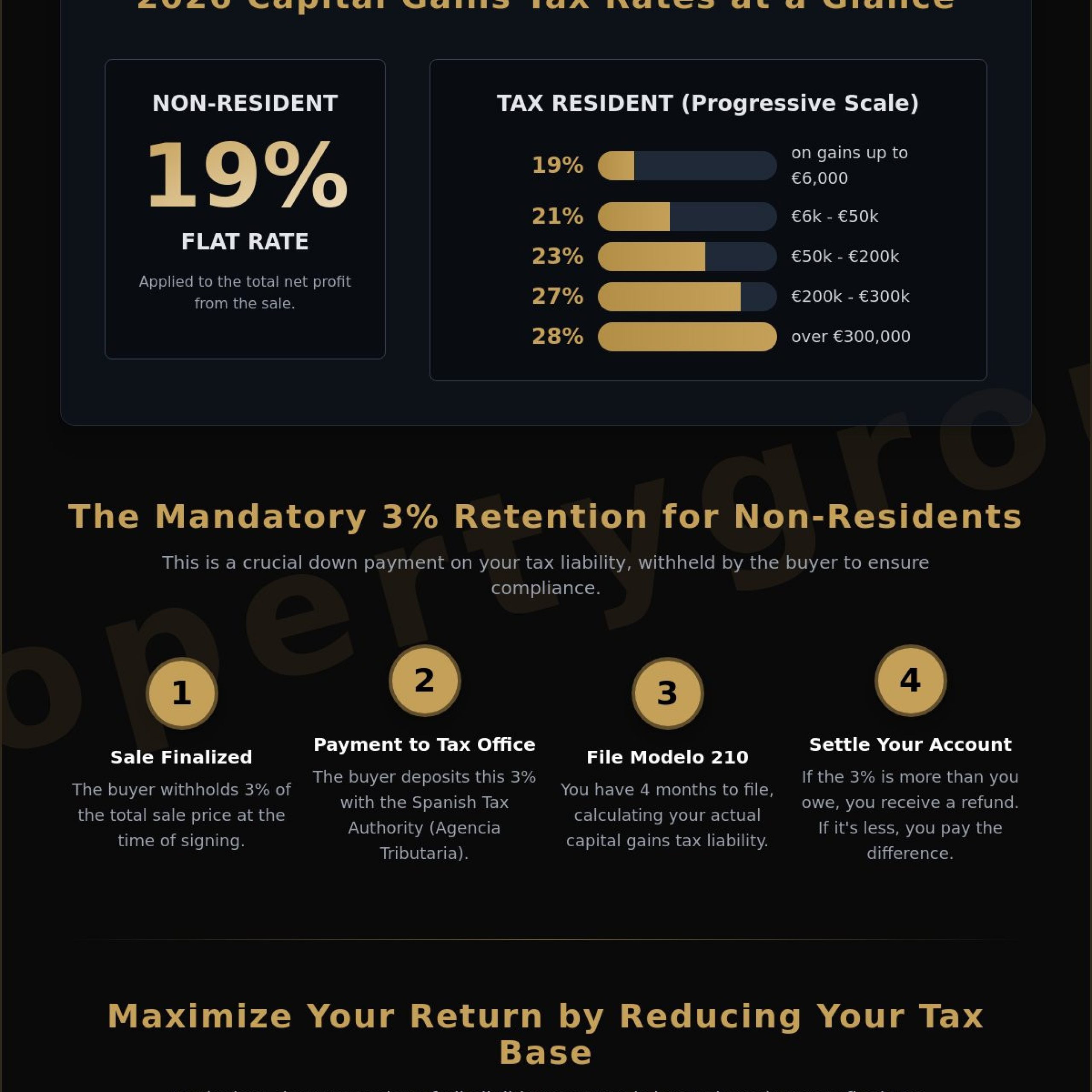
Non-residents fall under the Non-Resident Income Tax (IRNR) framework, which applies a flat rate to the net gain. Residents, by contrast, are taxed on a progressive scale where the percentage increases alongside the size of the profit.
This distinction fundamentally changes your final liability and requires careful planning long before the deed is signed at the notary. Our team often assists clients in exploring these definitions to provide clarity during their life-changing transitions.
Why 2026 is a Pivotal Year for Spanish Property Sellers
The Spanish property market continues to show remarkable stability, making 2026 an opportune moment for international investors to realize their gains. This steady growth allows for a confident exit strategy that preserves the value you’ve built over the years.
Securing a valid NIE number remains the cornerstone of any tax declaration in Spain. Without this identification, the legal machinery of the sale cannot proceed, making it a priority for any seller.
View this tax not as a hurdle, but as a standard milestone in a high-end investment lifecycle. Proper management of capital gains tax in Spain for foreigners ensures that your next international venture begins with a clean and professional financial slate.
Calculating Your Liability: Rates and Deductible Expenses
Precision is the hallmark of a sophisticated property exit. To determine the net profit subject to capital gains tax in Spain for foreigners, you must subtract the original purchase price and all associated acquisition costs from your final sale price.
The resulting figure represents your taxable gain. By meticulously applying every legal deduction, you transform a standard financial obligation into a managed investment cost that preserves your hard earned equity.
Documentation serves as your primary shield against overpayment. You must retain all original invoices for legal fees, notary services, and construction works to validate your claims before the Spanish tax authorities.
Current Tax Rates for Residents and Non-Residents in 2026
For tax residents, the 2026 progressive scale applies to what is known as savings income. This structure ensures that smaller gains are taxed at a lower threshold before reaching the higher brackets for substantial luxury sales.
- 19% for gains up to €6,000
- 21% for gains between €6,000 and €50,000
- 23% for gains between €50,000 and €200,000
- 27% for gains between €200,000 and €300,000
- 28% for gains exceeding €300,000
Non-residents enjoy a more streamlined framework. Whether you are an EU citizen or a resident of a non-EU country like the UK or USA, the Spanish tax office applies a flat rate of 19% on property sales profit.
Maximising Deductions to Reduce Your Tax Base
Reducing your tax base is a matter of professional diligence rather than luck. Several key expenses incurred during both the purchase and the sale of your property are fully deductible from your final gain.
- Transmission taxes such as ITP for resale properties or IVA for new builds
- Notary and Land Registry fees paid during the initial acquisition
- The local Plusvalía tax paid to the municipality at the time of sale
- Professional real estate agency commissions and legal fees
Structural improvements that increase the long term value of your home are also eligible for deduction. This includes significant renovations like adding a swimming pool, extending a terrace, or installing high end climate control systems.
Our advisors often coordinate with clients to secure comprehensive legal assistance, ensuring every eligible euro is accounted for before the final tax filing. This boutique approach provides the peace of mind that your financial transition is handled with global standards of excellence.
Legal Exemptions and Strategies to Mitigate Tax
Navigating the fiscal landscape requires more than just awareness of the headline rates. Sophisticated investors utilize “bonifications,” or legal tax reliefs, to optimize their financial outcomes during a sale. These aren’t loopholes but essential tools designed to reward long-term commitment when managing capital gains tax in Spain for foreigners.
Claiming these benefits requires absolute precision and documented proof of eligibility. Professional legal assistance is vital to ensure every specific condition is met before you finalize your transaction. This level of preparation ensures your transition to a new chapter remains as rewarding as the time spent in your current home.
The Main Residence Reinvestment Relief
If you choose to sell your primary home to purchase another, you may be eligible for a significant exemption. The profit from your sale isn’t taxed if the total amount is reinvested into a new habitual residence within a two-year window. This relief is a powerful way to maintain the momentum of your property portfolio.
To qualify for this incentive, the property must have served as your habitual residence for at least three consecutive years. This status transforms the asset from a simple financial holding into a protected family legacy. You’ll want to remember that this specific relief is generally reserved for those established as Spanish tax residents.
Specific Incentives for Sellers Over the Age of 65
Reaching the age of 65 unlocks exclusive fiscal advantages for those who’ve made Spain their home. If you sell your primary residence after this milestone, you’re entirely exempt from paying capital gains tax in Spain for foreigners who have attained residency status. There’s no requirement to reinvest these proceeds into a new property.
A unique strategy also exists for those selling second homes or high-end investment villas. By placing the sale proceeds into a certified Life Annuity within a six-month period, you can effectively eliminate your tax burden up to a limit of €240,000. This sophisticated move provides a steady stream of income while securing the long-term financial liquidity you deserve.
The Selling Process: The 3% Retention and Plusvalía
A successful property sale in Spain concludes with a structured settlement process designed to ensure fiscal compliance. For non-resident sellers, this involves a mandatory 3% retention calculated from the total sale price. The buyer acts as a temporary custodian, paying this amount directly to the Spanish Tax Agency on your behalf.
The buyer uses Modelo 211 to execute this payment within one month of the notary signing. This ensures the transaction is recorded correctly in the national tax registry. It’s a standard procedure that provides a clear paper trail for your financial exit.
This retention functions as a security deposit against your final capital gains tax in Spain for foreigners. It guarantees that the state receives an advance payment before the funds leave Spanish territory. While it may seem like an immediate cost, it’s actually the first step in finalizing your investment’s legal standing.
Managing the 3% Withholding and Potential Refunds
You aren’t necessarily losing this 3% forever if your actual tax liability is lower than the amount withheld. In cases where you sell at a loss or your calculated tax is minimal, you’re entitled to claim a full or partial refund. This requires filing the Modelo 210 form within four months of the property transfer date.
The refund process is rigorous and demands that all your local obligations are perfectly settled. The tax authorities will verify that your annual IBI and non-resident income taxes are fully up to date before releasing any funds. This scrutiny highlights why having meticulous legal assistance is an essential component of a high-end property transaction.
Once the claim is approved, the Agencia Tributaria typically issues the refund via bank transfer. Ensuring your Spanish bank account remains open until this process concludes is a vital piece of logistical advice. This patience ensures you recover every euro that is rightfully yours.
Understanding the Municipal Plusvalía Tax
While capital gains tax is a state-level obligation on your profit, the Plusvalía is a local tax levied by the municipality. It focuses specifically on the increase in the value of the urban land where your villa or apartment stands. This tax is a deductible expense when calculating your capital gains tax in Spain for foreigners.
In 2026, sellers can choose between two calculation methods to find the most favorable outcome. You can opt for the Real Profit method based on actual market values or the Objective Value method using cadastral data. You have a strict 30-day window from the date of the sale to settle this amount with the local Town Hall.
Missing this deadline can result in late payment surcharges that diminish your final returns. A well-connected advisor will ensure the Plusvalía calculation is audited for accuracy before payment. This attention to detail protects your investment during its final transition.
Navigating Your Spanish Property Transition with Professional Ease
Transitioning property ownership is far more than a financial settlement. It’s a life-changing milestone that marks the conclusion of one chapter and the deliberate beginning of another. A refined approach ensures that every detail reflects the high standards of your investment journey.
Managing capital gains tax in Spain for foreigners requires a bridge between local legal complexities and global financial standards. A trusted advisor provides the reassurance that your legacy is protected during this pivotal moment. This partnership allows you to move forward with the confidence that comes from professional precision.
We invite you to view your property sale as a sophisticated evolution of your portfolio. With the right support, the process becomes a seamless reflection of the upscale lifestyle you’ve cultivated. Your success in the Spanish market deserves a closing experience that is both authoritative and personally tailored.
The Value of End-to-End Legal and Financial Support
A stress-free closing process is built on a foundation of comprehensive professional management. Our holistic approach integrates essential services like currency exchange and mortgage facilitation to protect your interests at every turn. This ensures that the capital realized from your sale is managed with the utmost care.
With over 20 years of experience in the regional market, our team provides the stability and foresight needed for complex international transactions. This deep-rooted expertise allows you to focus on your next venture while we handle the intricate details of the Spanish fiscal system. We prioritize your peace of mind through every stage of the transaction.
Securing expert legal assistance is the final step in ensuring your obligations regarding capital gains tax in Spain for foreigners are met with absolute precision. This boutique level of care transforms a standard sale into a prestigious financial transition. It’s the difference between a simple transaction and a masterfully managed exit strategy.
Starting Your Next Chapter in the Spanish Market
The sale of one asset often opens the door to new, exclusive opportunities across the Mediterranean coast. Whether you’re seeking contemporary apartments, sprawling villas, or prime investment plots, the market continues to offer exceptional potential for growth. Each new acquisition is a chance to refine your vision of the ideal lifestyle.
Expert guidance serves as the essential key to unlocking access to the most desirable off-market listings. We remain deeply invested in your long-term success, providing the local passion and global standards required to navigate this vibrant landscape. Our role is to ensure your next investment is as rewarding as the last.
As you plan your next move, take a moment to uncover the best things to do in Malaga City, Spain for lifestyle inspiration. This region’s unique blend of culture and luxury remains a powerful draw for the discerning international collector. Your journey in Spain is a continuous story of discovery and prestige.
Secure Your Financial Legacy in the Spanish Market
Success in the luxury property sector is defined by the precision of your exit strategy. By mastering the nuances of deductible expenses and understanding the 3% retention process, you ensure your transition is both profitable and compliant. These strategic insights allow you to navigate the complexities of capital gains tax in Spain for foreigners with the poise of a seasoned investor.
Expertise is the bridge between a standard transaction and a masterfully executed sale. Our team brings over 20 years of experience in the Spanish luxury market, offering comprehensive legal assistance and currency exchange support tailored to your unique needs. We provide the dedicated boutique service that international investors deserve, ensuring every detail is handled with effortless care.
Your journey in the Mediterranean is an evolving narrative of growth and exclusivity. Discover how KEYS property group can manage your Spanish property sale with effortless precision. We’re here to unlock the full potential of your investment as you step confidently into your next prestigious chapter.
Frequently Asked Questions
Do foreigners pay capital gains tax in Spain?
Yes, all foreigners are liable for tax on profits made from selling Spanish assets like villas, apartments, or plots. This obligation applies regardless of whether you’re a tax resident or a non-resident. It’s a standard part of the fiscal landscape that ensures the integrity of the local property market.
How much is capital gains tax in Spain for non-residents in 2026?
Non-residents are subject to a flat tax rate of 19% on the net profit realized from their property sale. This rate remains consistent throughout the 2026 tax year for all international sellers. The profit is calculated after subtracting original acquisition costs and structural improvements from the final sale price.
Can I avoid capital gains tax if I am over 65?
You can claim a full exemption if you’re over 65 and selling your primary residence as a Spanish tax resident. Those selling investment properties or second homes can also mitigate tax by reinvesting proceeds into a certified life annuity. These sophisticated strategies require precise legal documentation to be successfully executed by the tax authorities.
What is the 3% retention when selling property in Spain?
The 3% retention is a mandatory withholding from the total sale price when a non-resident sells a property. The buyer pays this amount directly to the Agencia Tributaria as an advance on your final capital gains tax in Spain for foreigners. It effectively acts as a fiscal security deposit for the Spanish state during the transaction.
How long do I have to pay capital gains tax after selling my house?
Non-residents must file their final tax return via Modelo 210 within four months of the property transfer date. Residents declare their gains during the annual income tax window between April and June of the year following the sale. Adhering to these strict timelines is essential for a smooth and professional financial transition.
Are real estate agent fees tax-deductible in Spain?
Yes, professional real estate agency commissions are fully deductible from your taxable gain. You should also include notary fees, land registry costs, and legal assistance expenses in your final calculation. Keeping original invoices for these high-end services is vital to lowering your final liability and preserving your equity.
What happens if I sell my Spanish property at a loss?
You won’t owe any capital gains tax if your property is sold for less than its original adjusted acquisition cost. Even in this scenario, the 3% retention is still withheld by the buyer at the notary signing. You must then file a formal tax return to claim a full refund of this amount from the authorities.
Is there a difference in tax for EU vs non-EU citizens?
There is no difference in the 19% tax rate for EU versus non-EU citizens when selling property. While other income taxes may vary, the Spanish government applies a uniform rate for capital gains tax in Spain for foreigners regardless of their country of origin. This provides welcome clarity for UK, US, and European investors alike.
Properties in Capital Gains Tax in Spain for Foreigners: A Comprehensive 2026 Guide