
The Comprehensive Guide to Spanish Property Deeds (Escritura) in 2026
The Escritura is not just a receipt; it’s the definitive legal shield that transforms a private agreement into a globally recognized property right. This guide to Spanish property deeds (escritura) ensures you understand every line of this critical document before you pick up the pen. It’s the most important step in your journey, acting as the bridge between a simple promise and legal ownership.
It’s natural to feel a sense of unease when navigating a foreign legal system, especially when the terminology feels opaque and the stakes are high. You deserve the security of knowing your investment is protected and your transition to a Spanish lifestyle is seamless. We’ll help you master the complexities of the Spanish legal system with this definitive guide to understanding, signing, and registering your property deeds.
We’ll explore exactly what’s inside the Escritura, how to verify your ownership, and what the Notary’s role really entails. From navigating regional tax updates in 2026 to the final registration at the Land Registry, we provide the clarity you need for a confident completion day.
Key Takeaways
- Understand why the Escritura is the ultimate public document required to secure your legal standing and peace of mind as a Spanish homeowner.
- Learn how to cross-reference the Escritura with the Nota Simple and Catastro to verify ownership and uncover any hidden debts or liens.
- Gain a clear walkthrough of the Notary appointment, including the significance of the “Lectura” and why your presence is legally vital.
- Use this guide to Spanish property deeds (escritura) to master the essential post-signing steps, including the 30-day tax window and Land Registry submission.
- Discover the specific components of a valid deed, ensuring your personal details and the legal description of the property are perfectly recorded.
What is a Spanish Property Deed (Escritura de Compraventa)?
The Escritura de Compraventa is the definitive public deed that marks the final step of your property acquisition. While you may have signed several documents during the property buying process in Spain, this is the only one that carries the weight of the law. This guide to Spanish property deeds (escritura) clarifies why this specific document is the foundation of your ownership.
A deed becomes a “Public Document” only when it’s signed in the presence of a Notary. This official acts as an impartial witness for the Spanish state. They ensure that the Contrato de Compraventa or sales contract complies with all current regulations.
Without this formalization, you cannot register your title at the Land Registry. The Registry only accepts public deeds, making the Escritura your only path to absolute legal protection. It’s the moment your dream home moves from a private agreement into the public record.
Most buyers start with a private Arras contract to reserve the property. While this agreement is legally binding between you and the seller, it doesn’t notify the world of your new status. The Escritura effectively “elevates” that private deal into a public fact.
The Legal Significance of the Public Deed
The Escritura provides what Spanish law calls “fe pública,” or public faith. This means the facts stated within the document are legally presumed to be true. It creates a robust layer of security that protects you from potential future disputes.
The Notary’s primary role is to verify the identity and legal capacity of everyone involved. They check that the seller actually owns the property and has the right to sell it. They also ensure you understand the obligations you’re taking on.
This verification process shields you against third-party claims. If someone later tries to claim they have a right to the land, your registered Escritura serves as your primary defense. It’s the ultimate proof that you’re the rightful owner.
Why Private Contracts Are Not Enough
Relying solely on a private contract is a significant risk for any buyer. These documents are valid between the parties, but they don’t update the Land Registry. If the Registry isn’t updated, the seller could technically try to sell the property again or take out a mortgage against it.
Elevating the purchase to a Public Deed immediately is essential for your protection. It prevents the seller’s creditors from placing liens on the property after you’ve paid for it. This guide to Spanish property deeds (escritura) highlights that speed is your best friend for legal registration.
Spanish law also relies on the concept of “traditio,” which refers to the symbolic delivery of the property. When the Notary hands over the keys after the signing, it signifies the transfer of possession. This physical act, combined with the deed, completes your journey to homeownership.
Key Components: What Your Escritura Actually Contains
Every Escritura follows a standardized structure, yet the fine print is where your true security lies. This guide to Spanish property deeds (escritura) breaks down the specific clauses that define your ownership and protect your investment. Understanding these sections ensures you aren’t just signing a stack of papers, but a robust legal shield.
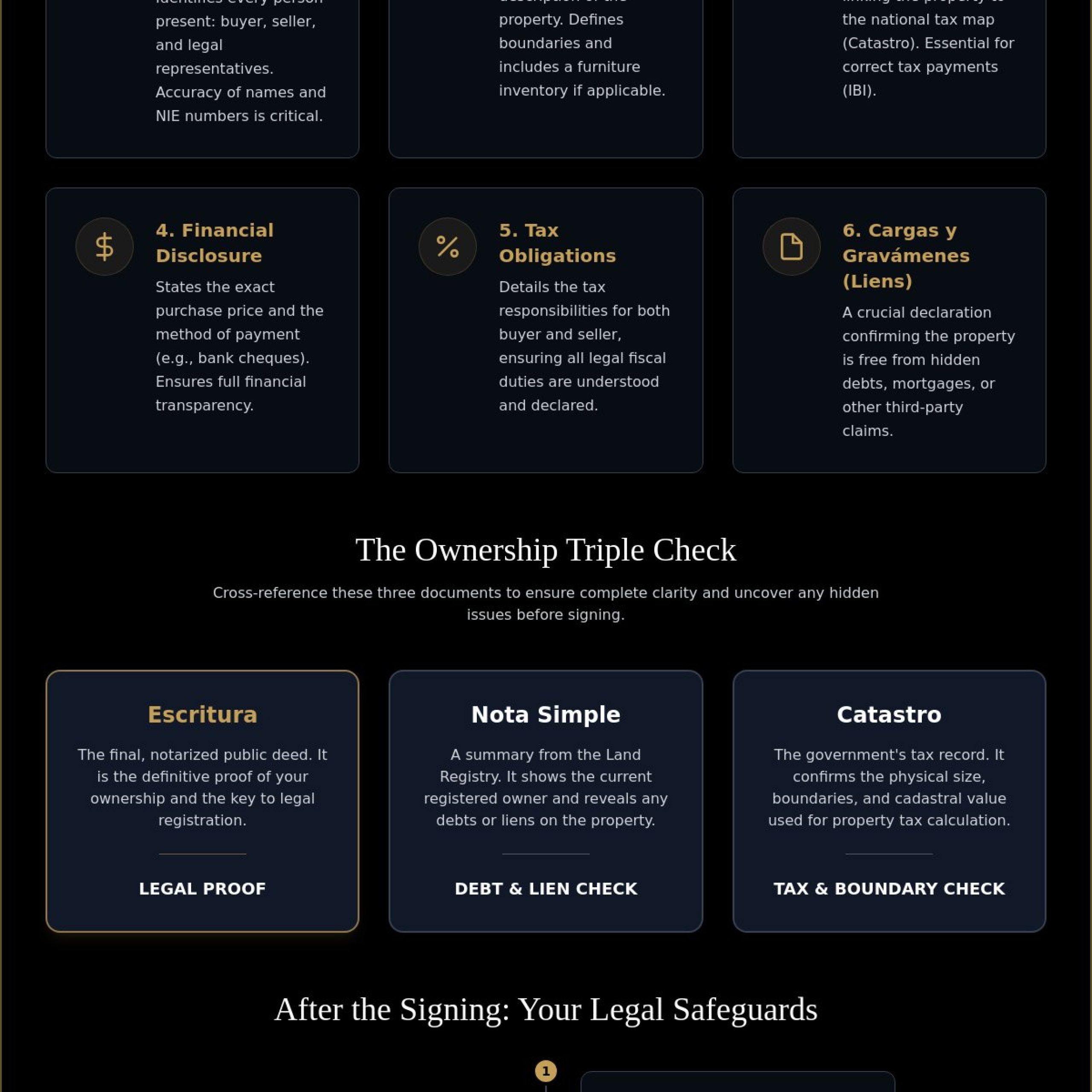
The document begins by establishing the “Comparecencia,” which identifies everyone present. This includes the buyer, the seller, and any legal representatives or translators. Precision here is non-negotiable for a smooth registration process.
Identifying the Parties and the Property
Accuracy is paramount when listing personal data. The document must precisely match the names and NIE numbers found on your passport. Even a minor character error can cause significant delays at the Land Registry or with local utility providers.
The “Descripción de la Finca” provides the physical and legal boundaries of the property. It must include the “Referencia Catastral,” a unique 20-digit code that links the property to the national tax map. This reference is vital for ensuring you’re paying the correct annual property taxes (IBI).
If you’re purchasing a furnished villa or apartment, it’s wise to include a furniture inventory. This annex prevents potential disputes over which items remain in the property after the transaction is finalized.
Financial Disclosures and Tax Obligations
Transparency is a core requirement of the modern Spanish legal system. The deed records the exact purchase price and the specific “Cheques Bancarios” used for the transaction. Photocopies of these bankers’ drafts are usually physically attached to the document to provide a clear audit trail.
For 2026 transactions, the “Valor de Referencia” is a critical figure you must monitor. This value, set by the Catastro, determines your minimum tax liability for Property Transfer Tax (ITP). If your purchase price is lower than this reference value, the tax authorities will still calculate your bill based on the higher amount.
The Notary will also read the “Advertencias Legales” aloud during the appointment. These are formal warnings regarding your obligation to pay relevant taxes within the 30-day window. They also explain the legal consequences of under-declaring the sale price to the authorities.
The “Cargas” section is arguably the most vital component for your peace of mind. It confirms whether the property is sold free of debts, mortgages, or long-standing liens. Our legal assistance team meticulously verifies these details to ensure your new home is delivered with a perfectly clean title.
Escritura vs. Nota Simple vs. Catastro: The Triple Check
Securing a property in Spain requires more than just a signature on a single document. You must align three distinct records to ensure your new home is legally sound and free of surprises. This guide to Spanish property deeds (escritura) explains how to navigate the vital differences between the Escritura, the Nota Simple, and the Catastro.
The Escritura serves as the physical proof of the legal act of purchase. It’s the formal narrative of your transaction signed before a Notary, detailing the parties, the price, and the terms. While it’s your primary title, it represents a specific moment in time rather than a real-time update of the property’s status.
The Nota Simple acts as the living pulse of the property within the Land Registry. It provides a current snapshot of ownership and any active financial burdens or legal restrictions. It’s the document that confirms the seller still has the legal right to sell at the exact moment of your appointment.
The Catastro is the administrative record used for tax purposes and geographic mapping. It defines the property’s physical footprint and location for the Spanish tax authorities. It’s the basis for your annual IBI payments and ensures the government knows exactly which boundaries are being taxed.
Understanding the Nota Simple’s Role
The Nota Simple is your most valuable tool for uncovering hidden liabilities that could haunt your investment. It reveals existing mortgages, local tax debts, or even court embargos that are attached to the land itself. If these aren’t cleared before signing, they become your responsibility as the new owner.
We always verify a “fresh” version issued within 24 hours of your signing date. This ensures that no last-minute liens have been placed on the property since your initial due diligence began. It’s a non-negotiable step for any buyer seeking absolute peace of mind.
Why the Catastro Records Must Match
Discrepancies in square meterage between the Land Registry and the Catastro are common, particularly in older coastal villas or rural plots. If these figures don’t match, you may face challenges when applying for renovation licenses or during future resale. It can also lead to overpayment or underpayment of local taxes, triggering potential audits.
Modern deeds now prioritize “Coordinación Catastro-Registro” to link these two databases permanently. This process ensures the legal description in the Registry matches the physical map in the Catastro. Achieving this synchronization is a vital step in the property buying process in Spain.
When these three records are perfectly aligned, your ownership is indisputable. This triple check provides the ultimate legal shield for your Spanish lifestyle. It transforms a complex administrative task into a secure foundation for your new home.
The Notary Process: Signing Your Spanish Property Deed
The moment of completion occurs at the “Notaría,” where the final version of your deed is formalized. This guide to Spanish property deeds (escritura) helps you prepare for this high-stakes environment where every detail is scrutinized. It’s a formal setting that requires focus and clear communication.
Scheduling this appointment usually requires coordination between your legal representative, the seller, and the bank if a mortgage is involved. It’s the culmination of weeks of preparation. The meeting typically lasts between 30 and 60 minutes, though it can take longer if complex translations are required.
The Role of the Notary Public in Spain
It’s vital to understand that the Notary is a neutral civil servant, not your personal advocate. Their primary duty is to verify that the transaction complies with Spanish law and that all parties are who they claim to be. They act as a witness for the state to ensure the integrity of the public record.
The Notary will check that there are no outstanding IBI debts or unpaid community fees that could transfer to you as the new owner. On the day, you’ll receive a “Copia Simple,” which is an unofficial version of the deed. You can use this document to set up utilities or insurance while the original is being registered.
Preparing for Completion Day
You must bring your original passport and a valid NIE certificate to the appointment. The Notary will also require proof of funds, often in the form of bankers’ drafts that were detailed in the previous sections of this guide. Your presence, or that of your legal representative with a Power of Attorney, is mandatory for the physical signing.
Sellers are required to provide a “Certificado de Eficiencia Energética” to confirm the property’s energy rating. Ensuring these documents are ready in advance prevents last-minute delays that can derail a completion. For 2026 transactions, the Notary will also verify that the purchase price aligns with the latest regional tax reference values.
If you aren’t fluent in Spanish, you’re legally required to have a translator present. The Notary performs the “Lectura,” reading the entire deed aloud to ensure both parties understand the legal descriptions and obligations. This isn’t just a courtesy; it’s a legal safeguard to prevent any future claims of misunderstanding.
Using professional legal assistance ensures that your paperwork is flawless before you ever step into the Notary’s office. Once the signatures are dry and the funds are exchanged, the Notary will hand over the keys. This physical act of “traditio” officially marks the transfer of possession.
If you’re ready to secure your future home with total confidence, contact our specialist team to ensure your completion day is handled with expert precision.
After the Signing: Registration and Legal Safeguards
The signing at the Notary is a major milestone, but your legal journey isn’t finished until the public records reflect your new status. This guide to Spanish property deeds (escritura) ensures you navigate the critical 60-day window following your purchase with total precision. Missing these deadlines can lead to significant penalties and leave your ownership vulnerable.
You have exactly 30 days from the signing date to settle your property taxes with the regional authorities. For resale properties in the Valencian Community, the ITP rate is 9% for properties up to €1 million as of June 2026. If you’ve purchased a new build, you’ll need to pay the 1.4% Stamp Duty (AJD) in addition to the 10% VAT already handled during the transaction.
Once the tax office stamps your document, your representative must submit the “Copia Autorizada” to the Land Registry. This is the authentic version of the deed that carries the Notary’s official seal and signature. It’s the only document the Registry will accept to finalize your title entry.
The Land Registry (Registro de la Propiedad)
While registering your title is technically voluntary under Spanish law, it’s practically essential for protecting your investment. Without registration, your ownership isn’t enforceable against third parties or future creditors of the previous owner. It’s the final step in securing your legal shield.
As soon as the deed is submitted, the Registry creates an “Asiento de Presentación.” This temporary entry acts as a 60-day block, preventing any other documents or liens from being filed against your property. It’s a vital safeguard that grants you immediate priority in the public record.
The final registration process typically takes between one and three months to complete. Once finished, the Land Registry will return the original deed with a registration sticker attached. This document is your definitive proof of ownership and should be kept in a highly secure location.
Final Steps for New Homeowners
Beyond the Registry, you must ensure the Catastro office is updated with your details to avoid issues with future tax bills. This administrative step ensures that the annual IBI (Council Tax) is correctly attributed to you. It’s also the time to transfer utility contracts and set up standing orders for community fees.
The “Plusvalía” tax is another critical consideration, as it’s a municipal tax based on the increase in land value. While this is legally the seller’s responsibility, your legal team will verify that it’s paid to prevent the local town hall from placing a lien on the property. We ensure every loose end is tied before we consider the process complete.
Security and maintenance should be your immediate focus once you possess the keys. We strongly recommend changing the locks immediately and securing professional key holding services to protect your home while you’re away. Taking these final practical steps allows you to transition into your new Spanish lifestyle with complete peace of mind.
Securing Your Spanish Legacy
Mastering the details of your property deed is the final step in turning an aspirational vision into a legal reality. This guide to Spanish property deeds (escritura) has highlighted the importance of aligning public records and meeting strict post-sale deadlines. With the right preparation, the complexities of the Spanish legal system become manageable milestones rather than obstacles.
KEYS property group brings over 20 years of local expertise to your purchase. We provide full legal and mortgage support to ensure your deed is perfectly drafted and registered without delay. Our commitment continues long after the keys are handed over through our dedicated property maintenance and key holding services.
You don’t have to navigate this significant life transition alone. It’s time to move forward with the quiet confidence that your investment is fully protected. Start your Spanish property journey with KEYS property group today. Your new lifestyle in the sun is waiting, and we’re here to ensure every step is secure and seamless.
Frequently Asked Questions
What is the difference between an Escritura and a Nota Simple?
The main difference is that the Escritura is the formal public contract of sale, while the Nota Simple is a temporary report from the Land Registry. The Escritura proves the legal act of purchase occurred, but the Nota Simple confirms the property’s current status, including any active debts or liens.
Think of the Escritura as your permanent title and the Nota Simple as a real-time snapshot of the property’s legal health. Both are required to ensure a secure transaction.
How much does it cost to get a Spanish property deed signed?
Notary and Land Registry fees are calculated on a legal sliding scale and typically total between €1,500 and €2,000 for a standard transaction. These costs are separate from the Property Transfer Tax (ITP) or Stamp Duty (AJD) you’ll pay to the regional government.
The exact price depends on the property’s value and the number of pages in the document. You should always budget for these administrative costs in addition to your legal fees.
Do I need a lawyer if a Notary is already involved in the signing?
You definitely need a lawyer because the Notary is a neutral civil servant who doesn’t represent your specific interests. The Notary ensures the document is legal, but they won’t perform the deep due diligence required to protect you from hidden urbanistic issues.
A lawyer acts as your advocate, checking for debt and ensuring the contract terms are in your favor. They provide the professional assurance you need when navigating a foreign legal system.
Can I sign the Escritura remotely if I am not in Spain?
You can sign the Escritura remotely by granting a Power of Attorney to a trusted legal representative in Spain. This “Poder Notarial” allows your lawyer to sign the public deed on your behalf at the Notary’s office.
This is a common practice for international buyers who can’t travel for the completion day. It ensures the process continues smoothly without requiring your physical presence.
What happens if there is a mistake in my Spanish property deed?
Errors in a deed are corrected through an “Escritura de Subsanación,” which is a secondary deed that rectifies the specific mistake. Minor clerical errors might be corrected by the Notary directly in the margins of the original document.
Significant changes, such as a mistake in the purchase price or property boundaries, often require both parties to return and sign the correction. It’s essential to catch these errors during the “Lectura” before the final signing.
How long does it take to get the final registered Escritura back?
It usually takes between one and three months to receive your final registered deed back from the Land Registry. This guide to Spanish property deeds (escritura) notes that while you receive a “Copia Simple” immediately, the official registration is a thorough administrative process.
Once the Registry confirms everything is in order, they’ll return the original document with an official registration sticker. This completed document is your definitive proof of ownership.
Is the Escritura the same as the Title Deed in the UK or US?
The Escritura serves the same ultimate purpose as a Title Deed in the UK or US by proving your legal ownership of the property. However, the execution is different because it’s a “Public Document” signed before a state official.
This provides a higher level of legal “public faith” than private contracts used in some other countries. It’s the only document recognized by the Spanish Land Registry as proof of title.
What is a “Copia Simple” and why is it different from the original?
A “Copia Simple” is an unofficial, non-signed copy of the deed that the Notary provides on completion day. It contains the full text of the agreement but lacks the official seals and signatures found on the “Copia Autorizada.”
You’ll use this copy for administrative tasks like setting up utility contracts or opening a bank account. The original signed version remains in the Notary’s protocol for permanent safekeeping.
Properties in The Comprehensive Guide to Spanish Property Deeds (Escritura) in 2026