
Taxes When Buying Property in Spain: A 2026 Guide to Purchase and Inheritance Tax
Did you know that choosing a villa in Madrid instead of Catalonia could save you as much as 4% in transfer taxes alone? It’s understandable if the mix of regional and national laws feels overwhelming as you plan your move. You’ve worked hard for your success, and the last thing you want is for hidden costs or complex inheritance rules to undermine your vision of a life in the sun. We believe that clarity is the foundation of a secure investment.
This guide empowers you to master the taxes when buying property in Spain, giving you the tools to protect your wealth and ensure a smooth transition for your family. We’ll examine the 2026 breakdown of ITP and VAT rates, explain how double taxation agreements work, and reveal the generous inheritance exemptions that make specific regions like Andalusia particularly attractive for long-term legacy planning. By the end of this article, you’ll have a professional’s perspective on the fiscal landscape, allowing you to focus on the joy of your new Mediterranean lifestyle.
Key Takeaways
- Identify the critical differences between resale and new-build purchase costs to accurately budget for your property acquisition.
- Clarify how your residency status and current 2026 regulations impact the taxes when buying property in Spain as an international investor.
- Discover why the Spanish inheritance system places the tax burden on the recipient and how regional reliefs can protect your family’s legacy.
- Gain confidence in managing your international obligations by understanding how double taxation agreements prevent redundant payments in your home country.
- Learn how professional legal assistance and a Spanish Will create a seamless transition for your assets and provide long-term security for your investment.
Taxes When Buying Property in Spain: ITP, VAT, and AJD
Understanding the specific taxes when buying property in Spain is the first step toward a secure investment. Your tax liability depends primarily on whether you’re acquiring a brand-new home from a developer or a resale property from a previous owner. While the overall transaction costs generally range between 8% and 13% of the purchase price, the way these costs are distributed varies significantly based on the property type and the autonomous community where the asset is located.
The Spanish tax system is decentralized. This means that while some rates are set at a national level, regional governments have the authority to adjust their own percentages. For a broader understanding of how these levies fit into the national framework, you can review the general principles of Taxation in Spain. Being aware of these regional nuances ensures your financial planning is both accurate and effective.
New Build Properties: VAT and AJD
Purchasing a new villa or apartment involves Value Added Tax, known locally as IVA. For residential properties in mainland Spain and the Balearic Islands, the VAT rate is a fixed 10%. If you’re looking at the Canary Islands, this is replaced by the IGIC at a lower rate of 7%. You’ll pay this tax directly to the developer as part of your payment schedule. It’s a straightforward national rate that provides immediate clarity for your budget.
In addition to VAT, new builds are subject to Stamp Duty, or Actos Jurídicos Documentados (AJD). This tax covers the legal documentation required to register the property at the Land Registry. Rates are set regionally and typically fall between 0.5% and 1.5%. For instance, in the Valencian Community, the AJD rate was recently reduced to 1.4% effective June 1, 2026. Understanding the property buying process in Spain helps you anticipate these regional adjustments well before you reach the notary’s office.
Resale Homes: The Property Transfer Tax (ITP)
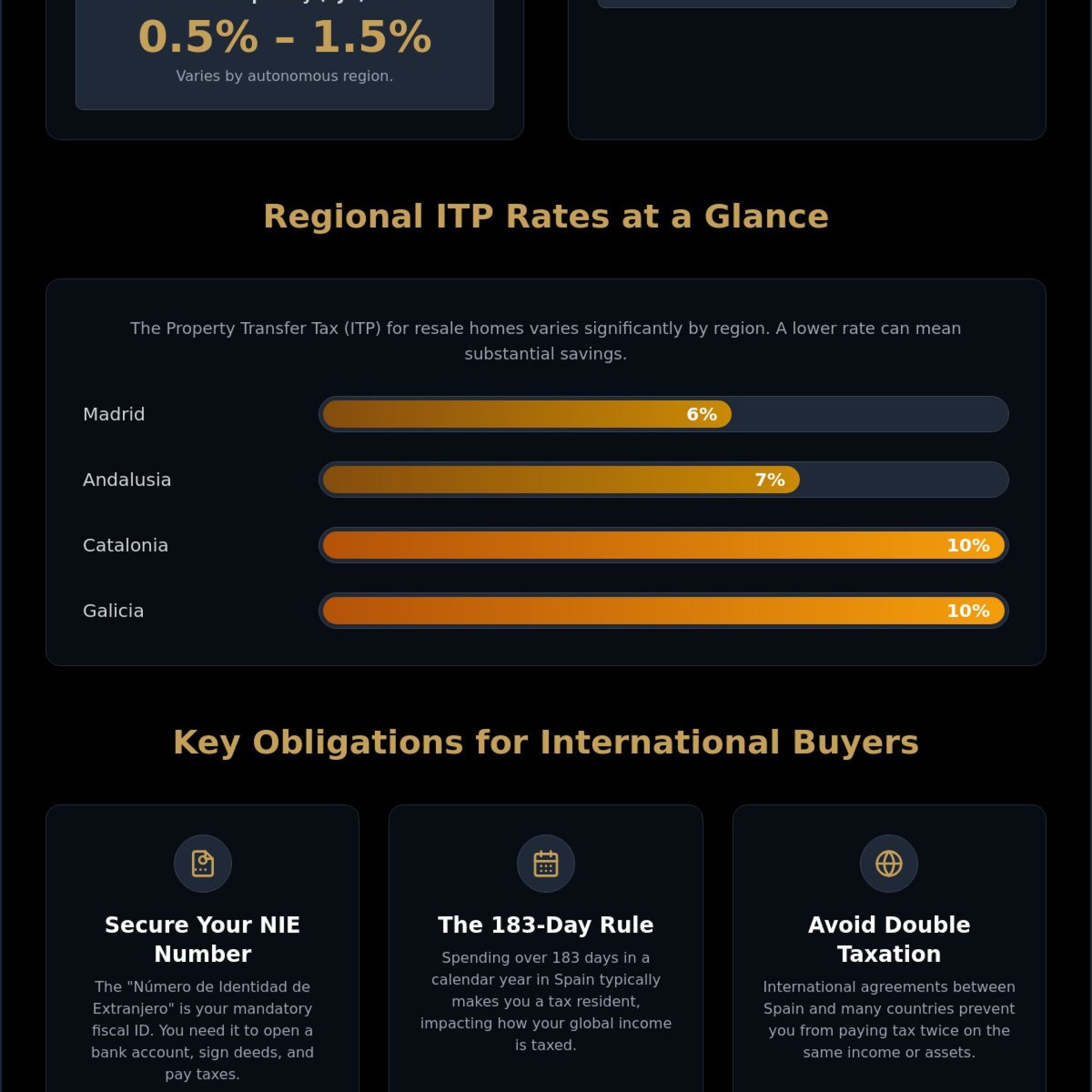
When you buy a resale home, you don’t pay VAT or AJD. Instead, you’ll pay the Property Transfer Tax, or Impuesto sobre Transmisiones Patrimoniales (ITP). This is a regional tax, which means the amount you pay depends entirely on the location of your chosen home. As of 2026, rates remain diverse. Madrid offers one of the lowest rates at 6%, while Catalonia and Galicia stand at 10%. Andalusia maintains a competitive flat rate of 7%.
It’s vital to remember that the tax isn’t necessarily calculated on the price you pay. Since 2022, the taxable base is the market value as determined by the cadastral reference value. Under-declaring this value can lead to audits and unexpected penalties. You must file and pay the ITP within 30 days of signing the public deed. Missing this window can result in avoidable surcharges, so timely professional filing is essential to protect your investment.
| Tax Category | New-Build Property | Resale Property |
|---|---|---|
| Value Added Tax (VAT/IVA) | 10% (National) | N/A |
| Stamp Duty (AJD) | 0.5% – 1.5% (Regional) | N/A |
| Transfer Tax (ITP) | N/A | 6% – 10% (Regional) |
| Payment Deadline | At time of purchase | Within 30 days of signing |
By mastering these initial costs, you can move forward with the confidence that your capital is well-managed. Clear fiscal knowledge transforms a complex transaction into a manageable step toward your new Mediterranean lifestyle. Whether you’re eyeing a modern penthouse or a historic townhouse, these taxes when buying property in Spain are the foundation of your legal security.
The 2026 Tax Landscape for Non-EU and International Buyers
Every international property journey begins with a single identification number: the NIE (Número de Identidad de Extranjero). This is your fiscal gateway to the country. You’ll need it to open a bank account, sign a public deed, and settle your taxes when buying property in Spain. Without this number, the process stops before it starts. We recommend securing yours early to avoid administrative delays that could impact your completion date.
A common point of confusion for our clients is the distinction between a resident and a non-resident for tax purposes. Spain uses a simple metric: the 183-day rule. If you spend more than 183 days in the country during a single calendar year, you’re generally considered a tax resident. This status changes how you’re taxed on your global income and wealth, not just your Spanish assets. Understanding your timeline is essential for strategic long-term planning.
Understanding Non-EU Buyer Regulations
If you’re purchasing from outside the European Union, you might have heard rumors about a massive tax hike. High-profile reports once discussed proposed 2026 tax changes for non-EU buyers, including a potential 100% purchase tax. We can confirm that as of June 2026, this proposal is not in force. It remains a stalled draft bill that has not been voted into law. The core real estate market remains stable and welcoming to international capital, with non-EU buyers paying the same standard purchase taxes as their European counterparts.
For those interested in contemporary living, new developments in Spain provide a highly transparent investment path. These projects operate under clear national VAT rules, which often simplifies the fiscal outlook for international buyers. Because these properties are built to modern standards, they also tend to offer better long-term value and lower maintenance costs, balancing your initial tax outlays.
Regional Tax Benefits for International Investors
While national laws provide the framework, the autonomous communities offer the nuance. Some regions actively compete to attract high-net-worth individuals through generous exemptions. Madrid and Andalusia, for example, offer 100% relief on regional wealth tax, effectively reducing that specific liability to zero. In the Valencian Community, the 2026 allowance was increased to €1 million, providing significant breathing room for most investors.
Identifying the most tax-efficient region requires a specialist who understands the interplay between your home country’s laws and Spanish regulations. Choosing the right location can save you thousands of Euro over the life of your investment. If you’re feeling uncertain about which region best aligns with your financial goals, our team can provide the legal assistance you need to move forward with total peace of mind. We act as your knowledgeable bridge, ensuring every practical step is handled with professional oversight.
Spanish Inheritance Tax: Protecting Your Estate for Heirs
Planning for the future is as much about the legacy you leave as the lifestyle you enjoy today. In Spain, inheritance is governed by the Impuesto sobre Sucesiones y Donaciones (ISD). Unlike systems in the UK or USA where the estate itself is often taxed before distribution, the Spanish system requires each individual recipient to pay tax on their specific share. This fundamental difference means your heirs’ tax liability depends entirely on their relationship to you and the location of your property.
Both residents and non-residents must account for this tax when it comes to Spanish assets. While you likely focused on the immediate taxes when buying property in Spain, the inheritance phase requires a different level of strategic foresight. Professional oversight ensures your assets transition seamlessly to the next generation without unnecessary financial friction. It’s about more than just numbers; it’s about providing lasting security for your family.
The Four Kinship Groups Defined
The Spanish tax office categorizes heirs into four distinct groups. These determine the base allowances and tax rates applied to an inheritance. Group I and II include direct descendants, spouses, and parents. These individuals enjoy the highest tax exemptions, often making the effective tax rate negligible in many regions. Group III covers siblings, nieces, nephews, and aunts or uncles, who receive more moderate allowances. Finally, Group IV includes distant relatives or unrelated individuals. This group typically receives no tax-free allowance, often resulting in a significantly higher tax burden for those involved.
The Power of Regional Inheritance Allowances
Spain’s autonomous regions have transformed the inheritance landscape by offering substantial reliefs. In areas like Madrid and Andalusia, close relatives can benefit from a 99% discount on the tax due. This means that for many families, the tax is effectively zero. A critical legal shift now allows non-residents to access these regional benefits as well. This ensures fairness across the board, regardless of where the heir lives or their residency status at the time of the transfer.
Before you consider listing your property for sale or drafting your final wishes, it’s vital to check the current regulations in your specific region. Laws change, and as of 2026, the competition between regions to attract investors has led to even more favorable conditions. Taking the time to understand these nuances now provides the confidence you need to truly enjoy your investment. We act as your dedicated local specialist to ensure you have the most accurate, up-to-date information for your specific location.
Non-Resident Obligations and Avoiding Double Taxation
One of the most frequent questions we hear from international investors is whether they’ll end up paying tax twice on the same asset. It’s a valid concern. The idea of settling taxes in Spain and then facing a second bill from your home country can feel like a significant hurdle. Fortunately, international tax frameworks are designed to prevent this specific scenario. As a non-resident, your fiscal obligation to the Spanish state is limited to assets physically located within its borders, such as your Mediterranean villa or coastal apartment.
The 2026 valuation process for these assets remains grounded in the cadastral reference value. This figure acts as the minimum taxable base for both wealth and inheritance tax filings. While you initially accounted for the taxes when buying property in Spain, maintaining an accurate record of this value is essential for your annual obligations. It provides a transparent benchmark that ensures you’re paying exactly what’s required, neither more nor less.
Avoiding Double Taxation: A Practical Approach
Most countries, including the UK, utilize a system known as Unilateral Relief to protect their citizens. If you pay inheritance tax in Spain on a Spanish property, HMRC typically allows you to claim a credit for that amount against any tax due on that same asset in the UK. This mechanism ensures that the total tax paid doesn’t exceed the higher of the two countries’ rates. To benefit from this, you must maintain meticulous records. Always keep your stamped Model 650 forms and official payment receipts, as these serve as your primary evidence when claiming relief abroad.
Reducing the Taxable Base
There are legitimate, professional ways to lower your taxable base and protect your wealth. For instance, if you have an outstanding mortgage on your property, the remaining debt is generally deductible from the property’s value for inheritance tax purposes. This effectively reduces the “net” value of the estate being taxed. Additionally, certain maintenance and improvement costs can impact your long-term tax position, especially when calculating capital gains in the future.
Identifying every available deduction requires a deep understanding of local regulations and how they interact with your global financial profile. We pride ourselves on acting as a knowledgeable bridge between your goals and the practical steps needed to reach them. If you want to ensure your investment is structured as efficiently as possible, our team provides the specialized legal assistance you need to navigate these complexities with confidence. Contact us today for a professional review of your tax position and ensure your Spanish legacy remains secure.
Securing Your Investment with Professional Guidance
Success in the Spanish market doesn’t end when you receive the keys. While we’ve explored the technicalities of taxes when buying property in Spain, the true value of your investment lies in its longevity and the ease with which it’s managed over decades. A significant life transition deserves a partner who understands both the emotional and financial weight of your assets. We believe that professional oversight is the bridge between a property that’s a burden and one that’s a lasting legacy.
Managing a foreign asset involves more than just settling annual bills. If an owner passes away, the probate process can become a complex administrative hurdle for heirs who may not be in the country. Our comprehensive Property Maintenance and Key Holding services ensure that your home remains secure, well-kept, and operational during these transition periods. Having a trusted local specialist on the ground provides your family with the breathing room they need to handle legal matters without worrying about the physical state of the asset.
The Strategic Importance of a Spanish Will
A Spanish Will is perhaps the most effective tool for simplifying the succession process. Under the “Brussels IV” regulation (EU Regulation 650/2012), you have the right to choose the law of your nationality to govern the succession of your Spanish assets. This is vital for buyers from countries like the UK, as it allows you to bypass the Spanish “forced heirship” rules that might otherwise dictate how your estate is divided.
Drafting a specific Will for your Spanish property doesn’t replace your existing Will in your home country. Instead, it works alongside it to avoid the need for expensive, time-consuming international probate. It ensures your wishes are executed efficiently and that your heirs can access regional inheritance tax reliefs without delay. Professional drafting ensures every detail aligns with current 2026 regulations, providing total legal security for your beneficiaries.
Taking the Next Step with KEYS Property Group
At KEYS Property Group, we act as your dedicated local partner for the entire lifecycle of your investment. Our expertise goes beyond the initial transaction. We offer a seamless blend of Legal assistance and long-term asset care, ensuring your property remains a source of pride and prosperity. By taking a proactive approach to management today, you protect the value of your estate for tomorrow.
The 2026 fiscal landscape offers unique opportunities for those who are well-prepared. Whether you’re in the final stages of a purchase or looking to restructure your existing holdings, we invite you to contact our team for a personalized consultation. Let’s discuss your estate planning goals and ensure your Mediterranean lifestyle is built on a foundation of professional assurance and local expertise.
Building Your Future with Confidence
Mastering the 2026 fiscal landscape is the final step in turning your Mediterranean dream into a secure reality. By understanding the nuances of regional ITP rates and the high exemptions available for family inheritance, you’ve already gained a significant advantage. Successfully managing the taxes when buying property in Spain is not just about compliance; it’s about making a strategic investment that protects your wealth for generations.
With over 20 years of local expertise, we provide the comprehensive end-to-end legal and management support required for a seamless transition. We specialize in guiding international clients through every stage of their journey, ensuring that every practical detail is handled with professional oversight. Our team acts as your dedicated companion, turning complex regulations into clear paths forward.
Secure your Spanish legacy with KEYS property group and move forward with the peace of mind you deserve. Your new lifestyle in the sun is waiting, and we’re here to ensure it’s built on a foundation of total security and expert care.
Frequently Asked Questions
How much tax do I pay when buying a property in Spain?
You should budget between 8% and 13% of the purchase price for the total taxes when buying property in Spain and associated legal fees. For resale homes, you’ll pay the Property Transfer Tax (ITP), which ranges from 6% to 10% depending on the region. New-build properties are subject to a national 10% VAT plus a regional Stamp Duty (AJD) typically between 0.5% and 1.5%.
Does a spouse pay inheritance tax on property in Spain?
A spouse is technically liable for inheritance tax, but regional reliefs often reduce this payment to a negligible amount. In communities like Madrid, Andalusia, or Valencia, spouses benefit from a 99% tax relief on their share of the estate. This ensures that the surviving partner can maintain their lifestyle without a heavy financial burden during what is already a difficult life transition.
What is the deadline for paying Spanish inheritance tax?
You have exactly six months from the date of death to file and pay Spanish inheritance tax. If you need more time, you can request a one-time six-month extension, but this request must be submitted within the first five months of the period. Missing these deadlines can lead to surcharges and interest, so we recommend seeking professional assistance as soon as the probate process begins.
Can I use a UK Will for my property in Spain?
While a UK Will is legally valid in Spain, using one for local assets is often slow and expensive. You’ll need to pay for official translations, Hague Apostilles, and a Grant of Probate to make it enforceable. We strongly recommend a separate Spanish Will specifically for your local assets to simplify the succession process and ensure your heirs can access the property with minimal delay.
Are there any exemptions for the family home in Spain?
Significant exemptions exist for the main family home depending on the region and your residency status. For wealth tax, the national standard includes a €300,000 exemption for a primary residence. In inheritance cases, many regions offer a 95% to 99% reduction in the taxable base if the heir lived in the property with the deceased, though specific conditions regarding the holding period apply.
Do non-residents get the same tax allowances as residents?
Non-residents now enjoy the same regional tax allowances as residents thanks to recent legal rulings from the Spanish Supreme Court. Whether you live in the EU or outside of it, you can apply the specific tax benefits of the autonomous community where your property is located. This ensures that the taxes when buying property in Spain and subsequent inheritance costs remain fair and competitive for all international owners.
What happens if I cannot afford to pay the inheritance tax?
If you can’t pay the tax upfront, you can apply for a deferral or a payment plan in installments. You must make this formal request before the initial six-month deadline expires. In some cases, Spanish banks will allow a partial release of the deceased’s funds specifically to settle the inheritance tax bill, allowing the estate to be settled without the heirs needing to provide personal capital.
How is the value of a Spanish property calculated for tax purposes?
Since January 2022, property value is determined by the cadastral reference value, which is the official market value set by the Spanish Tax Agency. This value acts as the minimum taxable base for your purchase, wealth tax, and inheritance filings. It’s important to use this figure rather than the agreed purchase price if the cadastral value is higher, as this prevents future audits and potential penalties.
Properties in Taxes When Buying Property in Spain: A 2026 Guide to Purchase and Inheritance Tax