
Getting a Tourist License for My Spanish Property: The 2026 Definitive Guide
What if the key to your property’s rental future isn’t just a regional permit, but a new dual-layered digital identity? Getting a tourist license for my Spanish property now requires navigating both local authorization and the mandatory National VUD registration system.
You likely feel the weight of these evolving rules, from the strict three-fifths majority vote required by the Community of Owners to the mandatory seasonal equipment standards. It’s natural to seek clarity when the distinction between a regional VFT and a national NRUA number determines your ability to list on global platforms.
This guide provides a sophisticated roadmap to Spain’s 2026 regulations, ensuring your villa, penthouse, or townhouse remains a compliant and prestigious investment. We’ll explore the precise path to securing your digital identity and finding the right legal assistance to handle the complex logistics for you.
Key Takeaways
- Master the new dual-registration mandate that pairs regional authorization with the mandatory National VUD ID. This ensures your luxury rental remains fully visible on global booking platforms.
- Navigate the essential legal steps for getting a tourist license for my Spanish property, including securing the required three-fifths majority from your Community of Owners.
- Identify the critical technical standards, from the License of First Occupation to seasonal climate control, needed to future-proof your asset against shifting regulations.
- Learn how expert legal assistance and property maintenance services provide a seamless path to compliance, allowing you to focus on the rewards of your investment.
Understanding the 2026 Tourist License Framework for Spanish Properties
A Spanish tourist license is the cornerstone of a legitimate rental enterprise, serving as the official seal of approval from regional authorities. It’s no longer just a piece of paperwork; it’s an active digital identity required to showcase your home to the world. For those considering getting a tourist license for my Spanish property, the 2026 framework represents a shift toward total transparency and centralized control.
The current landscape is defined by a move from passive registration to active digital compliance. This evolution ensures that every villa or penthouse offered to travelers meets the high standards expected in a world-class destination. Given the immense economic impact of Tourism in Spain, these regulations protect the integrity of the market while providing security for owners and guests alike.
Securing this authorization is a prerequisite for any presence on prestigious international booking platforms. Without a valid registration number, your property remains invisible to the global market. If you are in the process of buying property in Spain as a foreigner in 2026, integrating legal assistance into your acquisition strategy is essential for navigating these requirements.
Defining the 2026 Regulatory Landscape
The 2026 system operates through a sophisticated interplay between municipal zoning, regional tourism departments, and national digital databases. Short-term rentals are specifically defined as stays under 31 days intended for leisure or tourism purposes. Requirements are now standardized to ensure seamless digital visibility across all autonomous regions.
This centralization means that your property’s legal status is verified in real-time by listing sites. It creates a level playing field where quality and compliance are the primary benchmarks for success. Understanding these layers is the first step toward a worry-free investment experience.
Why a License is Non-Negotiable for Luxury Assets
Holding a valid license is a vital component in preserving the long-term valuation of your investment. It transforms a simple residence into a high-performing asset that can be legally monetized. For high-net-worth guests, a registered license serves as a critical trust signal, promising a safe and professional experience.
Operating without this authorization carries substantial risks, including severe financial penalties for “ghost” rentals. Authorities now use advanced digital tracking to identify unlisted or non-compliant properties. Getting a tourist license for my Spanish property is therefore the only path to a sustainable and prestigious rental presence.
The Dual Registration Mandate: Regional Licenses and the VUD National ID
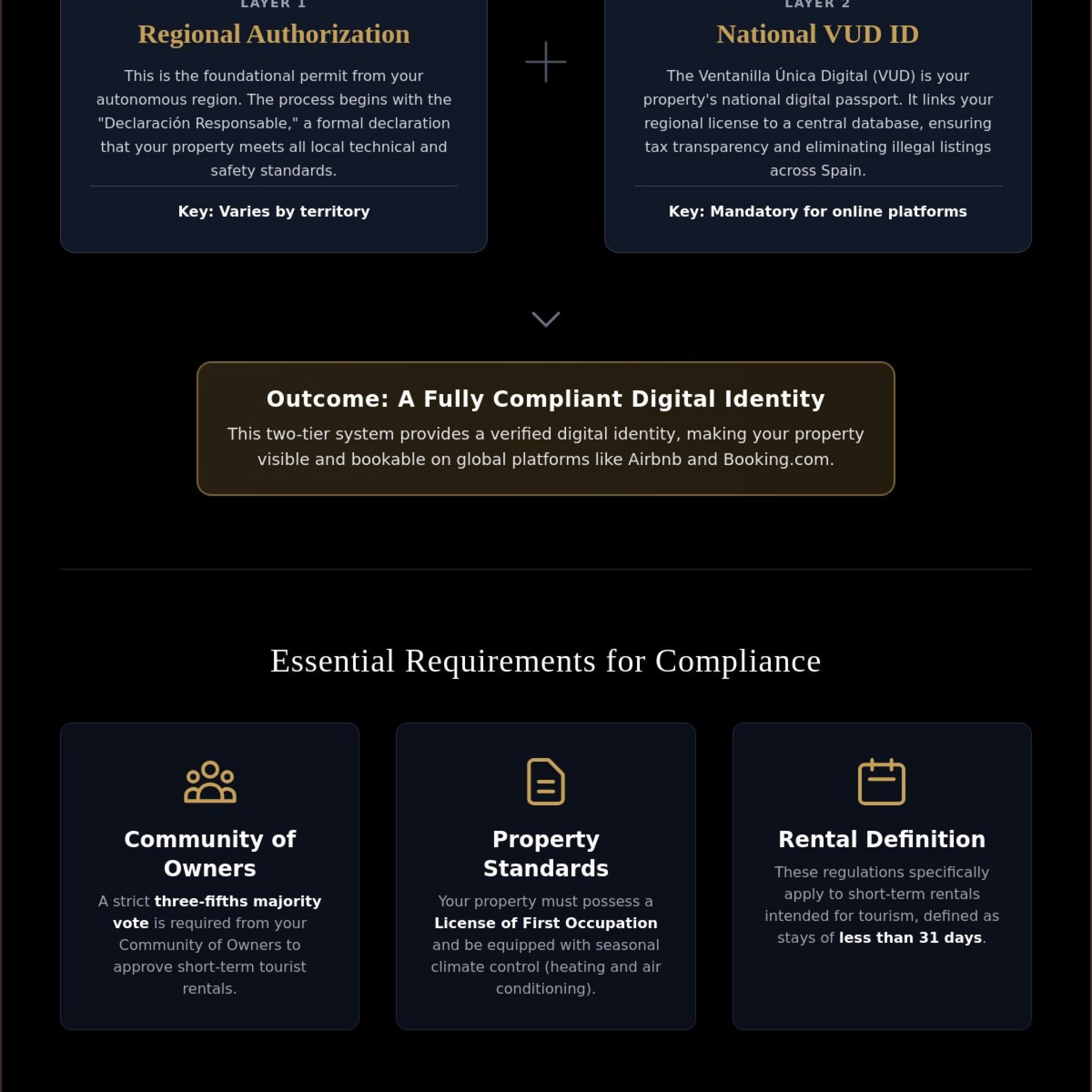
The 2026 landscape has matured into a two-tier system that demands meticulous attention to detail. While your regional permit was once the final word, it’s now just the first layer of a broader compliance strategy. Getting a tourist license for my Spanish property currently involves securing both a local authorization and a national digital identity.
This national identifier is known as the Ventanilla Única Digital, or VUD. It acts as a central hub designed to eliminate illegal listings and ensure total tax transparency across the country. It’s a mandatory requirement that bridges the gap between regional authorities and international booking platforms.
Think of the VUD as a digital passport for your holiday rental. Without this dual verification, your property won’t just be unlisted; it’ll be effectively invisible to the global market. Ensuring both layers are perfectly aligned is the only way to maintain a prestigious and compliant presence.
The Regional Authorization Process
Primary licensing power remains firmly in the hands of Spain’s autonomous regions. The journey begins with the “Declaración Responsable”, a formal declaration that your property adheres to all technical and safety standards. This document is your commitment to excellence and local law.
Processing times vary significantly between territories, often influenced by local demand and administrative resources. Starting this process early is a prudent investment in your property’s future. Navigating these regional nuances often requires local expertise to avoid common pitfalls.
Engaging professional legal assistance can streamline this phase significantly. An expert guide ensures that your initial application is flawless, setting the stage for a successful national registration.
Securing Your National VUD Identifier
Once your regional permit is active, you must link it to the National VUD database. This step is non-negotiable for anyone wishing to advertise on platforms like Airbnb or Booking.com. You’ll need a valid digital certificate to access the secure government portal and complete the registration.
The VUD system validates your regional license in real-time. Since the mandate took full effect in July 2025, major platforms have been legally required to delist any property lacking a verified VUD ID. This ensures that only legitimate, high-standard accommodations are available to travelers.
This digital handshake between regional and national systems is the core of modern Spanish rental law. It provides a transparent framework that protects your investment from the risks associated with non-compliance. Following this path ensures your home remains a distinguished choice for international guests.
Property Standards and the Influence of Community Regulations
Ensuring your home meets the rigorous physical requirements of the law is a vital step in the journey of getting a tourist license for my Spanish property. These regulations are designed to guarantee a premium experience for every guest while maintaining the high standards of the local market. You should also consider how these upgrades and compliance measures factor into the annual costs of owning property on the Costa del Sol.
A sophisticated investment requires more than just aesthetic appeal; it must be legally habitable and technically sound. This begins with the License of First Occupation (LFO), which serves as the foundational proof that your property is fit for use. Without this document, the path to a tourist license is effectively closed.
Mandatory Interior Standards for Guest Comfort
Spain’s 2026 regulations mandate specific interior features to ensure guest well-being. Every bedroom and living area must have direct ventilation to the outside and a system to darken the windows, such as shutters or high-quality blackout curtains. These details are essential for creating the refined atmosphere expected in a prestigious rental listing.
Seasonal climate control is now a legal requirement rather than a luxury. If you market your property between May and September, you must provide air conditioning. Conversely, heating is mandatory for rentals occurring between October and April. Beyond climate control, your property must include:
- A fully equipped kitchen with modern appliances and essential utensils.
- Standardized first-aid kits that are easily accessible to guests.
- Official “Libro de Quejas” (complaints books) and a visible sign announcing their availability.
These elements are verified during inspections to protect the integrity of the tourism sector. Maintaining these standards protects your reputation and ensures your asset remains a top-tier choice for discerning travelers. It’s a commitment to quality that guests will notice and appreciate.
Navigating Horizontal Property Law Restrictions
The social landscape of property ownership changed significantly in April 2025. Under the updated Horizontal Property Law (LPH), the “Comunidad de Propietarios” holds substantial power over new rental activities. A three-fifths majority vote from the community is now required to approve or restrict new tourist rental licenses within a building.
Before you begin the process of getting a tourist license for my Spanish property, you must examine the community “Estatutos” or bylaws. If the statutes already prohibit holiday rentals, obtaining a license will be impossible without a formal amendment. This makes early due diligence an essential part of your investment strategy.
In cases where the community is hesitant, professional mediation can be a powerful tool. Demonstrating a commitment to high-quality property maintenance and responsible guest management often reassures neighbors. It’s about building a bridge between your investment goals and the harmony of the community.
A Precise Step-by-Step Guide to Securing Your Rental License
Navigating the journey of getting a tourist license for my Spanish property requires a disciplined approach across five distinct phases. This structured roadmap ensures your villa or penthouse transitions from a private retreat to a legally recognized, high-performing asset. Each step is designed to meet the rigorous transparency standards of the 2026 regulatory landscape.
Phase 1 begins with Due Diligence, where you must verify community statutes and check municipal zoning quotas to ensure your area hasn’t reached its rental limit. Phase 2 focuses on Technical Compliance, specifically securing the License of First Occupation (LFO) or an equivalent certificate of habitability. This document is the foundational proof that your property meets all safety and construction codes.
Phase 3 involves the Regional Filing of the “Declaración Responsable” to your local tourism board, signaling your intent to operate. Once approved, Phase 4 requires National Integration, where you register your regional number within the VUD system to obtain your digital “passport”. Finally, Phase 5 is the Operational Launch, which includes displaying your license number and establishing mandatory guest registration protocols with the police.
Preliminary Documentation and NIE Requirements
A valid NIE (Foreigner Identification Number) is the essential starting point for all property owners in Spain. You’ll also need the original property deeds (Escritura) and the most recent IBI receipt to verify ownership and tax compliance. These documents form the core of your application and must be perfectly aligned with the land registry records.
The “Cédula de Habitabilidad” remains a critical requirement for proving the property is fit for tourism use. This document confirms that the interior space meets the minimum square meterage and ventilation standards required by law. Ensuring these documents are in order before you begin the process prevents unnecessary delays and administrative friction.
The Digital Submission and Approval Timeline
The 2026 application process is now entirely digital, conducted via the government’s “Sede Electrónica” portal. This shift demands a high level of technical precision, as even minor errors in the digital upload can lead to automatic rejections. You’ll need a secure digital certificate or a Cl@ve PIN to access these secure government systems.
Expect a timeline of several months to receive your final registration number, though regional processing speeds can vary. Be aware of “silencio administrativo”, a legal concept where a lack of response after a certain period might signify a rejection. It’s vital to track your application status actively through the digital portal to ensure everything remains on course.
To ensure your application is handled with the prestige and accuracy it deserves, consider our professional legal assistance services. We manage the intricate paperwork and digital filings so you can focus on the rewards of your Mediterranean investment.
Strategic Management: Elevating Your Asset Beyond Basic Compliance
Getting a tourist license for my Spanish property is a significant milestone, yet it’s merely the beginning of your journey as a host. In the refined world of luxury rentals, compliance is the baseline, while strategic management is what transforms a villa or penthouse into a prestigious, high-yield asset. Maintaining the standards required by the 2026 regulations demands a meticulous, proactive approach that goes far beyond the initial application.
Professional property management ensures that your investment remains a source of pride and profit rather than a logistical burden. For international owners, our bespoke property maintenance and key holding services provide a vital local presence. We act as your eyes and ears on the ground, ensuring every guest experience mirrors the high-end quality of your Spanish home.
Integrating Legal Compliance with Boutique Care
We take the complexity out of daily operations by managing the mandatory guest registration process, known as the “Parte de Entrada de Viajeros”. This includes the secure submission of guest data to the police, a critical legal requirement for maintaining your license. By blending technical compliance with boutique care, KEYS property group ensures your property is always ready for a discerning clientele.
Our team handles the regular property maintenance required by regional tourism boards, ensuring all equipment, from air conditioning to safety kits, is in perfect order. This commitment to detail protects your license from being revoked due to non-compliance during spot inspections. It’s a level of service that provides total peace of mind for owners living abroad.
Future-Proofing Your Investment in a Changing Market
The regulatory landscape in Spain is dynamic, and our 20 years of local expertise allow us to monitor legislative shifts in real-time. We ensure your license remains valid even as municipal zoning or national databases evolve. This forward-thinking approach is essential for anyone getting a tourist license for my Spanish property in 2026 and beyond.
Transitioning your property from a simple rental to a professionally managed asset increases both its market value and its desirability. We focus on long-term sustainability, helping you navigate the balance between high occupancy and the exclusivity of your brand. Trusting your investment to a well-connected expert guide is the ultimate way to secure your legacy in the Spanish property market.
Securing Your Legacy in the Spanish Rental Market
Navigating the 2026 landscape requires a shift from simple ownership to active, digital stewardship. By mastering the dual registration mandate and respecting community regulations, you protect the long-term prestige of your investment. These updated standards represent a commitment to quality that defines the modern Spanish market.
The journey of getting a tourist license for my Spanish property is complex, but it’s the essential foundation for a sustainable rental enterprise. These steps ensure your villa or penthouse remains a compliant and sought-after destination for international guests. It’s about transforming a beautiful residence into a legally fortified asset that yields consistent rewards.
With over 20 years of local expertise, KEYS property group provides the end-to-end legal and management support your high-end asset deserves. We specialize in high-end international client relations, ensuring your property is managed with the utmost care and professionalism. Secure your investment with KEYS property group’s management expertise and enjoy the rewards of your Mediterranean home.
Your vision for a successful Spanish property investment is well within reach with the right partner by your side. We’re here to ensure every transition is as seamless as the lifestyle you’ve chosen.
Frequently Asked Questions
Can I rent my Spanish property without a tourist license in 2026?
Operating a short-term rental without a valid license is strictly prohibited and considered a serious legal infraction. Depending on your specific region, fines for non-compliance can reach as high as €600,000. These significant penalties underscore the government’s commitment to a regulated, high-quality tourism sector that protects the integrity of your investment.
Operating within the law is the only way to ensure your property remains a prestigious and viable asset. Authorities now use sophisticated digital tools to track unlisted rentals, making compliance a non-negotiable part of your strategy.
What is the VUD ID and do I need it if I have a regional license?
The VUD is a mandatory national digital identifier that must be paired with your regional license for any online advertising. As of 2026, holding a regional permit alone is no longer sufficient to access global booking platforms. This dual-registration system was designed to eliminate illegal listings and ensure total transparency across the Spanish market.
Think of the VUD as the digital passport that validates your local authorization on a national level. Without this verified ID, major platforms are legally required to block your property from their search results.
Can my community of owners ban me from getting a tourist license?
Your community of owners holds the legal power to restrict or even prohibit holiday rentals within your building. Under the Horizontal Property Law, a three-fifths majority vote is required to approve or deny new rental activities. It’s essential to review the community statutes before getting a tourist license for my Spanish property to ensure your goals are achievable.
If the community “Estatutos” already contain a ban, you won’t be able to secure a license without a formal amendment. This makes early due diligence and professional mediation vital steps in your acquisition process.
How much does it cost to get a tourist license in Spain?
The total investment for licensing varies by region but generally includes administrative fees, technical certificates, and professional legal assistance. While some regional registrations are free, you’ll still need to budget for the License of First Occupation and mandatory safety equipment. These costs are a necessary investment in the long-term legality and prestige of your rental home.
Engaging an expert guide to handle the logistics can save you from costly administrative errors. Investing in professional support ensures your application is flawless from the very first submission.
How long does the approval process take for a rental license?
While submitting a “Declaración Responsable” can offer immediate effects in certain areas, the full verification process typically takes between 3 and 8 months. This timeline allows regional authorities to audit your documentation and confirm your property meets all physical standards. Starting the process early is the best way to ensure your property is ready for the peak season.
Administrative speeds vary across the country, and “silencio administrativo” can sometimes complicate the wait. Staying proactive and tracking your digital application is key to a successful and timely approval.
Do I need to pay tax on my holiday rental income in Spain?
Every property owner is required to pay tax on income generated through holiday rentals in Spain. Non-residents typically must file Modelo 210 on a quarterly basis to report their earnings to the tax authorities. Residents, on the other hand, include this rental income as part of their annual IRPF returns, ensuring full fiscal transparency.
Maintaining accurate records of your income and expenses is vital for a smooth filing process. Proper tax management protects your investment and ensures you remain in good standing with the Spanish treasury.
What happens if I list my property without a valid license?
Listing a property without a verified license will result in your property being blocked by major platforms like Airbnb and Booking.com. Beyond losing your digital presence, you face the risk of a formal sanctioning file being opened by regional authorities. This can lead to heavy financial penalties and a permanent ban on future rental activities.
The risk to your professional reputation and your asset’s valuation is simply too high to ignore. Getting a tourist license for my Spanish property correctly the first time is the only path to a secure and profitable future.
Properties in Getting a Tourist License for My Spanish Property: The 2026 Definitive Guide