
Buying a Rural Property (Finca) in Spain Guide: The 2026 Essential Handbook
What if the rustic charm of a Spanish farmhouse hides a legal nightmare that could lead to a demolition order? It’s a valid fear for many international buyers who feel overwhelmed by complex land classifications and language barriers. This buying a rural property (finca) in Spain guide provides the professional assurance you need to navigate these hurdles safely.
We understand the emotional weight of this transition and the importance of getting every technical detail right. You’ll learn how to verify legal ownership, secure reliable utilities like water and solar power, and establish professional management for your estate. This handbook ensures your investment is both protected and prepared for a new chapter of Mediterranean living.
Our guide covers everything from the 2026 tax landscape to the practicalities of maintaining a rural home while you’re away. We’ll walk through the essential steps for securing a property that meets modern standards for connectivity and comfort. By the end, you’ll have a clear roadmap to a lifestyle defined by peace rather than paperwork.
Key Takeaways
- Learn the critical differences between urban and rustic land classifications to avoid legal pitfalls and protect your long-term investment.
- Gain clarity on rural infrastructure, from navigating complex water rights to establishing modern solar and high-speed internet solutions.
- Follow our comprehensive buying a rural property (finca) in Spain guide to master the financial and legal steps required for a secure purchase.
- Discover how professional property maintenance and key holding services ensure your country estate remains pristine while you are away.
- Understand how to leverage legal and technical findings during price negotiations to secure a fair and transparent deal on your new home.
The Allure and Reality of Buying a Rural Property in Spain
In 2026, the definition of a finca has evolved far beyond simple agricultural land. It now represents a sophisticated sanctuary for those seeking a blend of historic charm and modern freedom. This buying a rural property (finca) in Spain guide explores why a new generation of buyers is trading dense coastal developments for the expansive horizons of the Spanish interior.
The shift toward rural living is driven by a desire for authenticity and personal space. While urban centers offer convenience, country estates provide a private canvas for a bespoke lifestyle. You’ll often find that your budget stretches much further in the countryside, offering significantly more land and square footage than comparable urban plots.
Success in the rural market requires aligning your lifestyle dreams with the practicalities of Spanish land law. It’s about more than just a beautiful view; it’s about ensuring your peace of mind through rigorous legal and technical checks. We help you bridge the gap between the romantic ideal of a farmhouse and the grounded reality of secure ownership.
The Modern Rural Lifestyle in Spain
Remote work has fundamentally reshaped the rural landscape in 2026. High-speed satellite internet now allows professionals to manage global businesses from centuries-old stone farmhouses. This digital connectivity has turned quiet villages into vibrant hubs for international residents who value work-life balance.
Restoring a piece of Spanish history is an emotional journey that offers immense rewards. You aren’t just buying a home; you’re preserving a legacy while tailoring it to your modern needs. The key is balancing this privacy with an active effort to join the local community and support village amenities.
Setting Realistic Expectations for Country Living
The pace of life in the Spanish countryside is famously steady, and this extends to administrative tasks. Administrative timelines for permits or utility upgrades can be slower than in major cities. Patience is a necessary virtue when working with local town halls or regional departments.
Securing your investment starts with Understanding Land Registration and how it impacts rustic boundaries. Rural deeds are sometimes less precise than urban ones, making expert verification essential. You can review the standard property buying process in Spain to see how rural acquisitions require specialized due diligence.
Professional guidance is non-negotiable when dealing with the complexities of country estates. From uncovering hidden easements to verifying ancient water rights, an expert eye protects you from unforeseen liabilities. We provide the grounded, reliable presence you need to navigate these unique challenges with confidence.
Decoding Land Classifications: Rustic vs. Urban Assets
Understanding the legal DNA of a plot is the most critical step in your journey. In Spain, land is divided into three primary categories: Suelo Urbano, Suelo Urbanizable, and Suelo Rústico. While urban land allows for standard residential development, rustic land is primarily protected for agricultural or environmental use.
Building on Suelo Rústico is heavily restricted to prevent over-development. For example, in regions like the Valencian Community, you generally need a minimum plot size of 10,000 square meters just to apply for a building permit. This buying a rural property (finca) in Spain guide highlights that many existing homes on rustic land exist in a legal “grey area” that requires expert verification.
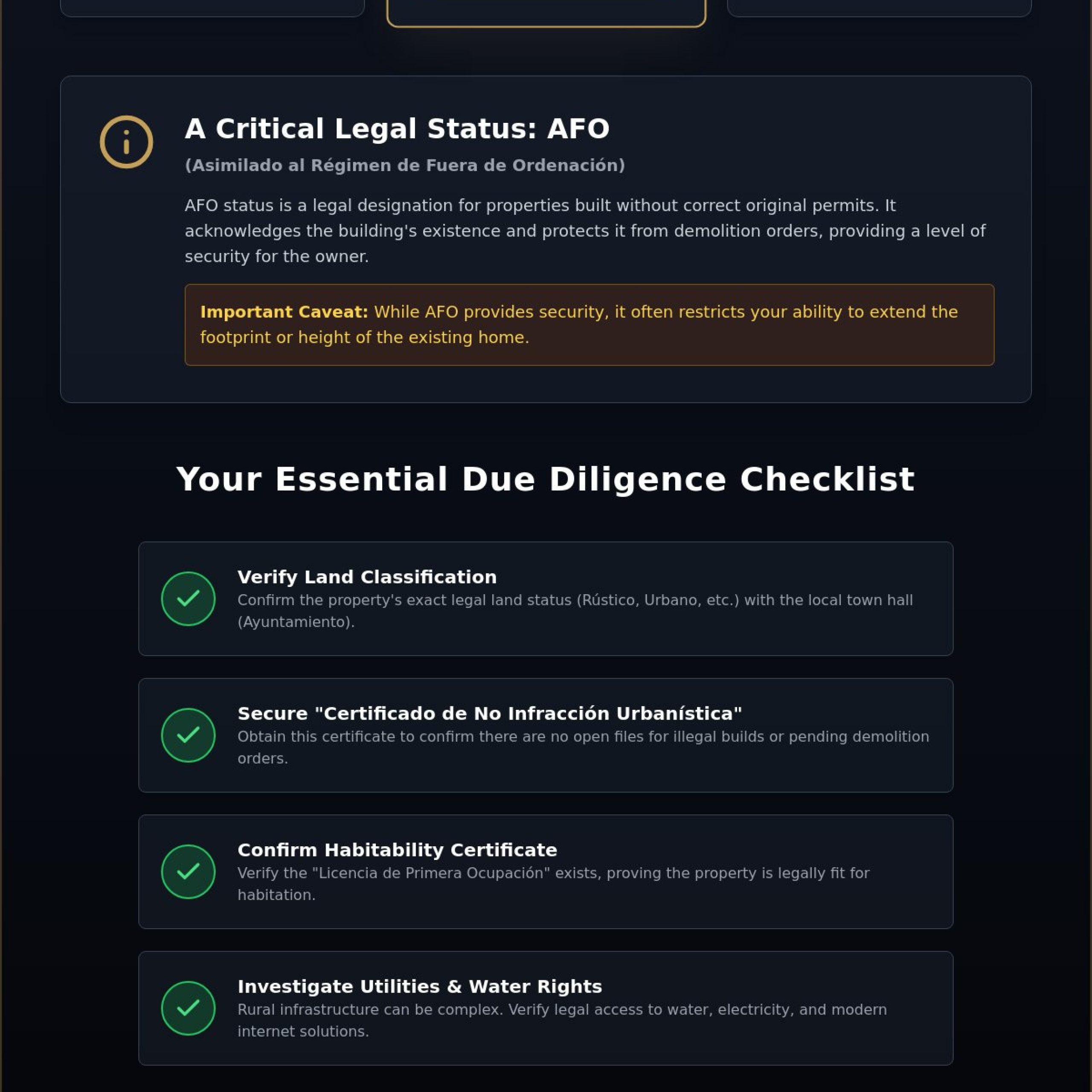
A “Certificado de No Infracción Urbanística” is your first line of defense against surprises. This document confirms the local town hall has no open files regarding illegal builds or demolition orders on the property. It’s a vital piece of the puzzle for anyone referencing the UK Government Guide to Buying Property in Spain to ensure a safe transaction.
Understanding Suelo Rústico Limitations
Many traditional fincas are classified as “Asimilado al Régimen de Fuera de Ordenación,” commonly known as AFO status. This designation acknowledges that a building exists without proper original permits but is now too old for the authorities to order its demolition. It provides a level of security, though it may limit your ability to extend the footprint or height of the home.
You must also verify the “Licencia de Primera Ocupación” or a habitability certificate. These documents prove the property is fit for living and allow you to legally contract essential services. If you have questions about a specific plot’s status, you can contact our specialists for a preliminary review of the documentation.
The Legal Due Diligence Checklist
Your lawyer must prioritize the “Nota Simple” to identify any hidden debts, mortgages, or ancient easements. It’s equally important to ensure the “Catastro” entries match the physical boundaries of the land. Discrepancies between the Land Registry and the tax office are common in rural areas and must be resolved before the final signing.
Securing a rural estate involves more technical layers than a standard apartment purchase. This is why engaging specialized Legal assistance is a non-negotiable step for protecting your capital. A local expert understands the specific regional laws that govern rustic land, ensuring your transition to the Spanish countryside is both legal and lasting.
Evaluating Essential Utilities and Rural Infrastructure
Once you’ve cleared the legal hurdles, the physical infrastructure of the land becomes your next priority. Reliable utilities are the heartbeat of a functional home, yet they are often the most misunderstood aspect of rural acquisitions. This buying a rural property (finca) in Spain guide helps you look beneath the surface of a charming exterior to evaluate the systems that will power your new life.
Living off-grid is no longer a compromise in 2026. High-efficiency lithium-ion batteries and bifacial solar panels allow for a seamless experience that rivals city living. However, you must verify if a mains connection is even possible, as the cost of bringing cables to a remote plot can be prohibitive.
Water is the most valuable asset in the Spanish interior. You’ll encounter various sources, including private wells, community irrigation networks, and standard mains supply. It’s essential to consult the UK Government guidance on buying property in Spain to understand how to verify the legality of these sources before committing.
Modern connectivity has transformed the viability of rural living. Satellite solutions like Starlink and widespread 5G coverage mean that remote workers can now enjoy high-speed internet in the most secluded valleys. You don’t have to choose between a rustic aesthetic and a professional digital presence.
Securing Reliable Water and Power
A private well is a significant asset, but it must be legally registered with the regional Water Board, or Confederación Hidrográfica. Unregistered wells can lead to heavy fines and may be sealed by authorities. We recommend verifying the “concesión de aguas” as part of your technical due diligence.
Upgrading solar systems in 2026 is more affordable than in previous years. Modern systems are modular, allowing you to increase storage capacity as your needs grow. This flexibility is vital for running energy-intensive appliances like air conditioning or pool filtration systems during the summer months.
Ensure your power supply can handle the peak loads of a modern household. If the property relies on an older generator or small battery bank, you’ll need to budget for a comprehensive upgrade. A reliable system provides the quiet confidence that your home will function perfectly, regardless of the weather.
Access and Boundary Verification
Access roads in rural Spain often involve a legal right of way, known as a “servidumbre de paso.” This means neighbors may have the right to cross your land to reach their own plots. Identifying these shared routes early ensures your privacy expectations align with the legal reality of the location.
Never rely solely on the tax office maps to confirm the size of your estate. We highly recommend a topographic survey to establish the precise coordinates of your boundaries. This process often reveals discrepancies that can be used as a negotiation tool during the purchase.
Solving boundary disputes before the purchase is finalized is essential for long-term peace. A clear, surveyed perimeter prevents future conflicts with neighbors and simplifies the registration of your property. Taking these proactive steps builds a secure foundation for your new life in the Spanish countryside.
A Strategic Roadmap for Your Rural Property Purchase
Once you’ve verified the infrastructure and land status, it’s time to activate your financial strategy. This buying a rural property (finca) in Spain guide moves into the execution phase, where your careful preparation meets the practicalities of the Spanish banking and legal systems. Success here depends on a methodical approach to the paperwork that follows.
Securing your Foreigner Identification Number (NIE) is your first priority. You’ll need this unique tax number for everything from opening a Spanish bank account to signing the final deeds. Most buyers find it’s most efficient to handle this via a power of attorney or through a Spanish consulate in their home country before they arrive.
Negotiation is where your previous technical due diligence becomes a powerful tool. If your surveys revealed that a well needs re-registering or a roof requires immediate attention, use these findings to justify a fair price adjustment. Sellers of rural estates often respect a buyer who presents a clear, evidence-based proposal backed by professional reports.
Financial Planning and Currency Management
Moving large sums of money across borders can incur significant hidden costs through poor exchange rates. We recommend using specialist Currency exchange services rather than high-street banks to maximize your purchasing power. These experts can often provide forward contracts to lock in a rate, protecting your budget from market volatility during the closing period.
The 2026 mortgage landscape for rural properties remains specialized. Lenders typically offer lower loan-to-value ratios for rustic land compared to urban villas, often requiring a larger deposit. You should also budget for total closing costs of 10 to 13 percent for resales, which covers the Property Transfer Tax (ITP), notary fees, and registration costs.
The Final Steps to Ownership
The Arras contract is the definitive agreement that secures the property. By paying a deposit, usually 10 percent of the purchase price, you commit the seller to the transaction. If the seller withdraws, they are typically legally required to pay you double the deposit amount, providing a strong layer of security for your investment.
Completion takes place at a Notary’s office, where the public deeds are signed and the remaining balance is paid. After the signing, a Gestoría will handle the post-completion tax filings and ensure the property is correctly recorded in the Property Registry. This is also the moment to engage professional Legal assistance to oversee the smooth transfer of all utility contracts into your name.
Ready to begin your search? Browse our current portfolio of Spanish rural listings with KEYS property group to find your ideal retreat.
Managing and Protecting Your Spanish Country Estate
Owning a finca is the beginning of a rewarding new lifestyle, but it requires a proactive approach to property care. This buying a rural property (finca) in Spain guide concludes by addressing the vital stage of long-term stewardship. Unlike a standard urban apartment, a country estate is a living asset that demands consistent attention to remain secure and functional.
Professional management is a necessity for non-residents who cannot visit their property every week. Remote locations offer unparalleled privacy, yet they can be vulnerable to environmental changes or security concerns when left vacant. Having a dedicated local partner ensures your home is monitored and maintained to the highest standards year-round.
Seasonal holiday rentals offer an excellent way to maximize your investment when you aren’t in residence. Managing guests in a rural setting involves unique logistics, such as coordinating arrivals on unpaved roads or explaining off-grid solar systems. A managed approach protects your property’s delicate infrastructure while generating a reliable return on your capital.
Security is a primary concern for many rural owners. Modern alarm systems linked to local response teams provide a strong deterrent, but physical checks are equally important. Regular visits by a trusted professional ensure that windows, gates, and perimeter fences remain intact and secure against unauthorized access.
Professional Maintenance and Security
Rural properties face unique environmental pressures, such as intense Mediterranean sun on traditional clay roofs and rapid garden growth. Regular intervention prevents small issues, like a slipped tile or a clogged gutter, from becoming costly structural repairs. We prioritize preventative care to keep your home in peak condition regardless of the season.
The value of Key Holding cannot be overstated for peace of mind while you’re abroad. Our team provides a reliable physical presence, responding to alarms and managing emergency repairs after heavy winter storms. This service ensures your home is always accessible for authorized maintenance or unexpected deliveries.
Managing emergency repairs in remote locations requires a deep network of local contacts. We act as your eyes and ears on the ground, coordinating with specialized technicians who understand the nuances of rural plumbing and electrical systems. This rapid response capability is essential for protecting your home’s integrity during extreme weather events.
Long-Term Asset Care
Preventative inspections are your best defense against common rural challenges like rising dampness or pest incursions. We coordinate with trusted local contractors who understand the specific construction methods used in traditional Spanish fincas. These regular checks ensure that the historic charm of your home is preserved for future generations.
Establishing a routine for estate improvements ensures your property continues to appreciate in value over time. From refreshing exterior lime wash to upgrading pool filtration systems, ongoing care is the key to a successful investment. Learn more about our Property Maintenance programs to see how we handle everything from landscaping to structural audits.
Coordinating with local contractors ensures that any work performed on your estate meets modern quality standards while respecting traditional aesthetics. We oversee every project to ensure timelines are met and the work is completed to your exact specifications. This professional oversight bridge the gap between your goals and the practical steps needed to reach them.
Your Journey to a Spanish Country Retreat Starts Here
Transitioning to a rural life in Spain is a profound step that offers unmatched tranquility and personal space. This buying a rural property (finca) in Spain guide has provided the technical and legal foundation you need to make this move with total confidence. By prioritizing land classification and infrastructure, you transform a beautiful vision into a secure, permanent reality.
Success depends on having a partner who understands both the technical details and the emotional significance of your investment. With over 20 years of local expertise, KEYS property group provides specialized support for international buyers, including legal assistance and currency exchange. Our full-service management continues long after the purchase through dedicated property maintenance and key holding.
Start your rural property search with KEYS property group today and let us guide you home. We look forward to helping you discover the perfect finca and ensuring your transition to the Spanish countryside is seamless and rewarding.
Frequently Asked Questions
Can I build a swimming pool on rustic land in Spain?
Building a new pool on rustic land is generally restricted and requires specific permits from the local town hall. In many regions, you need a minimum plot size of 10,000 square meters to even apply for such improvements. It’s essential to verify the current municipal regulations before purchase, as some areas have total bans on new excavations to protect local water resources.
What is the difference between a finca and a villa?
A finca typically refers to a property on rural or agricultural land, whereas a villa is usually situated on urban land with full mains services. This distinction is vital in this buying a rural property (finca) in Spain guide because land classification dictates what you can build or renovate. Fincas offer more space and privacy but come with stricter building regulations than urban villas.
How much are the annual taxes on a rural property in Spain?
Annual property tax, known as IBI, generally ranges from 0.4% to 1.1% of the property’s cadastral value. For 2026, rural properties in municipalities like Banyeres de Mariola have rates around 0.75%. You must also account for Non-Resident Income Tax (IRNR), which is 19% for EU residents and 24% for non-EU residents on an imputed value.
Is it possible to get a mortgage for a rustic finca?
Yes, mortgages are available for rustic properties, though lenders typically offer lower loan-to-value ratios than for urban homes. You can generally expect a mortgage of 50% to 60% of the property’s valuation. Banks often require the property to have a habitability certificate and a clear legal status before they approve any financing.
What happens if a rural property was built without a licence?
Properties built without a licence may face demolition orders or heavy fines unless they qualify for AFO status. This status acknowledges the building’s existence while restricting any future extensions or footprint changes. You must ensure a “Certificado de No Infracción Urbanística” is obtained to confirm there are no active legal proceedings against the structure.
Do I need a special permit to grow crops or keep horses on my finca?
You don’t need a permit for personal crops, but keeping horses requires a specific livestock license known as a REGA number. This permit ensures the land meets health and safety standards for animals. Local town halls also have specific rules regarding the construction of stables or fencing on protected rustic land.
How do I check if a rural property has legal water rights?
You verify water rights by requesting a certificate from the regional Water Board, such as the Confederación Hidrográfica. This document confirms if a well is legally registered and what volume of water you’re permitted to extract. Relying on verbal assurances from a seller isn’t enough, as unregistered wells can lead to significant legal liabilities.
Can I rent out my rural property as a holiday home?
Renting out your finca requires a tourist license from the regional government, which can be more difficult to obtain for rural properties. Requirements often include specific safety features and minimum acreage. In 2026, regulations have become stricter, so you should verify that the property meets all regional standards before planning a rental income strategy.
Properties in Buying a Rural Property (Finca) in Spain Guide: The 2026 Essential Handbook