
Hidden Costs of Buying Property in Spain: The 2026 Buyer’s Guide
Budgeting for your dream villa requires more than just the sticker price. Failing to account for an additional 15% in acquisition fees could stall your investment before the keys are even turned. It’s a common oversight that can turn a life-changing transition into a source of unnecessary stress.
You’ve likely spent hours browsing sun-drenched terraces and sleek penthouses, imagining a life defined by Mediterranean light and refined ease. It’s natural to focus on the architecture and the view, but the true complexity of an international purchase often lies in the fine print of the balance sheet. We understand that you seek a seamless journey, free from the friction of unexpected tax liabilities or complex bureaucratic fees.
This guide will empower you to master the full financial landscape, ensuring you navigate the hidden costs of buying property in Spain with absolute confidence. You’ll gain a clear, percentage-based budget for closing costs and a reliable framework for long-term asset care.
We’ll explore the regional tax nuances of 2026, from Andalusia’s flat rates to the latest shifts in the Valencian Community. By the end, you’ll have the expert knowledge needed to secure your Spanish legacy with both financial logic and peace of mind.
Key Takeaways
- Distinguish between the 10% VAT for new-builds and regional transfer taxes for resales to ensure your initial tax calculations are precise.
- Adopt the “15% Rule” to account for the hidden costs of buying property in Spain, providing a vital safety buffer for a seamless transition.
- Recognize the non-negotiable roles of the Notary and Land Registry in securing your title and protecting your prestigious investment.
- Anticipate ongoing ownership expenses, such as community fees and utility connections, to maintain the effortless lifestyle your new home promises.
- Factor in mortgage valuation fees and currency exchange logistics to avoid financial friction during the final stages of your acquisition.
Understanding the Spanish Property Tax Framework in 2026
Entering the Spanish market requires a clear understanding of the fiscal obligations that accompany your new lifestyle. While the advertised price of a villa or penthouse captures the imagination, the actual acquisition cost includes a layer of taxation that varies significantly based on the property’s history.
You’ll encounter two distinct fiscal paths: Value Added Tax (IVA) for brand-new developments and Property Transfer Tax (ITP) for resale homes. These taxes represent the largest portion of the hidden costs of buying property in Spain, so distinguishing between them is essential for accurate budgeting.
This tax structure is influenced by broader trends within the Spanish economic overview, where real estate remains a cornerstone of regional wealth. Understanding these nuances ensures you’re prepared for the financial commitment required to secure a high-end asset.
New-Build Properties and VAT (IVA)
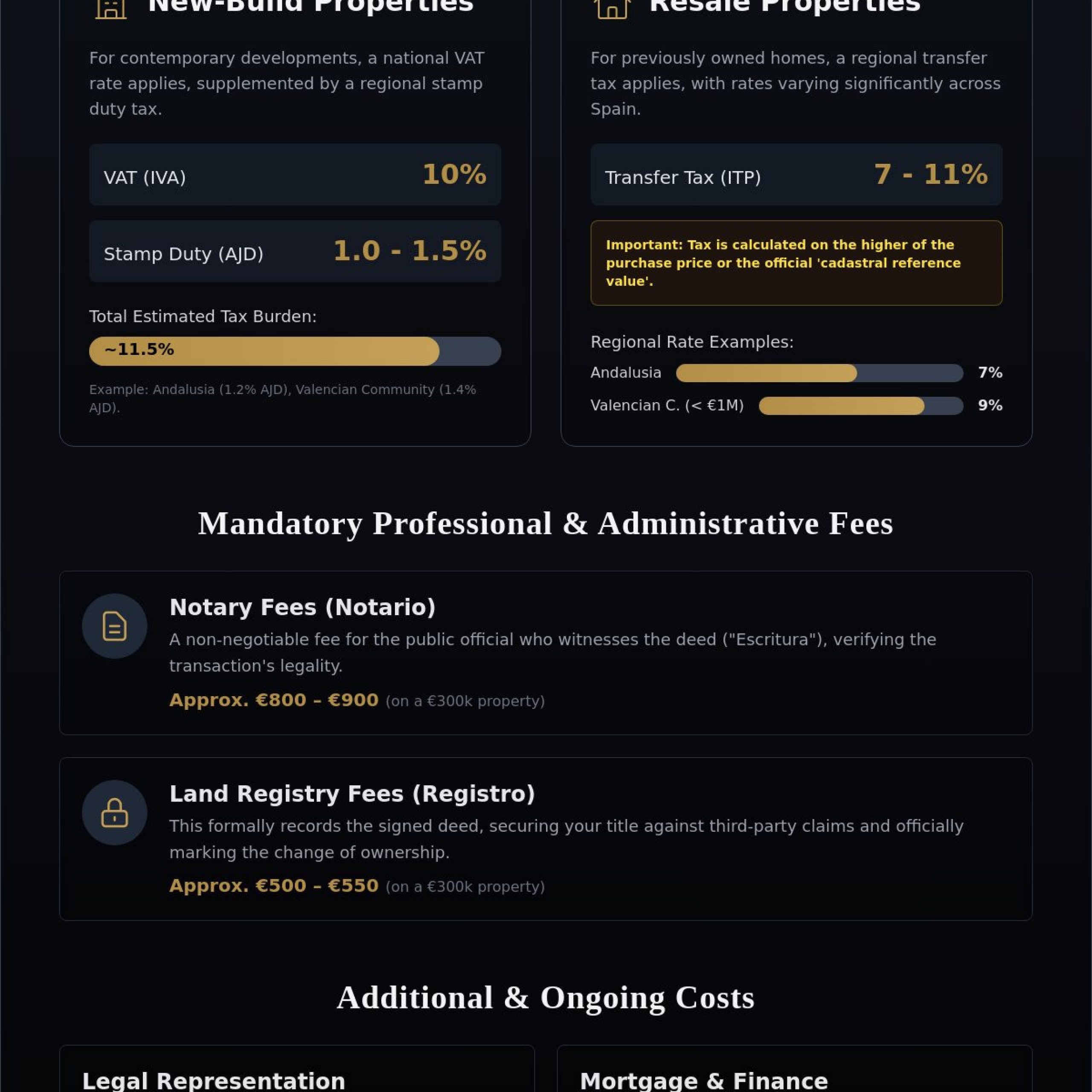
For those seeking the modern allure of a contemporary development, a flat VAT rate of 10% applies to all residential purchases nationwide. This is a consumption tax paid directly to the developer at the time of purchase, rather than at a later date to the tax office.
In addition to VAT, buyers must account for Stamp Duty, known locally as AJD. As of June 2026, this regional tax typically ranges from 1% to 1.5%, with Andalusia currently set at 1.2% and the Valencian Community at 1.4%.
New-builds often carry a higher tax burden than resales because they are subject to both national VAT and regional stamp duty, reflecting their status as first-time entries into the market.
Resale Properties and Transfer Tax (ITP)
If your heart is set on a historic estate or a previously owned penthouse, you’ll pay the Property Transfer Tax instead of VAT. This rate is determined by the autonomous community where the property is located, leading to significant variations across the country.
In 2026, we’ve seen several regions adjust their rates to remain competitive for international buyers. Andalusia maintains a flat rate of 7%, while the Valencian Community recently reduced its standard rate to 9% for properties under €1 million, rising to 11% for those above that threshold.
It’s vital to calculate your budget based on the official cadastral reference value rather than just the purchase price. If the purchase price is lower than this official benchmark, the tax authorities will use the higher value to calculate your liability, potentially leading to an unexpected bill.
Navigating these regional differences is a core part of the property buying process in Spain. Being proactive about these figures ensures your investment remains a source of prestige rather than a bureaucratic hurdle.
Mandatory Professional Fees and Administrative Expenses
Beyond the initial purchase price, the legal framework of your acquisition rests on a network of trusted professionals who provide structural security to your investment. These services form part of the hidden costs of buying property in Spain that ensure your title is unassailable and your peace of mind remains absolute throughout the transition.
In Spain, the Notary (Notario) acts as a neutral public official who witnesses the signing of the public deed, or “Escritura.” Their involvement is legally non-negotiable, providing the essential verification that both parties understand the contract and that the transaction adheres to national standards.
Once the deed is signed, it must be formally recorded in the Land Registry (Registro de la Propiedad). This step officially secures your title against any third-party claims or undisclosed liens, marking the final shift in ownership for your new villa or penthouse.
The Role of the Spanish Notary and Land Registry
Notary fees are regulated by a government-mandated sliding scale based on the property price. For a home valued at €300,000, expect to pay approximately €800 to €900 for this legal certification. Registration fees follow a similar regulated structure, typically costing around €500 to €550 to finalize the entry into official records and protect your long-term asset.
Legal Representation and Due Diligence
While the Notary represents the state, an independent solicitor is your personal advocate and expert guide. They oversee the intricate property buying process in Spain to ensure your interests are protected at every turn. Standard legal fees are approximately 1% of the purchase price plus VAT, a necessary step for discerning buyers.
Your legal team will conduct a series of essential checks to safeguard your investment. These include:
- Urbanistic legality and comprehensive building license verification.
- Debt-free certification for municipal taxes and community fees.
- Obtaining a “Nota Simple” to verify ownership and current liens.
A Gestoría often handles the administrative “paper trail” post-completion, ensuring tax filings are accurate and timely. Understanding these administrative layers is key to managing the hidden costs of buying property in Spain effectively. You can find more detail on these specific Taxes and Fees in 2026 to help refine your acquisition strategy.
Their expertise ensures no deadline is missed during the critical 30-day post-signing window, allowing you to focus on the allure of your new surroundings. If you’re ready to explore exclusive opportunities in the local market, our team is here to guide you. Connect with us to discuss your vision for a Spanish home and receive personalized hospitality from a boutique agency.
Mortgage Logistics and Currency Exchange Considerations
Financing your Mediterranean retreat involves more than just comparing interest rates. These logistical steps represent some of the most overlooked hidden costs of buying property in Spain, particularly for international clients moving capital across borders.
A seamless acquisition depends on anticipating the administrative fees and market fluctuations that occur between the initial offer and the final signing. By preparing for these financial nuances, you ensure that your transition remains a source of pleasure rather than a logistical burden.
Spanish Mortgage Costs and Requirements
Before a lender commits to your purchase, a formal property valuation, or “tasación,” is mandatory under Bank of Spain regulations. This independent assessment typically costs between €400 and €800, providing a certified valuation that forms the basis of your loan-to-value ratio.
Spanish banks also frequently require mandatory life and home insurance policies as a condition for mortgage approval. While these protect your investment, the annual premiums should be integrated into your initial budgeting to avoid surprises during the first year of ownership.
Our experts at KEYS property group offer dedicated mortgage facilitation to help you navigate these local banking requirements. We act as your trusted advisor, ensuring you secure the most competitive terms available in the current market.
Strategies for International Currency Exchange
The choice of how you transfer your funds can have a profound impact on your final acquisition cost. Many buyers lose between 3% and 5% of their total capital by relying on traditional retail banks, which often apply wide exchange rate margins and high transfer fees.
Utilizing a specialist currency broker allows you to access “forward contracts,” enabling you to lock in a favorable exchange rate for up to twelve months. This protection is invaluable during the typical two-month completion window, providing certainty in an often-volatile global market.
Currency volatility can change the effective property price by thousands of Euros overnight, making proactive exchange management a critical component of managing the hidden costs of buying property in Spain. It’s the difference between a calculated purchase and an unnecessary financial risk.
Finally, don’t overlook the commissions charged by Spanish banks for issuing banker’s drafts, or “cheques bancarios,” at completion. These fees can be significant, sometimes reaching a percentage of the total amount, so it’s wise to negotiate these costs with your bank well before the signing date.
Ongoing Ownership Costs and Initial Setup Requirements
The allure of a Spanish home lies in its promise of sun-drenched days and a relaxed pace of life. To protect this dream, you must look beyond the initial acquisition and account for the recurring hidden costs of buying property in Spain.
Receiving the keys to your new villa is a moment of profound achievement. However, the transition from buyer to owner involves a new set of financial considerations that define the long-term success of your investment.
Setting Up Your Spanish Household
Transferring water and electricity contracts requires more than a simple phone call. For older properties, utility companies often demand a new electrical safety certificate, known as a “boletín,” to verify that the installation meets current regulations.
Establishing direct debits for these services is the standard practice across the country. You’ll find that maintaining a local Spanish bank account is essential for managing these recurring monthly costs without administrative friction.
These initial setup fees are often overlooked but are vital for a seamless move-in experience. Properly planning for these minor expenses ensures your Mediterranean lifestyle remains as effortless as the day you first walked through the door.
Annual Taxes and Community Obligations
Annual obligations are a reality for every homeowner in the region. The Impuesto sobre Bienes Inmuebles (IBI) is a municipal tax based on your property’s cadastral value, with local rates such as 0.67% in Marbella or 0.65% in Malaga.
Non-resident owners must also account for the annual non-resident income tax, or Modelo 210. Even if you don’t rent out your home, the state applies a “deemed income” tax of 19% for EU residents and 24% for those living outside the EU.
If your property is part of a development, community fees cover the upkeep of shared pools, gardens, and security. These can range from €600 to over €2,400 per year depending on the exclusivity and scale of the amenities provided.
Long-Term Asset Care and Management
Investing in regular property maintenance is not just about aesthetics. It’s a strategic move to protect your home’s resale value and prevent the need for costly, reactive repairs in the future.
Professional key holding offers essential peace of mind for international owners who don’t reside in Spain year-round. These services ensure your asset is monitored, ventilated, and prepared for your arrival, acting as a safeguard for your investment.
Understanding these ongoing hidden costs of buying property in Spain allows you to enjoy your home with total financial clarity. Our boutique team provides the local expertise needed to manage these logistics with ease.
Reach out to our specialists today to learn how we can support your long-term ownership journey with personalized care and professional authority.
How to Budget for a Seamless Property Acquisition
To ensure your transition into the Spanish property market is as elegant as the homes you’re exploring, a conservative budgeting strategy is essential. We recommend the “15% Rule,” which suggests setting aside this percentage above the purchase price to cover all transactional expenses.
This buffer accounts for the various hidden costs of buying property in Spain we’ve discussed, from regional taxes to professional fees. It transforms a complex financial landscape into a manageable and predictable roadmap, allowing you to focus on the joy of your new acquisition.
Your financial timeline typically begins with a reservation deposit, followed by the “Arras” or private purchase contract, and concludes with the final deed at the Notary. Each stage requires precise liquidity, so having your funds organized well in advance is the hallmark of a sophisticated buyer.
The Final Purchase Checklist
Precision in the final weeks can prevent costly delays or administrative penalties. First, you must confirm that your NIE (tax identity number) is active and valid, as no property transaction can proceed without this essential identifier.
You should also ensure that the full purchase amount and estimated closing costs are sitting in your Spanish bank account at least 48 hours prior to the Notary appointment. This prevents last-minute transfer delays from disrupting the signing of the public deed.
Once the keys are in your hand, the clock starts on your tax obligations. All purchase taxes, whether ITP or VAT and Stamp Duty, must be settled within 30 working days to avoid automatic surcharges and interest from the regional tax office.
Partnering with a Full-Service Agency
Navigating these requirements becomes an effortless experience when you partner with a boutique agency that provides end-to-end coordination. By aligning legal experts, mortgage facilitators, and property managers, we eliminate the risk of “invisible” costs that often surprise unguided buyers.
This integrated approach ensures that every detail, from currency exchange to utility setup, is handled with professional authority and local passion. It’s the difference between a mere financial exchange and a curated lifestyle transition.
We invite you to begin your journey by exploring our exclusive Spanish property listings, where each home represents a unique opportunity for a new life. Our team is ready to act as your trusted guide, providing the global standards and local roots you deserve.
Ultimately, mastering the financial landscape is about more than just numbers; it’s about securing your Mediterranean legacy with confidence. With the right preparation, your Spanish home will be a source of pride and prestige for years to come.
Securing Your Mediterranean Legacy with Confidence
Mastering the financial landscape is the final step in turning your vision of a Spanish home into a lasting reality. By applying the 15% rule and prioritizing expert due diligence, you’ve already mitigated the primary risks associated with international acquisition. This strategic approach ensures your capital is protected while your lifestyle goals remain the priority.
Navigating the hidden costs of buying property in Spain ensures that your investment remains a source of prestige rather than a logistical burden. This clarity allows you to transition into your new lifestyle with the peace of mind and sophistication you deserve. It’s the difference between a simple transaction and a life-changing transition.
With over 20 years of expertise, we offer a boutique experience tailored to discerning international clients. From navigating legal complexities to providing comprehensive post-sale maintenance and key holding, our team is your dedicated bridge to the local market. We take pride in our personalized hospitality and professional authority.
Secure your Spanish investment with expert guidance; contact KEYS property group today.
Your journey toward a refined life in the sun starts with a single, well-informed step. We look forward to welcoming you home.
Frequently Asked Questions
What is the biggest hidden cost when buying property in Spain?
Purchase taxes represent the most significant financial commitment beyond the advertised price of a home. Depending on whether you choose a new-build or a resale property, these taxes range from 7% to 11% of the acquisition value.
Accurately identifying these hidden costs of buying property in Spain early in your search prevents unexpected liabilities during the final stages of the transaction. It’s the foundation of a well-planned investment strategy.
Do I need a Spanish lawyer to buy a house?
While not a strict legal requirement for the notary signing, hiring an independent lawyer is essential for protecting your interests. They conduct vital due diligence, verify building licenses, and ensure the property is free of any undisclosed debts or liens.
Your legal representative acts as a personal advocate, providing a layer of security that the neutral public notary does not offer. This professional oversight is a hallmark of a sophisticated and secure acquisition process.
How much should I budget for closing costs in 2026?
You should budget between 12% and 15% of the purchase price to cover all taxes, notary fees, and administrative expenses. This conservative buffer ensures you can navigate the entire fiscal landscape without financial friction or stress.
Allocating this amount early allows you to focus on the aesthetic and lifestyle aspects of your new villa. It provides the confidence needed to move forward with a prestigious international purchase.
Are property taxes higher for non-residents in Spain?
Non-residents are subject to a specific annual income tax known as IRNR, even if the property is for personal use only. For EU and EEA residents, the rate is 19% of a deemed income, while those from outside these regions pay 24%.
These rates are calculated based on a small percentage of the property’s cadastral value. Understanding these nuances is a key part of managing the hidden costs of buying property in Spain over the long term.
What are community fees and how are they calculated?
Community fees are monthly or quarterly contributions toward the maintenance of shared infrastructure like pools, gardens, and security. They are calculated based on your property’s “cuota de participación,” which is the percentage of the total development your home represents.
Higher-end developments with extensive amenities naturally command higher fees. Reviewing the community’s financial health during the due diligence phase ensures you aren’t surprised by upcoming special assessments.
Can I save money by not using a currency broker?
Choosing to use a traditional bank for international transfers often results in significant losses due to unfavorable exchange rates. Specialist currency brokers offer much tighter margins and the ability to lock in rates through forward contracts.
By bypassing retail bank spreads, you can save thousands of Euros on a high-value transaction. It’s a simple yet effective way to optimize your acquisition capital.
What happens if I don’t pay the property transfer tax on time?
Late payment of purchase taxes triggers automatic financial penalties and daily interest charges from the regional tax office. In most regions, you have exactly 30 working days from the date of the notary signing to settle these obligations.
Missing this deadline can lead to administrative complications and additional costs that are easily avoided with proper guidance. Timely filing is a critical step in finalizing your legal ownership.
Is the real estate agent fee paid by the buyer or the seller in Spain?
In the vast majority of Spanish regions, the seller is responsible for paying the real estate agent’s commission. This fee is typically included in the advertised asking price of the property you are viewing.
While the seller pays the fee, it’s always wise to confirm the local customs of the specific region where you are buying. Clarity on these roles ensures a transparent and professional relationship between all parties involved.
Properties in Hidden Costs of Buying Property in Spain: The 2026 Buyer’s Guide