
Finding Trustworthy Builders in Spain: The 2026 Expert Vetting Guide
In the 2026 Spanish property market, a glossy portfolio is no longer the hallmark of a master craftsman; it’s often just a clever marketing facade. True excellence is found in a builder’s willingness to subject their financial and legal standing to professional scrutiny before a single brick is laid. If you’re focused on finding trustworthy builders in Spain, you must look beyond the aesthetics to the underlying structural integrity of the business itself.
We understand that the fear of project delays and opaque pricing can make your dream of a Mediterranean sanctuary feel like a high-stakes gamble. You deserve a seamless transition into your new lifestyle, backed by the same rigor you apply to your global investments. This guide provides the definitive framework for identifying and securing elite construction professionals who respect both your timeline and your capital.
You’ll discover how to navigate the 2026 update to the Código Técnico de la Edificación (CTE), which now mandates Global Warming Potential (GWP) calculations for every new build. We’ll also detail the vetting process that ensures your villa or penthouse meets the highest standards of quality and contractual protection. Let’s unlock the door to a stress-free construction experience that preserves your investment value for years to come.
Key Takeaways
- Understand how the 2026 regulatory shift toward Zero-Emission Buildings (ZEB) transforms your property into a future-proofed sanctuary.
- Master a professional four-step framework for finding trustworthy builders in Spain by auditing fiscal health and structural insurance.
- Discover why a bespoke Contrato de Obra with certified payment milestones provides unparalleled security compared to standard templates.
- Access the key to an off-market network of elite construction professionals through a curated and boutique agency approach.
The Landscape of Construction in Spain for 2026
The Spanish construction sector is undergoing a profound transformation as we move through 2026. This evolution favors the discerning investor who prioritizes digital accountability and absolute transparency over old-world handshakes. Historically, The Landscape of Construction in Spain was defined by local tradition, but today it’s governed by rigorous EU-aligned standards.
Many international buyers fall into the “Expat Trap” by choosing a contractor solely because they speak the same language. While clear dialogue is vital, finding trustworthy builders in Spain requires a deeper dive into their technical certifications and local legal standing. Hiring based on shared culture rather than verified competence often leads to the very delays and pricing issues you wish to avoid.
Your most critical ally in this journey is the Aparejador, or Technical Architect. They act as your frontline quality controller and are legally responsible for the “Dirección de Ejecución” of the works. This professional ensures that every material and technique used on-site meets the exact specifications of your approved project and the latest building codes.
Modern Standards for Bespoke Living
The 2026 update to the Código Técnico de la Edificación (CTE) has introduced mandatory Global Warming Potential (GWP) calculations for all new builds. This shift means every new villa or penthouse is now designed as a high-performance sanctuary with a minimal carbon footprint. Investors can now claim specific tax deductions for energy efficiency improvements until December 31, 2026, under Royal Decree-Law 2/2026.
Luxury investors are increasingly demanding full ESG compliance from their construction partners to protect their property’s future resale value. High-end projects now utilize sustainable building techniques that target “A” or “B” energy ratings. These modern methods move beyond traditional masonry to include high-performance materials that provide unparalleled thermal comfort and lower annual property taxes in regions like Andalucía.
Navigating the “Mañana” Misconception
The outdated myth of the “mañana” culture is being replaced by a culture of precision and rhythmic digital updates. Professional firms now utilize real-time project management software to provide weekly visual reports and 360-degree site walkthroughs to their clients. This level of transparency ensures that the construction of your investment remains on schedule and within the agreed budget.
This digital shift ensures that whether you are in London or the Cayman Islands, you remain intimately connected to your project’s progress. A structured communication schedule between the builder, architect, and owner is now a standard hallmark of a truly elite firm. By leveraging these technologies, you can enjoy a seamless and stress-free construction experience that respects your time and capital.
The Anatomy of a Trustworthy Builder
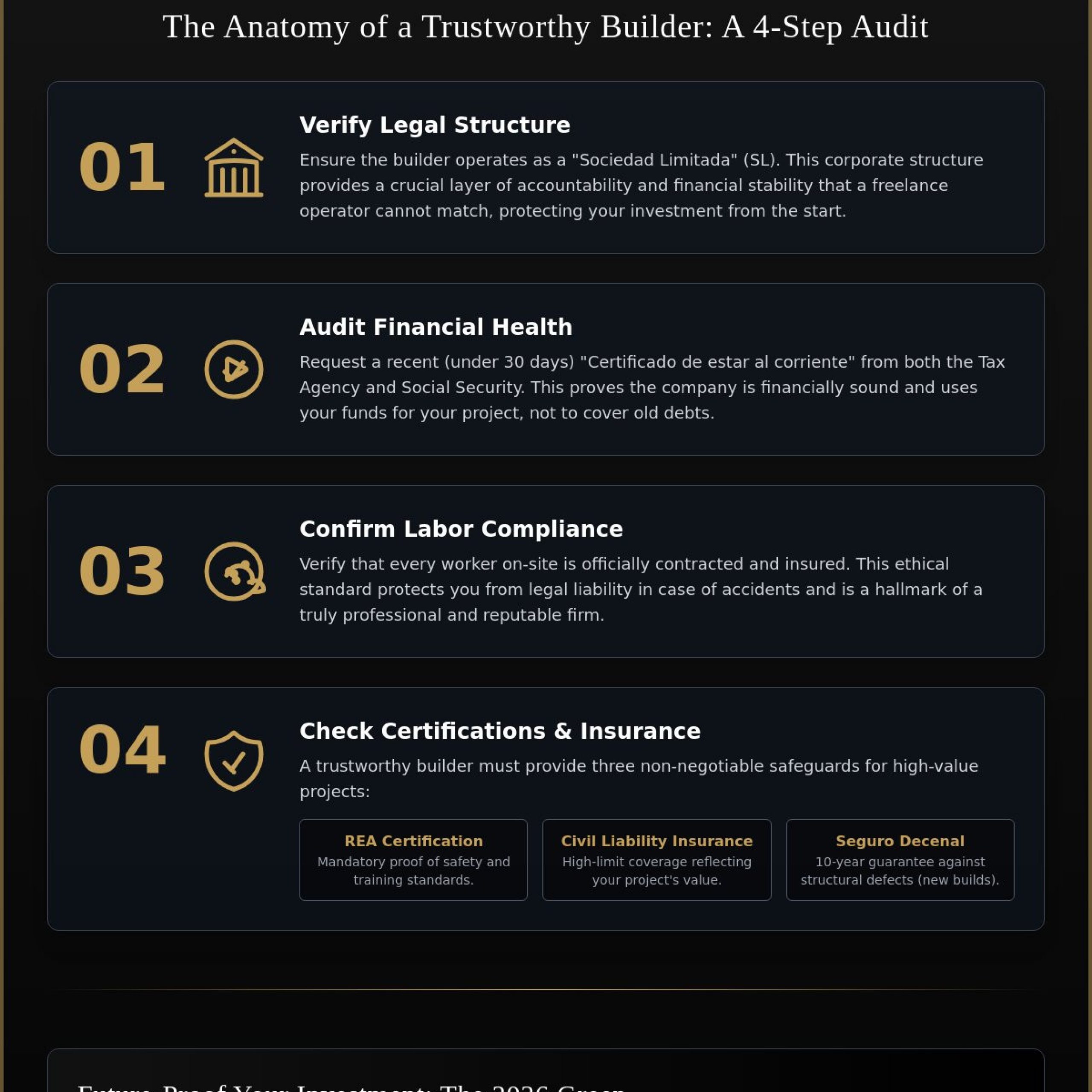
Identifying a partner for a bespoke villa or high-end renovation requires looking far beyond a polished website. A truly professional builder must operate as a “Sociedad Limitada” (SL), providing a layer of corporate accountability that individual freelancers simply cannot match. This legal structure ensures the business has the capital and formal registration necessary to handle high-value investments.
Financial transparency is paramount to ensure your capital is funding your specific project rather than settling a contractor’s previous debts. You should always request a “Certificado de estar al corriente” from both the Tax Agency and Social Security to verify their fiscal health. This document, which should be dated within the last 30 days, confirms the company is up to date with its public obligations.
Labor compliance protects you from becoming legally liable for on-site accidents or social security claims. Every worker must be officially contracted and insured, a standard that elite firms maintain as a core pillar of their professional ethics. When you are focused on finding trustworthy builders in Spain, verifying these internal standards is just as important as reviewing their architectural style.
Essential Certifications and Insurance
The “REA” (Registro de Empresas Acreditadas) is a mandatory certification for any firm operating in the Spanish construction sector. It proves the company meets essential safety and training standards required by Legal Safeguards and Contractual Best Practices. This registry is the first place our team looks when vetting potential partners for our international clientele.
For luxury investments, civil liability insurance (Responsabilidad Civil) should offer coverage limits that reflect the scale of a premium villa or penthouse. A “Seguro Decenal” is equally non-negotiable for new builds, providing a ten-year guarantee against structural defects. This policy is required by law for any property intended for sale, making it a critical asset for your property’s future marketability.
Portfolio Depth Beyond Aesthetics
A sophisticated marketing brochure is often just a starting point for your due diligence. True insight is found by visiting a “work in progress” to evaluate site cleanliness, safety protocols, and the quality of raw materials. A well-organized site is a reliable indicator of a builder who respects both the craft and the client’s investment.
Seek references from international clients who managed their builds remotely to understand how the builder handles long-distance communication. Finding trustworthy builders in Spain is significantly easier when you can speak with a peer who has navigated the process successfully. If you require expert guidance during this vetting phase, our bespoke legal assistance can help verify these credentials and provide the peace of mind you deserve.
A Four-Step Verification Framework for Investors
Securing your investment requires a disciplined approach that moves beyond social proof or anecdotal recommendations. We recommend a structured four-step framework designed to filter out high-risk contractors and identify elite professionals. This process ensures that finding trustworthy builders in Spain becomes a predictable exercise in risk management rather than a leap of faith.
The journey begins with a preliminary interview to assess communication style and professional alignment. You need a partner who understands the nuances of a high-end lifestyle project and shares your commitment to excellence. Following this, a comprehensive document audit is essential to verify the firm’s standing in the Register of Accredited Companies (REA) and their fiscal health.
The third stage involves a technical review where your independent architect scrutinizes the builder’s proposed “Presupuesto” or quote. Finally, a site inspection of a recently delivered property allows you to validate the quality of finishes firsthand. This final step confirms that the builder’s standards match the aspirational vision you have for your sanctuary.
Analyzing the Presupuesto
A lump sum quote is a significant red flag for any sophisticated construction project. These vague estimates often hide a lack of planning and lead to unexpected price hikes mid-build. A truly professional quote must include a detailed “Medición,” which is a granular breakdown of every material, brick, and labor hour required.
This level of detail allows you to compare quotes accurately and identify hidden costs that less transparent builders might exclude to appear more competitive. When every tile and fixture is accounted for, you gain a clear, contractual understanding of your financial commitment. It’s the only way to ensure your investment remains protected from unforeseen expenses that were actually predictable from the start.
Red Flags to Avoid
Transparency is the hallmark of integrity in the Spanish construction sector. Any request for large cash payments or “black” money, known locally as dinero B, to avoid IVA should be an immediate deal-breaker. Such practices are illegal and leave you with zero legal recourse or insurance protection if the project encounters difficulties.
Be wary of builders who refuse to work with independent, third-party architects or surveyors. An elite builder welcomes professional oversight because they are confident in their craftsmanship and regulatory compliance. Finally, a lack of a permanent physical office or a history of frequently changing company names suggests a lack of stability that no luxury investor should tolerate.
Legal Safeguards and Contractual Best Practices
Once you have completed the rigorous vetting process, the final layer of security lies in a robust, bespoke “Contrato de Obra.” Finding trustworthy builders in Spain is a vital first step, but even the most reputable firms require a clear legal framework to govern a high-value project. A standard template is rarely sufficient for a luxury villa or a complex penthouse renovation.
Your contract must define clear payment milestones linked to “Certificaciones,” which are certified stages of completion verified by your architect. This ensures you only pay for work that has been physically completed and inspected to your satisfaction. It’s a rhythmic approach to financing that keeps the project’s momentum aligned with your capital outlay.
A non-negotiable element of any professional agreement is the “Retención,” where you withhold 5% to 10% of every interim payment until the final sign-off. This retained capital acts as a powerful incentive for the builder to address the final “punch list” of minor snags before the keys are handed over. We also recommend including specific penalty clauses for unjustified delays to ensure your move-in date remains a priority.
The Role of Legal Assistance
Engaging a specialist real estate lawyer to review your construction contract before any deposit is paid is the hallmark of a sophisticated investor. They will ensure the inclusion of “Bank Guarantees” (Aval Bancario) for significant down payments, protecting your capital against company insolvency. This level of protection transforms a high-stakes transition into a secure and predictable investment.
Your legal representative will also confirm that the contract includes a comprehensive “Acta de Recepción,” or Final Acceptance Act. This document marks the official handover and triggers the commencement of the structural insurance periods. To ensure your interests are fully protected from the outset, we invite you to utilize our professional legal assistance for a thorough contract audit.
Permits and Licensing
Navigating the Spanish bureaucracy requires a clear understanding of the distinction between “Obra Menor” for minor refurbishments and “Obra Mayor” for structural changes. In 2026, many municipalities have transitioned to digital permit tracking systems that allow you to monitor your application status in real-time. This transparency helps eliminate the uncertainty that often plagued older construction cycles.
The Licencia de Primera Ocupación is the essential administrative document issued by the town hall that serves as the final hurdle before you can legally move into your new sanctuary.
Navigating Your Project with Expert Support
Finding trustworthy builders in Spain is just one chapter in the larger story of your property investment. While generic directories might offer a list of names, a boutique agency provides the sophisticated advocacy required to manage the complexities of a luxury build. We act as your local eyes and ears, ensuring your vision is executed with the precision and care it deserves.
Our curated network consists of elite professionals who often don’t advertise publicly, preferring to work exclusively through trusted advisors. This exclusivity is the key to accessing craftsmen who prioritize architectural integrity over volume. By bridging the gap between international standards and local expertise, we provide a layer of security that no public platform can replicate.
A relationship-building approach with a trusted advisor serves as the ultimate insurance policy for your capital. We remain deeply invested in your success, moving beyond the role of a traditional salesperson to become your long-term partner. This partnership ensures that every decision made on-site aligns with your broader investment goals and lifestyle aspirations.
The Value of a Bespoke Partnership
Leveraging over 20 years of local experience allows us to identify the most reliable construction partners who have consistently delivered high-end results. We integrate your specific lifestyle needs, from securing competitive mortgages to navigating complex currency exchange, into a single, seamless journey. This holistic approach ensures that your transition into your new home is as effortless as it is rewarding.
Professional property maintenance ensures your investment is cared for long after the contractors have left the site. We provide a continuous link between the construction phase and the daily reality of Mediterranean living. This ongoing relationship transforms a simple real estate transaction into a life-changing transition into a personal sanctuary.
Beyond the Build
Protecting your asset requires more than just a successful build; it demands professional key holding and meticulous oversight. Our team provides seasonal care and maintenance, ensuring your villa or penthouse remains in pristine condition throughout the year. This level of service allows you to enjoy the benefits of ownership without the administrative burdens often associated with overseas investments.
Once the final tile is laid and the gardens are in bloom, you can finally embrace the vibrant culture of your new surroundings. It’s the perfect time to uncover the best things to do in Malaga City, Spain to truly enjoy the lifestyle you have created. We’re here to unlock every opportunity your new life in paradise has to offer.
Your Journey to a Bespoke Spanish Sanctuary
Creating a high-end home in the 2026 market requires a sophisticated blend of aesthetic vision and rigorous technical oversight. By prioritizing the updated sustainability standards and following our disciplined verification framework, you protect both your capital and your future lifestyle. Success in finding trustworthy builders in Spain ultimately rests on moving beyond surface-level promises to verify legal and fiscal reality.
We leverage over 20 years of local real estate expertise to ensure your investment is managed with unparalleled precision from the initial plot purchase to long-term property maintenance. Our bespoke portfolio of luxury villas and penthouses is backed by a commitment to relationship-building that extends far beyond the final sign-off. It’s our passion to provide the expert guidance you need for a truly seamless transition.
Take the first step toward a secure and rewarding construction experience today. Unlock your dream property journey with the experts at KEYS property group and let us provide the key to your new life in paradise. We’re ready to help you build a legacy that lasts for generations.
Essential Insights for Your Spanish Construction Project
How much should I pay as a deposit to a builder in Spain?
A standard deposit typically ranges from 10% to 20% of the total construction value. For premium projects, you must insist that this initial payment is secured by a bank guarantee to protect your liquidity. Subsequent payments should only occur after your architect certifies that a specific stage of the build is complete.
Can I manage a renovation in Spain if I do not speak the language?
It’s possible but carries significant risk regarding technical errors and contractual misunderstandings. Most successful international investors rely on a bilingual advocate or boutique agency to bridge the communication gap. This professional oversight is essential for finding trustworthy builders in Spain who can deliver a high-quality home without delays.
What is the difference between a “Presupuesto” and a final invoice?
A “Presupuesto” is a formal quote based on anticipated measurements, while the final invoice reflects the work actually executed. In a well-managed project, the “Medición” ensures these figures remain consistent. Any discrepancies usually arise from “partidas alzadas” or provisional sums that weren’t fully defined at the start of the project.
Is a 10-year structural guarantee (Seguro Decenal) mandatory for all renovations?
The “Seguro Decenal” is mandatory for new residential builds but generally not for internal renovations. If your project involves structural changes, your lawyer should confirm if this ten-year policy is required for the final “Licencia de Primera Ocupación.” For all other works, ensure the builder carries a robust civil liability insurance policy.
What happens if my builder in Spain goes bankrupt during the project?
Your primary defense against bankruptcy is the bank guarantee and the 5% to 10% “retención” fund withheld from previous payments. These reserves provide the capital needed to transition the project to a new contractor without losing your initial investment. This financial structure is why we emphasize vetting the builder’s fiscal standing before signing any contract.
How long does it typically take to get a building license in Spain in 2026?
Most municipalities in 2026 process major building licenses within 3 to 9 months, though new digital systems are accelerating this in many regions. Minor works licenses are often processed much faster, typically taking between 15 and 30 days. Understanding these local timelines is crucial for planning your move-in date and managing your financing.
Should I hire an independent surveyor even if the builder has their own?
You should absolutely hire an independent surveyor to act as your personal quality controller on-site. The builder’s staff may overlook minor snags to meet deadlines, but an independent “Aparejador” ensures every detail meets your bespoke standards. This unbiased oversight is the best way to guarantee the long-term value of your property investment.
What are the typical working hours for construction crews in Spain?
Construction crews usually operate between 8:00 AM and 6:00 PM, including a traditional mid-day break for lunch and rest. Many coastal municipalities enforce “Plan de Ruidos” that prohibit loud works during the peak summer weeks of August to protect the local peace. These regulations help maintain the sanctuary-like atmosphere expected in luxury Spanish neighborhoods.
Properties in Finding Trustworthy Builders in Spain: The 2026 Expert Vetting Guide