
Healthcare in Spain for Expat Property Owners: The 2026 Essential Guide
Could your Mediterranean lifestyle be compromised by the very paperwork meant to protect it? We understand that securing high-quality healthcare in Spain for expat property owners often feels like a complex puzzle of public mandates and private premiums. It’s a vital component of your lifestyle transition that deserves the same level of care as the acquisition of your villa or penthouse.
You likely recognize that a truly successful relocation requires more than just a beautiful view; it demands a reliable medical safety net. We’ll help you master these complexities to ensure your residency remains secure and your health is supported by Spain’s world-class medical infrastructure.
This 2026 guide provides a clear roadmap through the latest regulations, including the updated costs for the Convenio Especial and the nuances of visa-compliant insurance. You’ll gain the clarity needed to transition from a property owner to a fully protected resident with absolute confidence.
Key Takeaways
- Learn the critical distinctions between the state-run system and premium private sectors to ensure your lifestyle is always supported by exceptional medical care.
- Discover the specific legal pathways that allow non-working residents to access public health services while maintaining their status as independent property owners.
- Identify the mandatory criteria for private healthcare in Spain for expat property owners to ensure your policy meets strict residency visa requirements.
- Follow a clear administrative roadmap that guides you from your local Padron registration through to obtaining your essential SIP health card.
- Understand how integrating your wellness plan with your property investment creates a sustainable and secure future in your new Mediterranean home.
Navigating the Spanish Healthcare Landscape for Expat Property Owners
Spain’s medical reputation is as sun-drenched and inviting as its Mediterranean coastlines. The country operates a sophisticated dual-tier framework known for its efficiency, innovation, and high standards of care. For a comprehensive Spanish healthcare system overview, one must look at the synergy between the public and private sectors.
The state-run Sistema Nacional de Salud (SNS) provides universal coverage to those contributing to the social security system. It’s a high-quality network of hospitals and clinics funded by taxpayers, ensuring that every registered resident has access to essential medical care and emergency services. This public pillar is the foundation of the nation’s health infrastructure.
Many newcomers assume that purchasing a luxury villa or a sleek penthouse provides an automatic gateway to these public services. However, property ownership is a separate legal track from healthcare eligibility. Establishing your right to healthcare in Spain for expat property owners requires specific administrative steps that extend beyond the signing of your title deed.
The 2026 landscape has evolved to embrace digital-first solutions and integrated patient portals. International residents now benefit from streamlined online systems and tele-health options that bridge the gap between their home and the local medical center. This modernization ensures that managing your health is as efficient as managing your investment portfolio.
The Public vs. Private Debate for International Residents
The choice between public and private healthcare in Spain for expat property owners isn’t always binary. Many affluent residents choose to maintain both to ensure they have every possible base covered. While the public system offers exceptional specialized care and emergency services, it can sometimes involve longer wait times for non-urgent procedures.
Private insurance is frequently the preferred route for its boutique-style service and immediate access to specialists. You’ll find English-speaking staff, significantly reduced waiting times, and modern facilities that mirror the comfort of a high-end hotel. These two systems often work in harmony to provide a seamless, world-class safety net for your family.
Why Healthcare is a Pillar of Your Property Investment
When you invest in a property, you’re investing in a long-term lifestyle. The enduring value of your home is deeply connected to its proximity to top-tier medical facilities and wellness centers. A villa located near a modern private hospital typically holds a more resilient market position and attracts a higher caliber of future buyers.
Buyers in the international resale market prioritize security and ease of access above almost everything else. Knowing that a robust medical plan is in place provides the peace of mind necessary to truly enjoy your Spanish retreat. It transforms a simple financial transaction into a sustainable, life-changing transition that protects your most valuable asset: your well-being.
Understanding Access to the Sistema Nacional de Salud (SNS)
Accessing the Sistema Nacional de Salud (SNS) is a fundamental pillar for those who contribute to the Spanish social security system. It’s a comprehensive network that provides medical services to residents through a blend of state funding and individual contributions. Public healthcare is a guaranteed right for those actively paying into the social security coffers, whether through employment or specific pay-in schemes.
While the central government sets national standards, the actual management of health services is decentralized across Spain’s 17 autonomous regions. This means that while your high-quality care remains consistent, the administrative name of your health card or the specific booking app you use might vary between the Costa del Sol and the Balearic Islands. This regional autonomy allows for medical services that are deeply attuned to the needs of the local community.
For many, establishing this connection to the state system is the final step in making their Mediterranean lifestyle truly permanent. It offers a layer of security that complements the luxury of your surroundings. Understanding the specific pathways to this system is essential for any long-term resident.
Contributing through Social Security and Employment
Property owners who choose to continue their professional journey in Spain often do so as autónomos, or self-employed individuals. Registering as an autónomo requires your NIE and social security number, which immediately unlocks full healthcare access for you and your dependents. This pathway is particularly popular for those who wish to maintain an active business presence while enjoying their Spanish villa.
If you’re employed by a Spanish company or a local branch of an international firm, your employer handles these contributions on your behalf. Your coverage is seamless from your first day of work, ensuring that your health needs are met without any waiting periods. This direct contribution model is the most common way for working expats to integrate into the local medical landscape.
The Convenio Especial: Pay-in Access for Non-Workers
The Convenio Especial is a sophisticated solution for healthcare in Spain for expat property owners who aren’t currently working or receiving a state pension. It functions as a public health insurance subscription, allowing you to pay a monthly fee to access the same state facilities as any Spanish worker. It’s an ideal bridge for those living on investment income or early retirement funds.
To qualify for this scheme, you must demonstrate at least 12 months of continuous legal residence in Spain, typically verified through your local Padrón registration. The cost structure is elegantly divided into two tiers based on age, with one rate for those under 65 and another for those 65 and older. It’s important to note that while this covers medical care, subscribers typically pay the full cost of prescriptions rather than the subsidized rates available to employees.
Navigating these residency requirements and social security filings can be complex, but professional legal assistance can ensure your transition is handled with precision. Having an expert guide ensures that your health coverage is as secure as your property investment.
Evaluating Private Health Insurance for Residency and Peace of Mind
Spain’s private medical sector offers an experience that mirrors the exclusivity of a high-end club. It’s often the preferred choice for those who value rapid access to renowned specialists and the comfort of state-of-the-art facilities. When considering healthcare in Spain for expat property owners, it’s vital to recognize that private cover is frequently a legal prerequisite rather than just a personal preference.
A residency-compliant insurance policy in Spain must provide comprehensive coverage equivalent to the public system, featuring zero co-payments, no deductibles, and no waiting periods for the entire duration of the visa. This specific structure ensures that the Spanish Ministry of Health and immigration authorities are satisfied that you won’t become a financial burden on the state system. For many, this private gateway is the most efficient path to securing their new life under the sun.
Beyond legalities, the peace of mind provided by private care is invaluable. You’ll often find that private hospitals on the coast or in major cities feel more like boutique hotels than clinical environments. These facilities prioritize your time and comfort, offering a level of service that aligns with the premium nature of your property investment.
Requirements for Residency and the Golden Visa
For those pursuing the Non-Lucrative Visa or the Digital Nomad Visa, the insurance policy must be from an insurer authorized to operate in Spain. Travel insurance or generic international health plans often fail to meet the strict criteria set by Spanish consulates. Specifically, policies must include a “repatriation” clause, which covers the cost of returning a person to their home country in the event of serious illness or death.
In 2026, typical monthly premiums for a visa-compliant plan with no co-payments range from €50 to €80 for applicants under 50. For those over 60, these costs can rise to between €90 and €180 per month. Ensuring your policy has no waiting periods is crucial, as any delay in coverage can lead to an immediate rejection of your residency application.
Selecting the Right Policy for International Owners
Choosing between a local Spanish insurer and a global provider depends on your lifestyle and how much time you spend abroad. Local insurers often have deeper networks within Spain and offer specialized “care coordination” services specifically for non-Spanish speakers. These services act as a personal concierge, helping you navigate appointments and ensuring you’re matched with English-speaking specialists.
It’s important to scrutinize how a policy handles pre-existing conditions, as many private providers may exclude them or apply significant surcharges. For healthy individuals, a 35-year-old can expect to pay approximately €700 per year for a compliant plan, while a 75-year-old might see premiums of €3,500 or more. Always verify the coverage limits to ensure they’re high enough to cover major surgical procedures without unexpected out-of-pocket expenses.
Essential Healthcare Logistics: From Padron to SIP Cards
Once you’ve signed the deeds for your new villa, the journey toward seamless integration begins. Establishing your medical profile is a procedural dance that requires precision and the right documentation. For those seeking healthcare in Spain for expat property owners, the process is a logical sequence that transforms you from a visitor into a protected resident.
The foundational document for this transition is the Certificado de Empadronamiento, commonly known as the Padrón. This registration at your local town hall proves you’re a resident in the municipality where your property is located. It serves as the primary bridge between your property investment and your right to access local medical services.
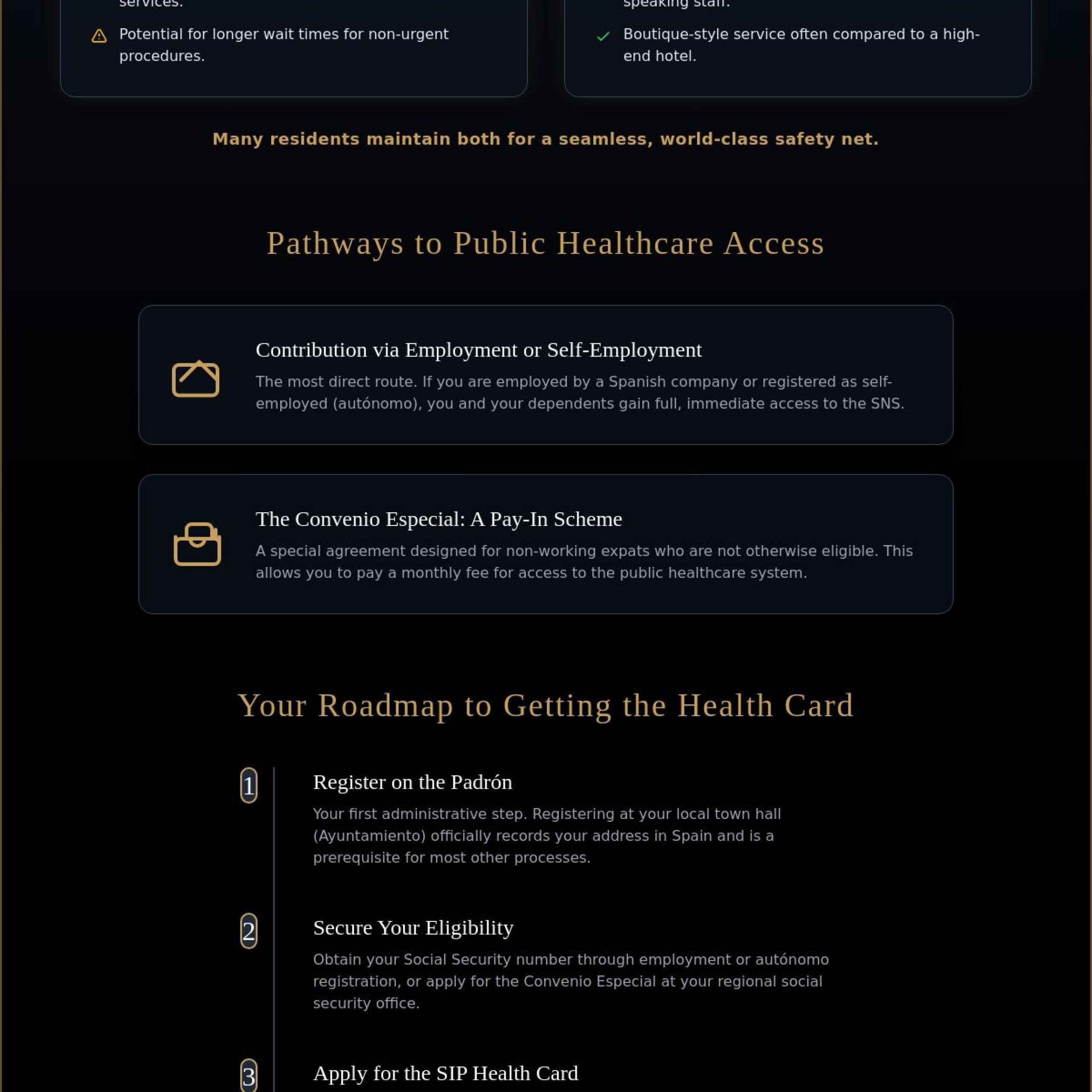
Modern Spain has embraced digital health folders, allowing you to manage appointments and records through secure online portals. This system ensures your medical history is accessible across the country, providing a level of continuity that’s essential for international owners. To secure your health card, follow these five essential steps:
- Secure your NIE (Foreigner Identification Number) and your residency visa.
- Register on the municipal Padrón using your property deeds or a long-term contract.
- Obtain your Social Security number or prepare your residency-compliant private insurance.
- Present your documents at the designated health center for your specific neighborhood.
- Receive your SIP or TSI card, which serves as your unique medical identification.
If you require expert guidance to manage these administrative hurdles, our team provides comprehensive legal assistance to ensure every detail of your relocation is handled with boutique care.
Registering at Your Local Health Centre
Your assigned Centro de Salud is determined by the specific geography of your property. This local hub is where you’ll meet your Médico de Cabecera, or GP, who acts as the sophisticated gatekeeper to Spain’s specialist network. It’s an essential relationship that ensures your long-term health is managed by a professional who understands your history.
To register, you’ll need to bring your NIE, passport, and the original Padrón certificate issued within the last three months. You must also provide proof of your entitlement, such as an S1 form for pensioners or proof of private insurance. Once registered, you’ll be assigned a dedicated doctor who will coordinate all your medical needs within the public system.
Emergency Services and Pharmacy Access
In the event of an urgent medical need, the national emergency number is 112, which provides immediate access to the Urgencias system. Spain’s emergency care is world-class, and hospitals are equipped to handle complex cases with speed and expertise. Most major facilities in international hubs offer translation services to ensure clear communication during critical moments.
Spain’s pharmacy network is equally impressive, with the 2026 co-payment reform ensuring transparent pricing based on income tiers. Since May 14, 2026, a new progressive system has established monthly spending caps for lower earners and pensioners. In upscale coastal areas, you’ll find that most pharmacies have English-speaking professionals who understand the specific needs of the international community.
Securing Your Future Health and Lifestyle in Spain
Wellness is the invisible thread that weaves through every successful relocation to the Mediterranean. It’s the tranquility of knowing that your physical well-being is as meticulously cared for as your luxury villa or penthouse. Mastering healthcare in Spain for expat property owners is the final step in transforming a temporary retreat into a permanent sanctuary.
Proactive planning is the hallmark of a sophisticated investor. By securing your medical access early, you ensure your new life remains sustainable and entirely stress-free. This foresight allows you to focus on the sensory delights of your surroundings rather than administrative uncertainty.
The right partner acts as a vital bridge between your property acquisition and your long-term integration. The team at KEYS property group remains deeply invested in your success; providing a level of care that extends far beyond the initial exchange of keys.
Integrating Healthcare into Your Long-Term Property Strategy
When selecting a property for retirement or a second home, proximity to world-class medical facilities is a strategic priority. A villa located within easy reach of a premier private hospital often sees more resilient asset appreciation. Future buyers in the international market value this accessibility as much as a sea view or a private pool.
It’s helpful to view your healthcare arrangements as a standard part of your annual property maintenance and legal costs. Just as you protect your investment through professional upkeep, you protect your lifestyle through comprehensive medical coverage. This holistic approach ensures that your health and your home remain in peak condition for years to come.
How KEYS property group Supports Your Transition
Our commitment to your journey is characterized by a boutique approach that prioritizes your personal peace of mind. We provide the expert legal assistance necessary to facilitate your residency and ensure your health insurance meets every regulatory requirement. This professional authority allows you to navigate the Spanish system with absolute confidence.
Our property management and key holding services provide an essential safety net for international owners. We act as your local eyes and ears, ensuring your home is maintained while you focus on your well-being. This relationship-driven service is designed to make your transition into the Spanish lifestyle both seamless and prestigious.
To truly understand the allure of this region, we invite you to explore more about living in Spain and our full suite of professional services. We’re here to ensure your investment is supported by a life of health, luxury, and local passion.
Embracing Your Future Under the Spanish Sun
Securing a Mediterranean retreat is a significant life transition that requires a holistic approach to wellness and security. By mastering the nuances of healthcare in Spain for expat property owners, you ensure that your investment is protected by a world-class medical safety net. From understanding the administrative steps of the Padrón to selecting residency-compliant private insurance, your journey is defined by clarity and confidence.
Success in this region depends on having a trusted advisor who possesses deep local roots and global standards. With over 20 years of local expertise, our team provides end-to-end legal and residency support alongside boutique property management and maintenance services. We’re here to act as the essential bridge between your dream home and a sustainable, high-end lifestyle.
Take the next step in your Mediterranean journey today. Explore our exclusive property portfolio and management services to find the perfect foundation for your new life. Spain is waiting to welcome you with open arms and unparalleled care.
Frequently Asked Questions
Do I get free healthcare if I buy a property in Spain?
No, purchasing a property doesn’t provide automatic access to free state medical services. While ownership is a significant step toward residency, healthcare in Spain for expat property owners is typically accessed through social security contributions, the Convenio Especial, or private insurance policies.
What is the “Convenio Especial” and who can apply for it?
The Convenio Especial is a public “pay-in” scheme that allows residents to access the state system for a fixed monthly fee. You’re eligible to apply after being registered on your local Padrón for at least 12 continuous months. For 2026, the monthly rate is €60 for those under 65 and €157 for those aged 65 and over.
Does my private health insurance need to be from a Spanish company for residency?
Yes, immigration authorities require your policy to be issued by an insurer authorized to operate within Spain. Generic international plans or travel insurance are almost always rejected during the visa application process. Your policy must also offer coverage equivalent to the public system with no co-payments or waiting periods.
How much does private health insurance cost for expats in Spain?
Typical monthly premiums for a visa-compliant private policy in 2026 range from €50 to €80 for individuals under 50. For those over 60, expect to pay between €90 and €180 per month for comprehensive coverage. These rates ensure that healthcare in Spain for expat property owners remains a predictable part of your annual lifestyle budget.
Can I use my EHIC or GHIC card as a property owner in Spain?
EHIC and GHIC cards are strictly for temporary visitors and don’t provide coverage once you become a legal resident or spend more than 183 days in the country. As a property owner establishing a permanent base, you’ll need to transition to a local private policy or the Spanish state system. Relying on travel cards for long-term stays can lead to significant out-of-pocket expenses and residency complications.
Is it easy to find English-speaking doctors in Spain?
English-speaking medical professionals are very common in popular coastal regions and major metropolitan hubs. Most private hospitals cater specifically to an international clientele and provide dedicated translation services or “care coordinators” to assist you. Even within the public system, many specialists in expat-heavy areas are proficient in English.
What happens if I have a medical emergency before I am registered?
Spain provides emergency medical care to everyone regardless of their registration status or nationality. Royal Decree 180/2026 has further standardized this access, ensuring that life-threatening situations are treated immediately at any public hospital. However, you may be billed for these services later if you don’t have valid insurance or social security coverage.
Do I need healthcare coverage to apply for the Spanish Golden Visa?
The Golden Visa program officially concluded in April 2025, so it’s no longer an available route for new applicants. For current alternatives like the Non-Lucrative Visa, comprehensive health insurance with no co-payments remains a mandatory requirement for approval. Our team can help you navigate these updated residency pathways to ensure your transition is handled with professional precision.
Properties in Healthcare in Spain for Expat Property Owners: The 2026 Essential Guide