
Essential Legal Checks for Rural Property in Spain: A 2026 Guide
What if the charming farmhouse you’ve found technically doesn’t exist according to the local town hall? Performing the right legal checks for rural property in Spain is the only way to ensure your Mediterranean dream doesn’t turn into a complex administrative burden.
It’s natural to feel overwhelmed by the disconnect between the Land Registry and the Catastro, or the nuances of Suelo Rústico zoning. You deserve a transition to rural life that’s defined by tranquility rather than the fear of an illegal build or missing water rights.
This 2026 guide offers a clear roadmap to secure, legal land acquisition by breaking down the sophisticated documentation you need for total confidence. We’ll examine how to verify property boundaries, navigate the latest regional tax updates like the 9% ITP rate in Valencia, and confirm that your home is a safe, long-term asset.
From understanding the implications of the AFO certificate to ensuring your access rights are set in stone, we provide the expert clarity required for a risk-free purchase. You’ll gain the specialized knowledge needed to bridge the gap between your lifestyle goals and the practical legal steps to reach them.
Key Takeaways
- Understand the nuanced classifications of Suelo Rústico to distinguish between developable rural land and strictly protected environmental zones.
- Learn how to reconcile data mismatches between the Land Registry and Catastro to ensure your property boundaries and ownership are legally indisputable.
- Identify the specific protections and limitations provided by AFO and DAFO certificates when performing legal checks for rural property in Spain.
- Verify essential utility rights by confirming the registration of private wells and the legality of existing access easements.
- Discover why independent legal assistance is a fundamental requirement for protecting your deposit and navigating complex rural zoning laws.
What is Suelo Rústico? Understanding Rural Land Classification
Suelo Rústico is land categorized for protection from the sprawling urban development often seen in Spanish coastal towns. It’s a legal classification that prioritizes the preservation of the landscape, agriculture, and natural resources over residential expansion.
Understanding these categories is vital, as they root back to broader Property Law Principles that prioritize public interest over private development. This means the land is not intended for the creation of new neighborhoods or urban-style estates.
In 2026, the distinction between national frameworks and regional nuances is where many buyers find themselves confused. While the central government sets broad guidelines, individual regions like Andalusia or the Valencian Community dictate the precise building allowances and restrictions.
Performing comprehensive legal checks for rural property in Spain is the only way to determine if a plot is truly “urbanizable” or if it’s destined to remain rural forever. The classification of the land determines everything from your tax obligations to your ability to renovate existing structures.
Ordinary vs. Protected Rural Land
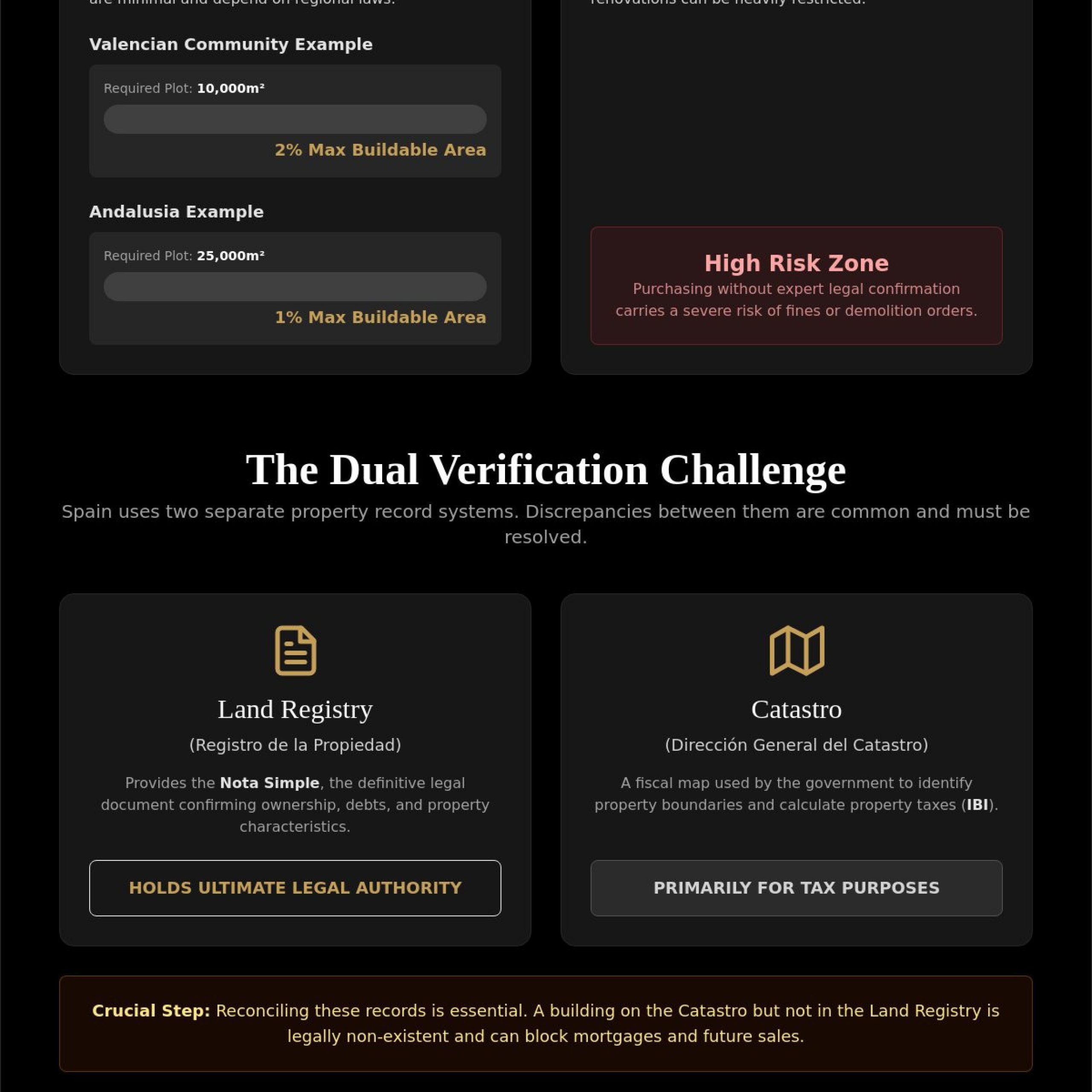
Ordinary rural land, often called “Suelo Rústico Común,” offers a narrow window for residential use under strict conditions. In the Valencian Community, the LOTUP law generally requires a minimum plot of 10,000 square meters for a single home, with a maximum buildable area of just 2%.
Specially protected areas are far more restrictive. These zones are designated for their ecological, historical, or cultural value, making any new construction nearly impossible. Purchasing in these areas without professional guidance carries a high risk of future demolition orders or heavy fines.
Regional laws dictate these specifics, and they can change based on the municipality. In Andalusia, the LISTA law typically requires a massive 25,000 square meter plot for new private residences, limiting the build allowance to a mere 1% of the total land area.
The Legal Purpose of Rural Land
The primary legal purpose of rural land is to support the primary sector, including forestry, livestock, and farming. Residential life in these zones is viewed by the state as an “extraordinary use” rather than a standard right.
Because of this, your property’s usage must align perfectly with the classification stated in the deeds and local registers. If a structure is used as a home but registered as an agricultural warehouse, you’ll encounter significant hurdles during the property buying process in Spain.
Conducting thorough legal checks for rural property in Spain ensures that the physical reality of the house matches its legal description. It’s the only way to avoid the pitfalls of buying a building that the local authorities don’t officially recognize as a residence.
It’s a common mistake to assume a large plot automatically grants the right to build or expand. Every square meter is subject to regional planning laws that prioritize the rural character of the land over individual development goals.
The Dual Verification: Nota Simple vs. Catastro Discrepancies
Spain operates with two distinct property records that rarely speak the same language. The Land Registry, known as the Registro de la Propiedad, serves as the ultimate legal authority on ownership and title. Conversely, the Catastro acts as a fiscal map used primarily for tax purposes and geographic identification.
Executing thorough legal checks for rural property in Spain requires a deep dive into both systems to ensure the land you see matches the land on paper. Discrepancies between these records are remarkably common in rural areas, where boundaries were historically defined by landmarks rather than GPS coordinates.
The Land Registry holds the highest legal weight in any property transaction. If a building appears on the Catastro but is missing from the Registry, it technically hasn’t been legally declared. This “non-existence” can block mortgage applications and create significant hurdles during a future resale.
Reconciling these records is one of the most vital legal checks for rural property in Spain because it establishes the true perimeter of your estate. Without this alignment, you risk purchasing a property with disputed borders or unrecognized structures.
Reading the Nota Simple for Rural Property
The Nota Simple is your primary defense against unpleasant surprises. It lists the current legal owners, a physical description of the property, and any outstanding “cargas” or charges. Consulting the UK Government Property Buying Guide can help you understand why checking for hidden debts or old mortgages is non-negotiable.
This step is a cornerstone of the property buying process in Spain, protecting you from inheriting the previous owner’s financial liabilities. You must verify that the description in the Nota Simple accurately reflects the number of buildings and the total land area currently present on the plot.
Any old mortgages or tax embargoes must be cancelled at the Registry before you complete the purchase. If these charges remain, they stay with the property, meaning you could become responsible for debts you didn’t create.
Identifying Boundary and Size Discrepancies
It’s common to find that the Catastro records a larger plot size than the Land Registry. This often happens because the Catastro uses modern aerial photography while the Registry might still rely on traditional, centuries-old descriptions. According to Spanish Mortgage Law, discrepancies up to 5% might only require a simple declaration by the owner to rectify.
Differences between 5% and 10% usually necessitate a cadastral certificate to update the Registry records. However, if the discrepancy exceeds 10%, a formal notarial procedure known as an expediente de dominio is required. This process involves notifying all adjoining neighbors to ensure no one is losing land in the correction.
A professional topographical survey is the only reliable way to verify physical fences against these official records. Resolving these mismatches before the final signing prevents future legal disputes and ensures your investment remains secure. If you’re feeling uncertain about these records, our team provides expert legal assistance to guide you through every verification.
Building Legality: Navigating AFO and DAFO Certificates
In the complex landscape of Spanish property, a building can exist without being fully legal. An AFO certificate (Asimilado a Fuera de Ordenación) is an administrative recognition for structures built on rural land without the original planning permissions.
This certificate doesn’t make a home “legal” in the traditional sense; it simply “regularizes” its status. It confirms that the statute of limitations for planning enforcement has passed, which in Andalusia is typically six years from the date of completion.
Obtaining this status is a crucial part of your legal checks for rural property in Spain. In 2026, the estimated cost for a DAFO or AFO in Andalusia ranges from €10,000 to €15,000, covering architect fees and necessary upgrades such as modern septic systems.
The official UK government guidance emphasizes the importance of verifying these certificates before committing funds. While an AFO allows you to access utility connections and insurance, it strictly prohibits any future extensions or significant structural changes.
The Risk of the Casa de Aperos
One of the most persistent myths in the rural market is the “casa de aperos” or tool shed. Sellers often market these small agricultural buildings as charming guest houses, but their legal status is strictly reserved for farming equipment.
Living in a structure registered as a tool shed is a violation of local planning laws. If your legal checks for rural property in Spain reveal a building is registered for agricultural use, you must accept it can never officially be a residence.
Authorities identify these discrepancies through aerial inspections and utility usage monitoring. Converting a tool shed into a dwelling without a formal change of use permit is a high-risk gamble that can lead to heavy fines or restoration orders.
Renovation Restrictions on Rural Buildings
Buildings with AFO status are strictly limited to “conservation and maintenance” works. You can repair a leaking roof or update internal plumbing, but you cannot add a new bedroom or increase the building’s footprint.
Attempting unauthorized construction on rural land often triggers immediate legal action from the local town hall. If your goal is to design a bespoke modern home, exploring new developments might offer a more secure and flexible path forward.
Always verify the specific registered use of every structure on the plot before signing any contract. A house that is “regularized” provides peace of mind against demolition, but it doesn’t grant the same freedom as a fully urban villa.
Investigating Easements, Water Rights, and Access
Rural properties often look idyllic, but their functionality depends on invisible legal threads. These threads, known as easements or servidumbres, can dictate who walks across your land or where your water comes from. Performing these legal checks for rural property in Spain is about ensuring your lifestyle isn’t interrupted by ancient rights you didn’t know existed.
Access is the first priority. A “Servidumbre de Paso” grants a neighbor the right to cross your plot to reach theirs. You must check the Nota Simple for these registered rights, but also look for physical signs like well-worn paths or gates that suggest an unregistered but active right of way.
Electricity is another common hurdle. Bringing mains power to a remote villa can cost tens of thousands of euros if new poles or a transformer are required. Many buyers in 2026 opt for advanced solar systems to avoid these infrastructure costs and the bureaucratic delays of the local power company.
Check if the land is part of a “Coto de Caza” or private hunting estate. This is common in regions like Andalusia and Castilla-La Mancha. If it is, hunters may have the legal right to enter your property during specific seasons, which significantly impacts your privacy and safety.
Verifying Private Wells and Water Shares
Every private well, or “pozo,” must be registered with both the regional Ministry of Mines and the relevant Water Basin Authority. Without this dual registration, your water extraction is technically illegal and subject to heavy fines. To verify this as a non-resident, you should request the “concesión de aguas” document from the seller.
If the property uses community water shares, you’ll need to review the statutes of the local water community. These shares often come with annual maintenance fees and strict usage schedules. Confirming these details ensures you won’t face a dry tap during the peak of a Spanish summer.
Conducting these specific legal checks for rural property in Spain prevents the risk of buying a home without a sustainable water source. It’s a fundamental step that goes beyond the basic ownership verification found in urban purchases.
Access and Boundary Rights
Don’t assume the road leading to your front gate is public. You must verify if the access road is maintained by the municipality or if it’s a private track requiring a registered easement. If the road is private and no easement exists, you could technically be blocked from your own home by a neighbor.
View rights, or “servidumbres de vistas,” are also worth investigating. These can prevent you from building walls or planting tall trees that might block a neighbor’s established view. Similarly, check for grazing rights where local shepherds might have historical permission to move livestock across your land.
Securing these rights is a complex process that requires local expertise and deep research. If you need help navigating these investigations, our team offers specialized legal assistance to ensure every easement is fully documented before you buy.
Securing Your Rural Investment with Professional Assistance
The transition from browsing properties to securing a contract requires a shift in focus from aesthetics to administrative reality. While the scenery captures your heart, an independent lawyer ensures the legal framework protects your interests. These experts perform the most rigorous legal checks for rural property in Spain to ensure your investment is sound.
A specialist lawyer understands the emotional weight of a significant life transition. They act as a knowledgeable bridge between your vision and the practical steps required for a secure purchase. Their role is to uncover any hidden liabilities that could compromise your ownership long after the keys are handed over.
The Notary plays a critical role in witnessing the final deeds and verifying identities at the point of sale. However, they don’t conduct the deep technical research or site visits that your lawyer performs. Relying solely on a Notary without independent advice is a common mistake that can leave you vulnerable to planning infractions.
Why Expert Guidance is Non-Negotiable
Local knowledge is invaluable when interpreting municipal regulations that vary from one village to the next. A specialist identifies risks, such as unregistered easements or pending planning changes, that a generalist might overlook. You can begin your search by viewing current listings that have been selected for their quality and potential.
Securing professional legal assistance is the best way to protect your deposit. Your lawyer will ensure that funds are held securely and only released when the property meets all legal requirements. This grounded presence builds trust and allows you to move forward with optimism and peace of mind.
Final Steps to a Secure Purchase
The “Certificado Urbanístico” acts as a final shield against unexpected surprises from the local town hall. This document provides a formal statement on the property’s current planning status and any potential restrictions. It’s a vital component of the final legal checks for rural property in Spain before you head to the Notary’s office.
Regional tax changes in 2026 have made some areas more accessible for buyers. For example, the Valencian Community reduced its general ITP rate to 9% in June 2026. Similarly, the city of Madrid lowered its general IBI rate to 0.414% in 2026, reducing the annual carrying costs for property owners.
Managing post-purchase obligations is essential for a risk-free experience. Ensuring that rubbish collection fees and utility bills are transferred into your name prevents future administrative headaches. If you’re looking for a dedicated partner to guide you through this process, contact us to discuss your requirements and secure your new lifestyle.
Take the Next Step Toward Your Rural Retreat
Securing a home in the Spanish countryside is a rewarding journey when you prioritize transparency and due diligence. Aligning the Land Registry with physical reality and understanding the specific limitations of AFO certificates are vital steps for any prospective owner.
Completing thorough legal checks for rural property in Spain ensures your investment remains a source of peace rather than a complex administrative burden. These protocols protect your lifestyle and your capital, allowing you to focus on the beauty of your new surroundings.
With over 20 years of local real estate experience, we offer a grounded, reliable presence to guide you through every stage. From comprehensive legal assistance and mortgage support to dedicated property management and maintenance, we act as a knowledgeable bridge to your goals.
Explore our legally verified property listings in Spain and discover a curated selection of villas and plots. Your new life in the Mediterranean sun is within reach when you have a seasoned specialist by your side.
Frequently Asked Questions
What is the main difference between Suelo Rústico and Suelo Urbano?
Suelo Rústico is protected land intended for agriculture, forestry, or environmental preservation, where residential building is strictly limited. Suelo Urbano is land integrated into a town’s planning zone, featuring municipal services like paved roads, street lighting, and sewage systems.
While urban land is designed for housing, rural land is meant to remain undeveloped. Any residential use in a rústico zone is treated as an exceptional use rather than a standard right.
Can I build a swimming pool on rural land in Spain?
Building a new swimming pool on rural land is generally prohibited by modern regional planning laws. Most municipalities only allow you to renovate an existing agricultural water tank, known as a balsa, into a pool with a specific permit.
Attempting to build a pool without a license can lead to significant fines and restoration orders. You must verify local bylaws before assuming any water feature can be added to the plot.
How do I know if a rural house has an illegal extension?
You identify illegal extensions by comparing the physical structure to the square meterage listed in the Land Registry and the Catastro. If the house you see is larger than the one described in the deeds, the extra space is likely undeclared.
Performing these legal checks for rural property in Spain helps you spot discrepancies before you commit to a purchase. Always check if the extra rooms have been regularized through an AFO process.
What happens if my rural property is not in the Land Registry?
A property missing from the Land Registry lacks legal title protection, meaning you cannot prove ownership to a bank or the state. This makes it impossible to secure a mortgage and creates massive hurdles for a future sale.
The property must undergo a formal registration process called inmatriculación. This involves a notary and can take several months to complete, as it requires notifying neighbors and local authorities.
Is it possible to get a mortgage for a rural property in Spain?
Mortgages for rural properties are possible, but Spanish banks are notably more conservative with their lending criteria. Lenders typically offer a lower Loan-to-Value ratio, often capping the mortgage at 50% or 60% of the property’s appraised value.
Banks prioritize properties that are fully registered and have residential status. If the property only has an AFO certificate or is registered as an agricultural shed, securing traditional financing is significantly more difficult.
What is a Nota Simple and why is it essential for rural land?
A Nota Simple is an official summary from the Land Registry that lists the current owners and any debts or legal charges. It’s the most critical document for legal checks for rural property in Spain because it proves the seller has the right to sell.
This document reveals if there are old mortgages, tax embargos, or court orders attached to the land. You should never sign a contract without reviewing a Nota Simple issued within the last 24 hours.
What are the risks of buying a property with an AFO certificate?
The primary risk of an AFO certificate is that it limits you to basic maintenance and conservation work only. You’re legally prohibited from ever expanding the footprint of the home or adding new structures like garages or guest annexes.
While the AFO protects the house from demolition, it doesn’t grant the same rights as a fully legal urban villa. You must accept the property exactly as it is without the hope of future development.
How do I check if my well water is legal?
You verify well legality by requesting the concesión de aguas document, which proves the well is registered with the regional Water Basin Authority. It must also be recorded with the Ministry of Mines to be fully compliant.
Many rural wells are illegal extractions that could be closed by the authorities at any time. Confirming this registration is the only way to ensure a sustainable and legal water supply for your home.
Properties in Essential Legal Checks for Rural Property in Spain: A 2026 Guide