
Non-Resident Income Tax in Spain: The Definitive Guide to Modelo 210 in 2026
Did you know that the Spanish tax authority has the right to audit and claim up to four years of unpaid taxes, alongside significant interest and penalties? For many international owners, the quiet prestige of a Mediterranean villa is often shadowed by the complexities of non-resident income tax Spain (Modelo 210).
You likely chose your Spanish home for the lifestyle and the view, not to spend your time decoding the intricacies of the 183-day residency rule. It’s understandable to feel a sense of unease when faced with the opaque requirements of the official tax agency website.
Our comprehensive guide will empower you to master these fiscal responsibilities, ensuring your property investment remains a source of joy rather than a liability. We’ll explore the critical 2026 filing deadlines, the specific tax rates for your country of residence, and the expert strategies to safeguard your assets.
Key Takeaways
- Determine your fiscal status with clarity by understanding the 183-day residency rule and how it impacts your obligations.
- Master the complexities of non-resident income tax Spain (Modelo 210) to protect your luxury investment from avoidable audits.
- Stay ahead of the 2026 filing calendar for both imputed and rental income to maintain your financial peace of mind.
- Uncover the essential documentation required, from NIE numbers to Cadastral Values, for a flawless tax submission.
- Learn how a holistic approach to property maintenance and legal care can simplify your international ownership experience.
The Essentials of Non-Resident Income Tax in Spain
Owning a luxury villa or a sleek coastal penthouse in Spain is a dream realized, but it brings specific fiscal responsibilities that require your careful attention. The primary mechanism for managing these obligations is the non-resident income tax Spain (Modelo 210), which serves as the standard form for declaring both rental income and the benefit of property ownership.
It’s vital to distinguish between your local IBI (Impuesto sobre Bienes Inmuebles), which functions like council rates, and the national IRNR income tax. While your bank might automate your local property rates, the national tax requires a proactive self-assessment filing that you must initiate yourself.
The Spanish tax system operates on this self-assessment basis, meaning the tax agency won’t send you a bill or a reminder when your payment is due. Staying compliant is the only way to ensure your Mediterranean legacy remains secure and free from administrative hurdles.
You must file this return even if your property remains a private sanctuary for your exclusive use and is never rented out. The Spanish government views the ownership of a second home as a taxable benefit, often referred to as imputed income, which must be declared annually.
Failing to stay compliant can lead to unexpected bank account freezes or significant complications when you eventually decide to sell your property. Proactive management of these filings reflects the same care you put into maintaining the physical beauty of your home.
Determining Your Fiscal Status
Most international owners define their status by the 183-day rule. If you spend more than 183 days in Spain during a calendar year, you’re generally considered a tax resident. However, the authorities may also look at your center of economic interest, such as where your primary business or immediate family resides.
Understanding the broader scope of Taxation in Spain helps clarify how international treaties protect your global assets. These Double Taxation Treaties are vital tools that prevent you from being taxed twice on the same income by both your home country and Spain.
Why Modelo 210 is Mandatory for All Owners
Every individual listed on the property deed holds an independent obligation to the Spanish state. If you own a villa with a partner or family member, you cannot submit a single joint tax return. Each owner must file their own non-resident income tax Spain (Modelo 210) based on their specific percentage of ownership.
This individual filing requirement ensures total transparency with the tax agency and protects each owner’s individual legal standing. It’s a boutique approach to taxation that mirrors the personalized nature of high-end property ownership.
To complete these filings, a valid NIE (Número de Identidad de Extranjero) is essential for every person named on the property title. This identification number serves as your fiscal heartbeat in Spain, connecting your investment to the national tax system and enabling all future legal transactions.
Calculating Your Liability: Imputed vs. Rental Income
Understanding how much you owe begins with identifying how you use your property. The Spanish tax system distinguishes between “imputed income,” which is a tax on the benefit of owning a second home for personal use, and actual rental income earned from tenants.
Your starting point for these calculations is the valor catastral, or cadastral value, found on your annual IBI (council tax) receipt. This administrative value is typically much lower than the market price, serving as the basis for your non-resident income tax Spain (Modelo 210) obligations.
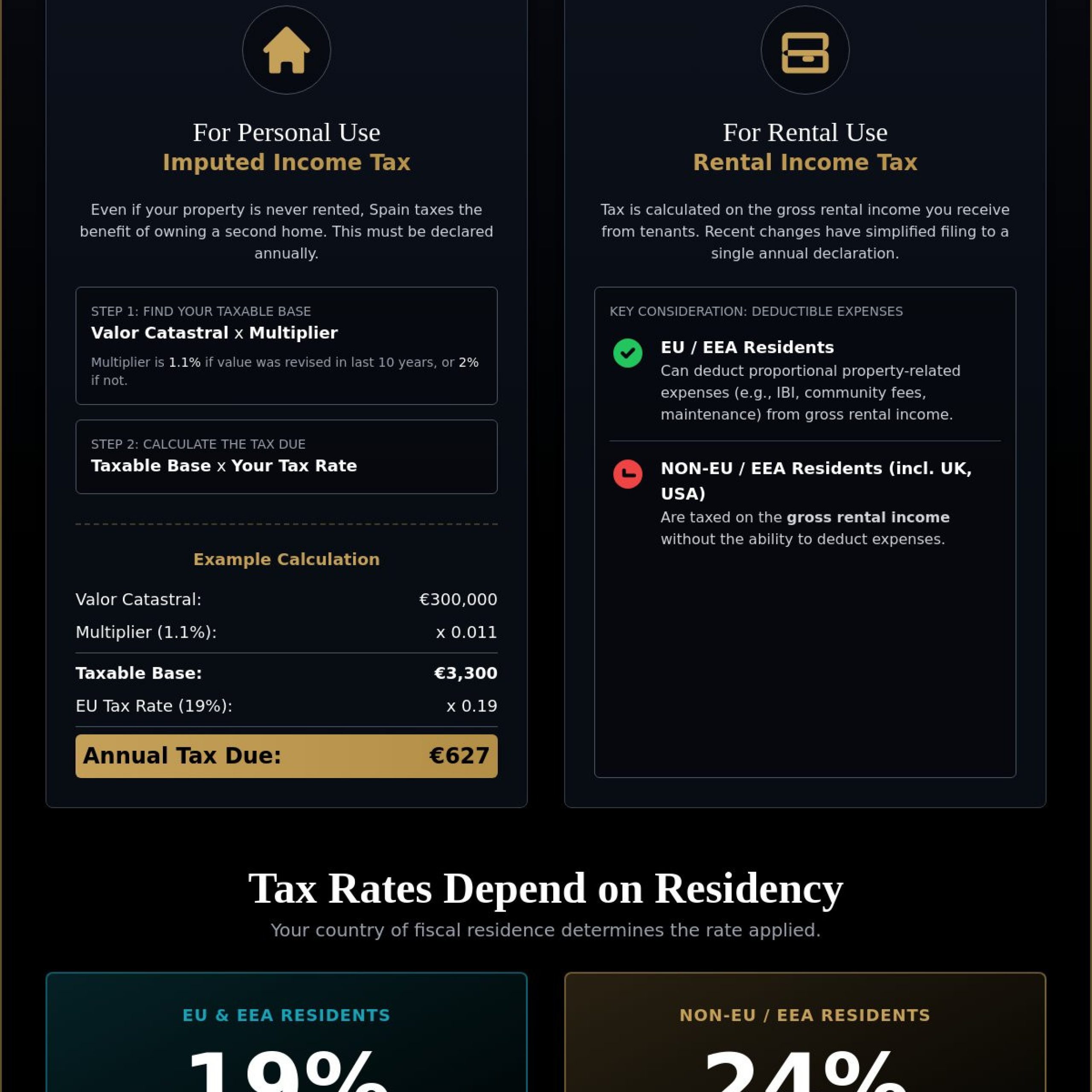
The tax rates applied to this base depend on your country of residence. Residents of the EU and EEA (including Iceland and Norway) benefit from a flat rate of 19%, while those residing in non-EU countries, such as the UK or USA, are subject to a 24% rate.
Staying informed via the official Spanish Tax Agency guidelines ensures you’re applying the correct percentages to your specific situation. Accuracy here is the hallmark of a responsible and sophisticated property owner.
If you’re looking for peace of mind, our experts provide comprehensive legal assistance to ensure your calculations are flawless and your investment remains protected.
Understanding Imputed Income Calculations
If your villa or apartment is for your own enjoyment, you’ll pay tax on a percentage of the cadastral value. This multiplier is 1.1% if the value was revised by the municipality within the last 10 years, and 2% if it hasn’t been updated recently.
For a luxury property with a cadastral value of €300,000 that has been recently revised, the taxable base would be €3,300. An EU resident would then pay 19% of that amount, totaling €627 for the year.
It’s important to remember that this tax is pro-rated. If you purchased your dream home mid-year, you’re only liable for the months you actually held the deed, ensuring a fair and logical financial transition.
Rental Income and Deductible Expenses
When you choose to let your property, the focus shifts to the actual income generated. While previous years required quarterly submissions, the most significant recent trend is the shift to a single annual filing for non-resident income tax Spain (Modelo 210), simplifying the process for international landlords.
EU and EEA residents enjoy the privilege of deducting allowable expenses from their gross rental income. You can subtract costs such as property maintenance, insurance, and interest on mortgages, provided they’re directly related to the period the property was rented.
Non-EU residents, however, face a different landscape where they must pay the 24% tax on the gross income received. No deductions are permitted for owners living outside the EU or EEA, making precise record-keeping even more essential for your financial planning.
Filing Deadlines and the Risks of Non-Compliance
Punctuality in your fiscal affairs is as essential as the upkeep of your Mediterranean garden. For those enjoying a private villa, the deadline to file non-resident income tax Spain (Modelo 210) for imputed income is December 31st of the following year. This generous window allows you to settle the previous year’s obligations with ease and clarity.
The system relies on the concept of accrual, where you report on the benefits or income gained during the prior calendar year. If your property is part of a rental portfolio, the deadlines have recently become more streamlined. For income earned throughout 2025, you must file your declaration between January 1st and January 20th, 2026.
If you prefer the convenience of direct debit, ensure your submission is finalized by January 15th. This proactive approach ensures your payments are handled automatically, leaving you free to focus on the more aspirational aspects of your Spanish lifestyle.
The Consequences of Missing a Deadline
Delays in filing invite unnecessary friction into your relationship with the Spanish authorities. Surcharges begin as a small percentage of the tax due but grow steadily alongside late-payment interest. In more severe cases, the tax agency may freeze your local bank accounts, causing significant disruption to your property maintenance or utility payments.
Unresolved tax debts also act as a red flag during future property transitions. Whether you’re upgrading to a larger estate or passing your legacy to the next generation, a clean tax record is mandatory. Notaries often require proof of tax compliance before authorizing a sale or inheritance transfer.
Grouping Rental Income
Simplification is a welcome trend in the current tax landscape. Recent changes now allow owners to group multiple rental periods into a single annual filing for non-resident income tax Spain (Modelo 210). This reduces the administrative weight on your shoulders while maintaining full transparency with the state.
To benefit from this grouping, you must maintain a diligent archive of your rental activity. You’ll need to provide clear documentation of the periods the property was occupied and the exact expenses incurred. This level of detail ensures that your deductions are respected and your tax liability is calculated with absolute precision.
The Procedural Path to Filing Modelo 210
Fulfilling your fiscal duties in Spain is a structured process that mirrors the elegance and precision of your property investment. To begin your filing for non-resident income tax Spain (Modelo 210), you must first gather your essential ownership documents. Your property deeds and the most recent IBI receipt provide the foundation for an accurate and professional declaration.
Ensure your NIE number and passport details are current and easily accessible before you begin. These identifiers are the digital keys that allow you to interact with the Spanish Tax Agency’s infrastructure. Without a valid NIE, the procedural path remains closed, potentially delaying your compliance and peace of mind.
Once your data is prepared, you’ll calculate the taxable base and enter the figures into the official electronic portal. While the interface is designed for technical accuracy, it requires a meticulous eye to ensure every field reflects your specific ownership percentage. A single error in these digital forms can lead to administrative friction that is easily avoided with professional care.
Finalizing the process involves arranging the actual transfer of funds to the state treasury. You can choose to pay through a local Spanish bank or via an international transfer from your home country. For expert guidance through this administrative landscape, our team provides professional legal assistance to manage every detail on your behalf.
Payment Methods for International Owners
If you maintain a Spanish bank account, the Direct Debit (domiciliación) option is the most seamless path available. This allows the tax authority to collect the exact amount on the deadline date automatically, ensuring you never miss a window. For those paying manually, the NRC (Complete Reference Number) system acts as a digital receipt that validates your payment instantly.
International owners without a local account can utilize the SWIFT/BIC system for cross-border transfers. This method requires specific coding to ensure your payment is correctly attributed to your NIE and property record. Precision in these banking details prevents the risk of your funds being misallocated or lost in the international banking system.
The Role of the Fiscal Representative
Many of our most discerning clients choose to appoint a local fiscal representative to oversee their Spanish interests. This professional serves as your official point of contact with the state, receiving all formal tax notifications at a local, professional address. This ensures that no critical communication is missed while you are enjoying your time away from Spain.
A fiscal representative provides an essential layer of security for your property legacy. They offer the confidence that comes from knowing an expert is monitoring your non-resident income tax Spain (Modelo 210) status year-round. This boutique service integrates perfectly with our broader property maintenance offerings, creating a truly effortless ownership experience.
Securing Your Spanish Investment with Professional Care
Owning a prestigious property in Spain should be an experience defined by tranquility and reward rather than administrative weight. True peace of mind comes from knowing that every facet of your investment is being managed with the same level of care you expect in your primary residence.
Integrating your tax compliance into a broader management strategy ensures that your non-resident income tax Spain (Modelo 210) is handled with absolute precision. This proactive stance transforms a mandatory legal requirement into a pillar of your property’s long-term security and value.
When professional legal assistance meets dedicated property maintenance, the result is a seamless ownership journey. You no longer need to worry about missing a deadline or miscalculating a cadastral value while you’re away from the coast.
Comprehensive Support for International Clients
Navigating the vibrant Costa del Sol market requires a guide who understands both the local landscape and global standards of service. We provide end-to-end support that covers everything from key holding and property maintenance to complex currency exchange and mortgage advisory.
This boutique approach allows us to act as your essential bridge to the local market, ensuring your interests are always the priority. By leveraging local expertise, you protect your asset against the shifting sands of regulatory changes and administrative nuances.
Our commitment to relationship-building means we don’t just manage properties; we nurture the lifestyle they represent. Whether you own a sleek penthouse or an expansive villa, our team is dedicated to preserving the exclusivity of your Spanish retreat.
Next Steps for Your 2026 Tax Filing
As you look toward the coming year, we suggest a thorough review of your current property deeds and previous tax returns. Having these documents organized is the first step toward a flawless submission for your non-resident income tax Spain (Modelo 210).
Seeking a professional consultation can also reveal opportunities to optimize your tax liabilities, particularly for EU residents eligible for deductions. An expert eye ensures that you’re only paying what’s legally required while remaining in full compliance with the state.
Your Spanish home should remain a source of joy and a legacy for the future. Ensure your Spanish property remains a secure investment with KEYS property group and let us handle the complexities of your international ownership.
Protecting Your Spanish Legacy for the Future
Mastering the nuances of non-resident income tax Spain (Modelo 210) is more than a fiscal duty; it’s an investment in your ongoing peace of mind. By clearly distinguishing between residency rules and the specific calculations for imputed or rental income, you ensure your Mediterranean retreat remains a sanctuary of joy.
Our agency offers a sophisticated bridge to the local market, blending over 20 years of local expertise with a boutique approach to high-end property management. We provide the comprehensive legal and fiscal support necessary to navigate these complexities with the elegance and precision your investment deserves.
Secure your Spanish property investment with our professional management services and let us handle the administrative details on your behalf. Your journey in Spain is a life-changing transition, and we’re committed to making every moment as effortless as the coastal breeze.
Common Questions Regarding Non-Resident Taxation
What is the difference between IBI and Modelo 210?
IBI is a local municipal tax paid to your town hall to fund regional services, similar to council rates. In contrast, non-resident income tax Spain (Modelo 210) is a national obligation based on the benefit of property ownership or rental profits.
While your bank might automate the local IBI payment, the national income tax is a self-assessment that you must proactively calculate and file. Keeping these two obligations distinct is vital for maintaining a flawless fiscal record in Spain.
Do I have to pay Modelo 210 if I do not rent out my apartment?
Yes, you’re required to file even if your property is strictly for personal use and never generates rental income. The Spanish government taxes the “benefit” of owning a second home as a form of imputed income.
This annual declaration is mandatory for every person listed on the property deed. It ensures your standing with the tax authorities remains secure, protecting your investment from unexpected audits or penalties.
How much is the non-resident tax in Spain for 2026?
The tax rate depends on your country of residence at the time of filing. Residents of the EU and EEA (including Iceland and Norway) benefit from a flat rate of 19% on their taxable base.
For owners residing in any other country, such as the United Kingdom or the United States, the rate is 24%. These percentages apply to both the imputed income for personal use and any rental profits earned during the year.
What happens if I forget to file my Modelo 210 tax return?
Missing a deadline triggers a sliding scale of surcharges and late-payment interest that grows over time. The Spanish Tax Agency also has the authority to freeze local bank accounts to recover unpaid debts.
Unresolved tax issues frequently emerge during property sales or inheritance transfers, where a notary may halt the process until all debts are settled. Maintaining compliance is the simplest way to protect your property’s long-term legacy.
Can I file Modelo 210 myself or do I need a lawyer?
It’s possible to submit the form yourself via the official electronic portal, though many find the system technically demanding. Most discerning owners opt for professional legal assistance to ensure every detail is handled with boutique care.
Expert guides manage the complexities of the 183-day rule and double taxation treaties on your behalf. This professional oversight provides a level of security that a self-filed return rarely offers.
Are there any tax deductions for UK residents after Brexit?
Unfortunately, UK residents are now treated as non-EU residents and cannot deduct property expenses from their rental income. You’re required to pay the 24% tax rate on the gross income received from tenants.
This differs from EU residents, who may still subtract costs like insurance and maintenance. Despite this change, meticulous record-keeping remains essential for demonstrating the transparency of your Spanish financial affairs.
When is the deadline for filing non-resident income tax in Spain?
For imputed income on properties for personal use, the deadline is December 31st of the following calendar year. If you’ve earned rental income, the window for the new annual filing is between January 1st and January 20th.
Ensuring your non-resident income tax Spain (Modelo 210) is submitted within these windows prevents the friction of late-payment surcharges. Setting reminders for these dates is a key part of responsible international ownership.
How do I find the cadastral value of my Spanish property?
The valor catastral is most easily found on your annual IBI (Council Tax) receipt provided by the local municipality. This figure represents the administrative value of the land and buildings, which is typically lower than the market price.
If you don’t have a copy of your IBI receipt, you can request this information from the local Cadastral Office. You’ll need your property’s unique reference number to access the official valuation for your tax calculations.
Properties in Non-Resident Income Tax in Spain: The Definitive Guide to Modelo 210 in 2026