
What Do Spanish Community Fees Cover? A Complete 2026 Homeowner Guide
What if your dream Mediterranean apartment came with a hidden financial history that could cost you thousands in its first year? Owning a home in Spain is a milestone achievement, yet the complexity of communal costs often feels like a barrier to total peace of mind. It’s natural to feel uneasy when asking what do Spanish community fees cover and how they impact your long-term budget.
This guide ensures you’ll understand exactly where your money goes and how to verify the financial health of a property before you sign the deed. We’ve updated this 2026 roadmap to include the latest legal shifts, including the five-year statute of limitations on fee debts and new energy efficiency mandates for communal buildings. Knowing these details protects your investment from unexpected special levies known as derramas.
We’ll break down how your specific quota is calculated and show you how to influence community spending effectively. You’ll gain the confidence to transition from a curious buyer to a well-informed homeowner with total transparency. Our goal is to provide the grounded, reliable presence you need during this significant and exciting life transition.
Key Takeaways
- Understand the legal framework of the Horizontal Property Law to ensure your communal interests are fully protected.
- Discover exactly what do Spanish community fees cover, ranging from essential staff salaries to the maintenance of luxury amenities.
- Learn how your property’s unique participation coefficient determines your monthly contributions and long-term financial commitments.
- Empower yourself with knowledge on your voting rights and the mandatory reserve funds designed to prevent unexpected special levies.
- Identify how professional property maintenance and key holding services can safeguard your investment while you are away.
The Legal Framework of Community Fees in Spain
Owning property in Spain involves a shared commitment to the collective environment. This commitment is formalized through mandatory payments known as Gastos de Comunidad, which fund the upkeep of everything outside your private front door.
Understanding what do Spanish community fees cover starts with the Ley de Propiedad Horizontal (Horizontal Property Law). This legislation ensures the building’s structural integrity and aesthetic standards remain high for all residents, protecting your property’s long-term value.
These fees aren’t optional contributions. If an owner fails to pay, the community can initiate a “monitorio” process, a simplified court procedure designed to recover debts quickly and efficiently.
Current legal standards established by Law 42/2015 set a five-year statute of limitations for claiming unpaid fees. However, most communities act much sooner to place a lien against the property, ensuring the collective budget remains stable and fair for everyone.
What Constitutes a Community of Owners?
The Comunidad de Propietarios is the legal entity that manages all shared spaces. It’s established the moment a building or complex is divided into individual units, creating a framework for shared responsibility.
You might wonder why a detached villa in a gated urbanisation still pays these fees. If your home shares a road, street lighting, or a perimeter fence, you’re part of a legal community regardless of your property type.
The specific boundaries and obligations are defined in the Escritura de Obra Nueva. This document is a vital part of the property buying process in Spain because it outlines your exact share of common expenses.
The Role of the Community Administrator
Most communities hire an Administrador de Fincas to manage daily operations. This professional ensures the complex stays compliant with the latest regulations, such as the energy efficiency updates introduced in Law 10/2022.
They handle the annual budget, organize meetings, and collect fees from every owner. For international homeowners, having a professional manager provides a layer of security and professional oversight while they’re away.
A skilled administrator acts as a neutral bridge between neighbors. They provide the transparency needed to ensure your investment remains financially healthy and your community runs with the precision you expect.
A Detailed Breakdown of What Community Fees Cover
When you step into a well-maintained Spanish development, you’re seeing your community fees in action. Many new buyers ask what do Spanish community fees cover to ensure they’re getting true value for their investment. It’s a comprehensive list that extends far beyond simple gardening.
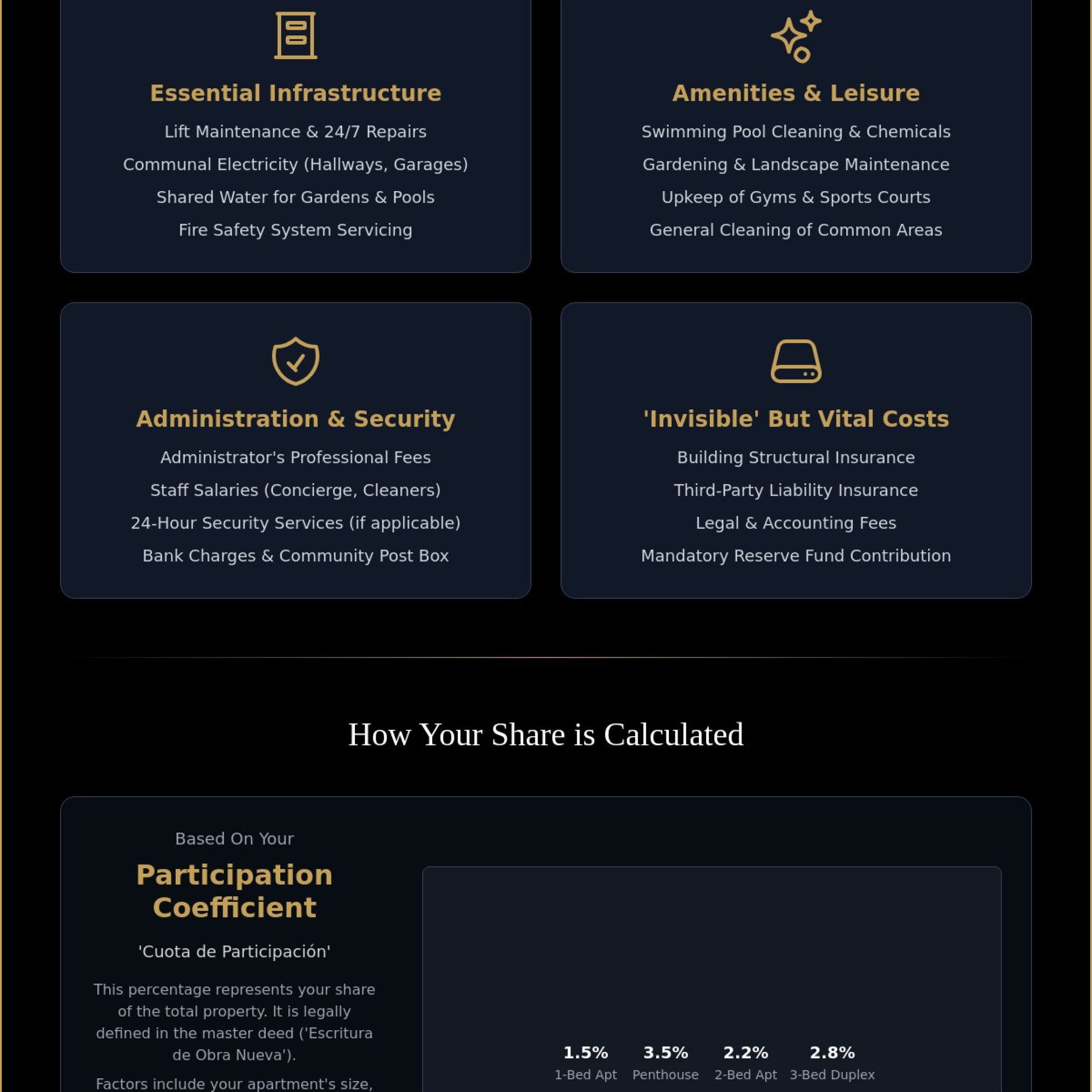
Your contributions fund the meticulous care of shared facilities like swimming pools, tennis courts, and gymnasiums. These amenities are the heart of the Mediterranean lifestyle, requiring daily chemical treatments and seasonal maintenance to remain safe and inviting for all residents.
Beyond the visible perks, your fees cover essential “invisible” costs. This includes the building’s structural insurance and third-party liability for shared zones. According to Spain’s Horizontal Property Law, these funds also cover legal and accounting fees required to keep the community’s administration transparent and compliant.
If you’re browsing our latest property listings, you’ll notice that fees vary based on the level of service provided. More exclusive developments often include 24-hour security and concierge services in their monthly breakdown to provide an elite level of comfort.
Essential Shared Services and Utilities
The core of any community budget is dedicated to the infrastructure that keeps the building running safely. These services are often non-negotiable and strictly regulated by Spanish safety standards to protect the residents.
- Lift Maintenance: Regular safety inspections (elevadores) and 24/7 emergency repair services for all shared elevators.
- Communal Utilities: Electricity for hallways, external lighting, and the power required to run pool pumps and irrigation systems.
- Water Usage: The cost of filling the pool and maintaining the lush, vibrant gardens that define Spanish urbanisations.
- Fire Safety: Annual servicing of extinguishers, alarms, and smoke ventilation systems in shared areas.
Staffing and Security Infrastructure
A significant portion of your fees pays for the professionals who make your community feel like home. This human element provides both convenience and a sense of security for resident and non-resident owners alike.
In gated developments, this includes 24-hour security patrols and the monitoring of CCTV systems. Security staff act as a deterrent and provide immediate assistance during incidents, maintaining the peace of the neighborhood throughout the year.
Concierge services, or Portería, handle daily logistics like managing deliveries and controlling visitor access. Their presence adds a layer of service that simplifies your daily life and ensures the lobby areas remain pristine at all times.
It’s vital to remember that these fees do not cover private interior repairs or your individual electricity and water consumption. Your community fees focus solely on the shared environment, ensuring the collective asset remains in peak condition for years to come.
How Community Fees Are Calculated and Paid
The way your contributions are calculated is both logical and transparent. Every property in a development is assigned a ‘Cuota de Participación’ or participation coefficient. This number represents your percentage of ownership in the entire complex and dictates your share of the expenses.
This coefficient is usually determined by the square meterage of your home relative to the total built area. It’s established when the building is first registered and is recorded in the property’s title deeds. When you ask what do Spanish community fees cover, remember that your specific payment is simply the community’s total annual budget multiplied by your participation quota.
Owners meet once a year at the Annual General Meeting (AGM) to review and vote on this budget. This meeting is your opportunity to influence how the community spends its funds and to ensure the administration remains efficient. Most communities collect these fees on a monthly or quarterly basis to maintain a steady cash flow for operations.
Transparency is a cornerstone of a healthy community of owners. You have the right to request a detailed breakdown of the budget at any time from the administrator. This ensures you know exactly how every euro is being reinvested into the quality and security of your Mediterranean home.
Ordinary vs. Extraordinary Expenses
Understanding the difference between these two categories is essential for managing your personal finances. Ordinary expenses are the predictable costs of daily life, such as cleaning, lighting, and gardening. These are planned well in advance and rarely fluctuate during the fiscal year.
Extraordinary expenses, known as Derramas, are one-off payments for major projects like structural repairs. A Derrama is a non-regular levy voted on for specific projects that fall outside the scope of the standard annual budget. These can range from a few hundred euros to over €5,000 for significant works.
The Mandatory Reserve Fund (Fondo de Reserva)
Spanish law provides a safety net for owners through a mandatory reserve fund. Under Spain’s Horizontal Property Law (Ley de Propiedad Horizontal), every community must maintain a reserve of at least 10% of its annual budget.
This reserve fund handles emergency repairs without the need for an immediate Derrama. Since the 2022 reforms, these funds can also be used to finance energy efficiency upgrades. A healthy reserve fund directly protects your property’s resale value and ensures the complex remains in peak condition.
Don’t overlook the importance of checking the status of this fund before purchasing a property. A robust balance suggests the community is prepared for the future, while a depleted fund might signal upcoming special assessments. It’s another reason why what do Spanish community fees cover is such a vital question during your initial property search.
Homeowner Rights and Obligations in Spain
Owning a home in Spain is a partnership between you and your neighbors. While you enjoy the benefits of shared amenities, you also carry specific legal responsibilities to ensure the community remains harmonious and financially sound.
Your primary obligation is to maintain your private property in a way that prevents damage to shared areas. If a leak in your apartment damages the hallway, you’re personally liable for the repairs. Additionally, paying your fees is mandatory to retain your right to vote and influence what do Spanish community fees cover in the future.
Disputes are best handled through the Community President or the professional Administrator. These figures act as mediators to resolve issues ranging from noise complaints to disagreements over budget allocations before they escalate to legal action.
Voting and the Annual General Meeting (AGM)
The Annual General Meeting (AGM) is the most powerful tool in a homeowner’s arsenal. It’s the forum where you exercise your right to vote on the annual budget and any changes to the community’s internal rules.
If you can’t attend in person, you can assign a proxy to represent your interests and cast your vote. Majorities are calculated differently depending on the decision. For example, banning tourist rentals now requires a 3/5 majority vote, while energy efficiency works often only need a simple majority.
Purchasing a Property: Checking for Debts
Due diligence is non-negotiable when entering a new community. In Spain, the property itself carries the debt for community fees, meaning a new owner can be held responsible for unpaid fees from the current and previous three calendar years.
To protect yourself, you must obtain a ‘Certificado de estar al corriente’ from the seller. This document, signed by the Administrator and President, confirms there are no outstanding debts at the time of sale. You can find more detail on these safeguards in our guide to the property buying process in Spain.
Verifying the financial health of a community before you buy is the only way to avoid inherited liabilities. If you have concerns about a potential purchase, you can contact our legal assistance team to help you navigate the paperwork with total confidence.
Optimising Your Property Management Experience
Once you understand what do Spanish community fees cover, the next step is ensuring your investment is actively managed. Passive ownership can lead to missed opportunities at annual meetings or oversight of communal maintenance standards. Proactive involvement ensures that the administrative team remains transparent and every euro is spent wisely.
Effective oversight ensures the community budget is allocated to vital areas like energy efficiency or security upgrades. This professional approach prevents the need for large, unexpected levies that can disrupt your financial planning. It’s about turning a shared obligation into a tool for long-term asset protection.
Choosing a dedicated partner to navigate these complexities makes the transition to Spanish property ownership feel seamless. A grounded, reliable presence on the ground provides the peace of mind you need when you aren’t physically present. This level of support bridges the gap between your lifestyle goals and the practical steps required to reach them.
Professional Oversight and Maintenance
Aligning your private property maintenance with the community’s high standards is vital for aesthetic harmony. For non-resident owners, having a local representative to monitor communal works ensures your interests are always protected. This oversight guarantees that the services you pay for are delivered with the precision you expect.
Our property management services provide this essential local presence. We act as your eyes and ears on the ground, attending meetings and verifying that shared projects are completed to the highest quality. This dedicated support ensures your home remains a source of joy rather than a logistical burden.
Securing Your Investment Long-Term
Well-managed communities consistently see higher capital appreciation over time. When communal amenities are pristine and fees are paid consistently, the entire development becomes more attractive to future buyers. High-quality shared spaces are often the first thing a potential purchaser notices when viewing a property.
Transparency in the budget is a hallmark of a healthy community of owners. By understanding what do Spanish community fees cover, you can judge if your development is positioned for long-term growth. A robust reserve fund and well-maintained facilities are clear indicators of a financially sound investment.
If you need expert advice on buying or managing your Spanish home, our team offers the specialized knowledge you require. We help you navigate every aspect of ownership with quiet confidence and professional assurance. Our goal is to act as your comprehensive partner, ensuring your property remains a valuable and cherished asset for years to come.
Embracing Your New Mediterranean Lifestyle with Confidence
Navigating the nuances of communal living is a vital step toward enjoying your new home with total peace of mind. By mastering the details of what do Spanish community fees cover, you ensure that every contribution serves to protect your property’s value and enhance your daily experience.
Remember that active participation in community decisions and thorough due diligence during the buying process are your best defenses against unexpected costs. These steps transform a shared obligation into a powerful tool for long-term financial security and consistent asset growth.
Our independent and privately owned team brings over 20 years of local real estate expertise to your journey. We provide comprehensive end-to-end management services that bridge the gap between your aspirations and the practical realities of Spanish homeownership.
Ready to take the next step toward your dream lifestyle? Explore our latest listings and find your perfect home in Spain today. We look forward to acting as your dedicated partner and helping you build a secure, vibrant future in this beautiful part of the world.
Frequently Asked Questions
Are community fees mandatory in Spain if I don’t use the facilities?
Yes, community fees are mandatory for every owner regardless of whether they use the shared facilities. Under the Horizontal Property Law, your obligation to contribute is based on your property’s participation quota rather than your personal usage of the pool, gym, or gardens.
Even if you never step foot in the communal areas, these spaces contribute to the overall value and structural integrity of the development. Maintaining them is a collective legal responsibility that ensures the entire complex remains attractive and functional for all residents.
What happens if I don’t pay my Spanish community fees?
The community can initiate a legal “monitorio” process to recover unpaid debts through a simplified court procedure. This action often leads to a lien being placed against your property, which prevents you from selling it until the debt is settled.
Non-payment also results in the immediate loss of your right to vote at community meetings. It’s important to resolve disputes through the proper channels rather than withholding fees, as the community has strong legal powers to enforce collection.
How much are typical community fees for an apartment in Spain?
Typical monthly fees depend entirely on the level of service and amenities provided. A standard apartment in an urbanisation with a pool usually costs between €100 and €200, while a basic apartment in a block without a pool might range from €50 to €100.
In more exclusive developments with 24-hour security and extensive facilities, fees often range from €300 to €600 per month. These costs reflect the high standards of maintenance required to preserve an elite lifestyle and protect your long-term investment.
Can the community of owners increase my fees without my consent?
Yes, the community can increase fees if the new budget is approved by a majority vote at a General Meeting. While you have the right to attend and vote against the proposal, you’re legally bound by the collective decision once it’s officially passed and recorded.
Budget increases are often necessary to cover rising utility costs or to comply with new regulations, such as the 2026 energy efficiency standards. Engaging with the annual meeting is the best way to influence how the community manages its spending.
Do I have to pay for a new lift if I live on the ground floor?
Yes, ground-floor owners are generally required to contribute to the installation or repair of a lift. Lifts are classified as essential common elements that improve the entire building’s accessibility and market value, even if you don’t use them to reach your front door.
The only exception is if the community’s founding statutes explicitly exempt ground-floor units from these specific costs. Most modern communities follow the standard participation quota for all major structural improvements.
Is the community fee the same as the IBI property tax?
No, these are two completely different financial obligations. IBI is a local government tax paid annually to the town hall, while community fees are private payments used exclusively for the upkeep of your specific development’s shared areas.
When asking what do Spanish community fees cover, it’s helpful to remember they fund private services like gardening and pool cleaning. IBI, on the other hand, funds public infrastructure such as city roads, street lighting, and local police services.
How often are community meetings held in Spain?
An Annual General Meeting (AGM) is legally required once per year to approve the accounts and elect the community officers. This meeting is the primary forum for discussing the budget and any planned improvements for the coming year.
Extraordinary meetings can also be called at any time to address urgent repairs or significant changes to the community rules. These are usually convened by the President or by a group of owners representing at least 25% of the total participation quotas.
Can I see the community accounts before I buy a property?
Yes, you should always request the community accounts and the last two years of meeting minutes during your due diligence. Reviewing these documents allows you to verify the financial health of the complex and see exactly what do Spanish community fees cover in that specific development.
Checking the accounts helps you identify if there are any pending “derramas” or special levies for major works. It also confirms that the current owner is up to date with their payments, ensuring you don’t inherit any unexpected debts after the purchase.
Properties in What Do Spanish Community Fees Cover? A Complete 2026 Homeowner Guide