
Wealth Tax in Spain for Property Owners 2026: A Sophisticated Guide
What if the very asset that defines your Mediterranean lifestyle also holds the key to an unexpected financial obligation? You’ve likely felt the tension of balancing the allure of a coastal villa with the complexity of overlapping national and regional laws, especially as you look toward your wealth tax in Spain for property owners 2026.
It’s understandable to feel a sense of hesitation when faced with shifting thresholds and the indefinite extension of the Solidarity Tax. This guide promises to demystify these intricacies, offering you the expert clarity needed to protect your property investments and ensure seamless fiscal compliance.
We’ll examine the critical differences between regional allowances in places like Madrid and Andalusia, the nuances of the “valor de referencia” for valuations, and the legal pathways to maximize your exemptions. You’ll gain a sophisticated understanding of your 2026 liability, allowing you to focus on the life-changing transitions your Spanish home provides.
Key Takeaways
- Identify how the December 31st snapshot influences your wealth tax in Spain for property owners 2026 to maintain a clear view of your fiscal responsibilities.
- Clarify your liability by distinguishing between personal and real obligations based on your residency status and time spent in the country.
- Navigate the complexities of the Solidarity Tax to understand how this top-up levy applies to property portfolios valued above €3,000,000.
- Apply the essential “Three-Value Rule” to ensure your property assets are valued correctly using the highest of the three official benchmarks.
- Leverage expert legal assistance and property management to turn complex tax requirements into a streamlined part of your luxury lifestyle.
Navigating the Spanish Wealth Tax Landscape in 2026
The Impuesto sobre el Patrimonio is more than just a fiscal requirement; it’s a reflection of your standing within the vibrant Spanish economy. For those managing a wealth tax in Spain for property owners 2026, understanding this annual levy on net global assets is the first step toward long-term security. It positions your investment within a framework of transparency and prestige.
Everything hinges on a single moment in time. The Spanish tax authorities take a financial snapshot of your assets exactly as they stand on December 31st each year. This specific date determines the valuation of your entire portfolio for the upcoming filing cycle, making year-end asset management a critical task for the discerning owner.
As we approach the 2026 cycle, the fiscal environment has reached a point of sophisticated stability for those managing a wealth tax in Spain for property owners 2026. While regional variations exist, the national government continues to prioritize enforcement through digital integration and cross-border data sharing. Relying on Spain’s wealth tax system ensures that your prestigious property portfolio remains both compliant and optimized for growth.
The Core Principles of Net Worth Calculation
Calculating your liability requires a precise look at your net value, which accounts for your total assets minus any deductible debts or charges. This ensures you’re only taxed on your true equity rather than the gross value of your villas or apartments. Liability rests solely with the individual who holds the economic right to the property.
Net worth is the balance after all liabilities are subtracted from the gross estate. This fundamental calculation acts as the baseline for all subsequent tax planning and exemption strategies. It’s the bridge between simple ownership and sophisticated estate management.
Annual Deadlines and the 2026 Filing Window
Preparation is the hallmark of the successful investor. The standard filing window for the 2025 tax year opens on April 8 and closes on June 30, 2026. Missing these dates can lead to unnecessary complications that disrupt the peace of your Mediterranean lifestyle.
Spanish tax law requires individual filings via Modelo 714. Even for married couples holding joint assets, each partner must submit a separate declaration reflecting their specific share of the wealth. This tailored approach to compliance prevents errors and ensures each individual’s allowances are fully utilized.
Maintaining meticulous records throughout 2025 is the most effective way to ensure a seamless submission in 2026. Our team provides the expert legal assistance and property maintenance records necessary to substantiate every deduction and protect your investment’s integrity.
Determining Liability for Resident and Non-Resident Owners
Identifying your specific tax category is the essential first step for any wealth tax in Spain for property owners 2026 strategy. Spain distinguishes between “Obligación Personal,” which applies to residents, and “Obligación Real,” which governs those living abroad. This distinction dictates whether your entire global portfolio or merely your Spanish villas and apartments fall under scrutiny.
Your lifestyle and the time you spend enjoying the local culture directly shape your fiscal identity. Double taxation treaties play a vital role here, acting as a protective shield to ensure your international assets aren’t taxed twice. Understanding your residency status is the primary key to unlocking a secure and efficient tax plan.
The 183-Day Rule and Economic Interests
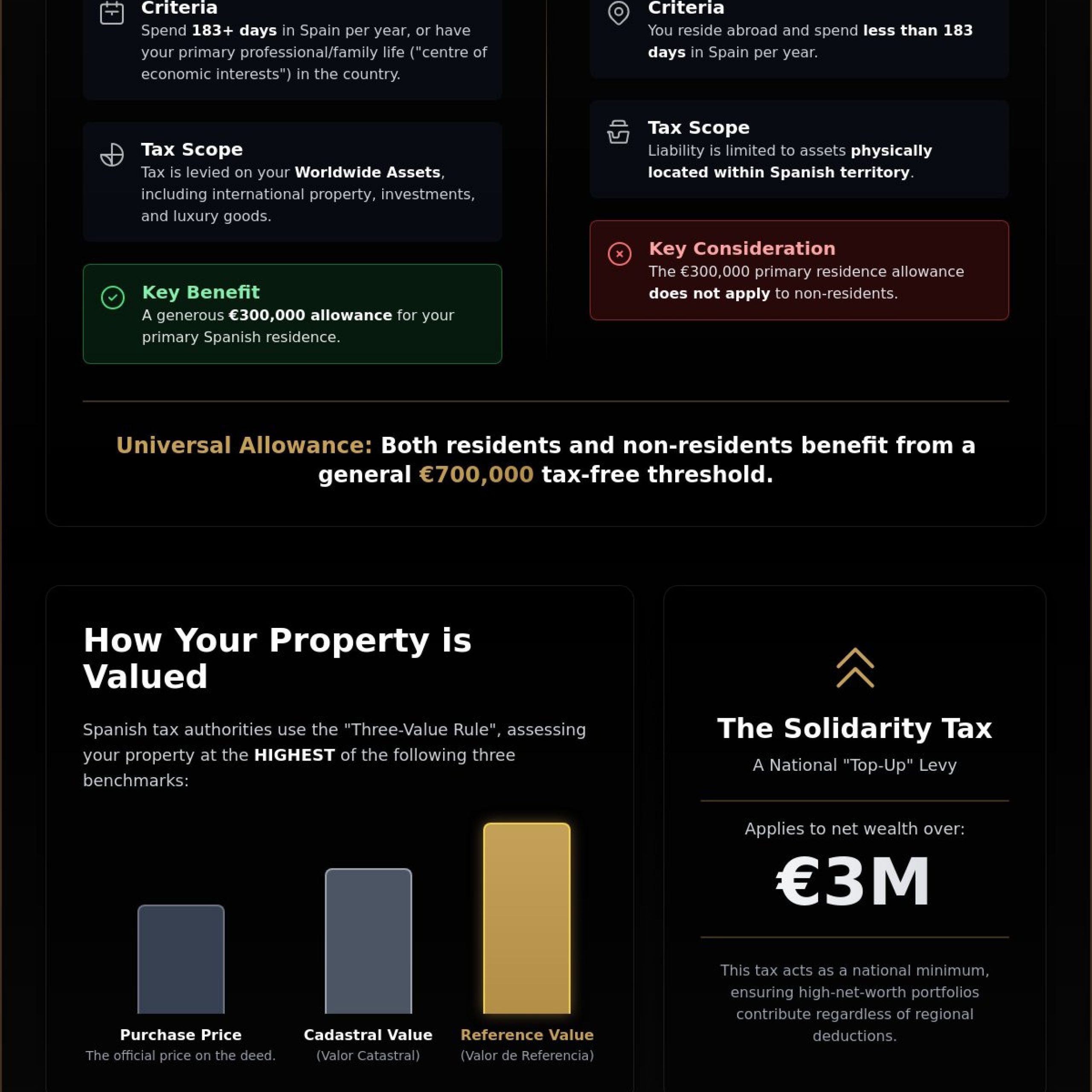
Spend more than 183 days in the country during a calendar year and you’re typically considered a resident for tax purposes. The authorities also look at your “centre of economic interests,” meaning if your primary professional activity or family life is rooted here, residency follows. Owning a primary residence often strengthens this presumption, requiring you to declare your worldwide estate.
Residents face a broader reporting requirement that encompasses all assets, regardless of where they’re located globally. This includes:
- International bank accounts and investment portfolios.
- Luxury real estate holdings outside of Spain.
- Private collections, art, and high-value vehicles.
While this may seem expansive, residents benefit from specific exemptions, such as the €300,000 allowance for a primary home. Balancing these benefits against the requirement to disclose global wealth is a hallmark of sophisticated estate planning.
Specific Obligations for Non-Resident Property Owners
If you reside abroad, your liability is limited to assets physically located within Spanish territory. Recent shifts in the legal landscape have clarified the tax liability for non-residents, particularly regarding how properties held through foreign entities are treated. This ensures that only the value tied directly to the Spanish soil is subject to the wealth tax in Spain for property owners 2026.
Holding property through a corporate structure requires a nuanced approach to maintain compliance and avoid unexpected bills. Non-residents don’t receive the primary residence exemption, but they still benefit from the general €700,000 threshold. This makes strategic acquisition of apartments or plots a highly efficient investment when managed correctly.
Navigating these rules requires a well-connected partner who understands the local landscape. Appointing a dedicated tax representative ensures that your filings are handled with the same care you’d expect from a boutique firm. Our bespoke legal assistance provides the peace of mind needed to enjoy your Spanish estate without administrative burden.
The Interplay Between Wealth Tax and the Solidarity Tax
The Impuesto de Solidaridad de las Grandes Fortunas acts as a central government safeguard, ensuring that the most prestigious estates contribute regardless of regional incentives. For those calculating their wealth tax in Spain for property owners 2026, it’s vital to recognize this tax isn’t a temporary measure but a permanent fixture of the fiscal landscape. It serves as a harmonizing force, bridging the gap between national standards and the varied tax reliefs found in specific autonomous communities.
It functions as a sophisticated top-up mechanism rather than a separate, additional burden. If your regional wealth tax payment is lower than the calculated Solidarity Tax, you simply pay the difference to the central state. This credit system ensures you aren’t paying twice on the same wealth, preserving the financial integrity of your Spanish property portfolio. This interplay is particularly relevant in regions that have historically offered 100% relief, as the central tax now effectively steps in to capture that contribution.
For property owners in Andalusia or Madrid, this means that while the regional wealth tax might be zero, the Solidarity Tax will still apply if the €3,000,000 threshold is met. This ensures a baseline level of fiscal responsibility across the most desirable locations in Spain. By understanding this balance, you can navigate the market with the clarity of a seasoned investor and the security of expert guidance.
This dual-layered system requires a proactive approach to asset valuation and record keeping. Our boutique firm provides the legal assistance necessary to calculate these credits accurately, ensuring you only pay what’s strictly required. It’s about transforming a fiscal obligation into a secure foundation for your life-changing transition to the Spanish coast, where your villas and apartments remain protected assets.
Thresholds and the €3 Million Trigger
The trigger for this contribution is a net wealth exceeding €3,000,000, reflecting the government’s focus on high-net-worth individuals. Progressive rates apply: 1.7% for wealth up to €5 million, 2.1% up to €10 million, and 3.5% beyond that. These rates apply to your net assets after all regional tax credits are deducted. The solidarity tax ensures a minimum level of taxation across all regions.
Strategic Exemptions for Large Estates
Residents still benefit from the €700,000 general allowance and the €300,000 primary residence exemption when calculating their taxable base for the wealth tax in Spain for property owners 2026. Non-residents also utilize the €700,000 threshold to offset their Spanish-based assets like villas or plots. High-net-worth individuals should view these taxes as a unified wealth strategy. This holistic view ensures your prestigious portfolio remains both compliant and optimized for future growth.
Valuation Rules and Essential Exemptions for Property Assets
The Spanish tax administration employs a specific hierarchy to determine how your villas and penthouses are valued. For your wealth tax in Spain for property owners 2026, you must apply the “Three-Value Rule” to each property in your portfolio. This requires identifying the highest figure among the cadastral value, the price recorded in the public deed of purchase, and the administrative reference value.
The administrative reference value, or valor de referencia, has become the primary benchmark since its introduction in early 2022. It’s designed to align tax valuations more closely with actual market trends across the region. Ensuring your declaration reflects the correct peak value is essential for maintaining full fiscal compliance and avoiding future inquiries.
Refining your net estate value also involves identifying non-taxable assets that don’t fall under the wealth tax umbrella. Household contents, excluding high-value art or jewelry, and certain business assets are often exempt. This allows you to focus your fiscal strategy on the core of your prestigious property investments.
Appraising Your Property Portfolio
Your cadastral value is easily located on your annual IBI receipt, serving as the foundational figure for many local taxes. While this number is often lower than market rates, it remains a mandatory comparison point in the valuation hierarchy. It’s a reliable starting point for assessing the tax weight of your Spanish estate.
The purchase price on your deed isn’t always a static figure. If you’ve invested in significant structural renovations or upscale improvements to your villa, these costs can influence the final taxable base. Keeping detailed records of these life-changing transitions ensures your investment’s value is accurately represented.
For properties with unique architectural heritage or historical significance, a standard valuation might not capture the full story. In these exclusive cases, professional appraisals can provide the necessary context to justify your declared values. This boutique approach to valuation protects the prestige of your most prized assets.
Deductible Debts and Mortgage Considerations
Strategic debt management is a powerful tool for optimizing your net estate. Outstanding mortgages can be deducted from the total value of your Spanish assets, effectively lowering your taxable wealth base. This deduction is only permitted if the loan was specifically secured for the acquisition or improvement of the property in question.
Ensuring these deductions meet strict regulatory standards requires a discerning eye for detail. Our team provides the expert legal assistance needed to verify that all liabilities are correctly linked and documented. It’s about creating a sense of security through precision and local expertise.
Mastering these valuation nuances is the bridge between simple ownership and a truly sound investment. If you’re looking to refine your 2026 tax position, our advisors are ready to help you optimize your Spanish property portfolio with confidence and grace.
Strategic Considerations for Optimising Your Spanish Estate
Managing a wealth tax in Spain for property owners 2026 requires more than just filling out forms; it demands a holistic view of your estate. Professional property management ensures that every renovation cost and maintenance record is meticulously documented for future valuations. This proactive stance transforms administrative burdens into a streamlined part of your luxury lifestyle.
A boutique approach to real estate means you’re never caught off guard by sudden fiscal updates or regional shifts. By working with a trusted advisor who understands both the local market and global standards, you gain a unique sense of security. It’s about building a relationship that values your success as much as you do.
View 2026 as a pivotal moment to review and restructure your Spanish holdings. Whether you’re moving from a villa to a penthouse or expanding your commercial portfolio, strategic planning today prevents high tax bills tomorrow. Expert guides bridge the gap between complex investment logic and the protective embrace of Spanish law.
The Role of Professional Legal and Tax Support
Generic tax calculators can’t capture the nuances of a high-end property portfolio. Bespoke advice is essential to navigate the specific exemptions available to your unique estate. Our team handles the intricacies of NIE applications, residency status, and precise tax filings with a polished, professional touch.
KEYS property group provides the metaphorical and literal “keys” to a stress-free ownership experience. We blend the sophistication of a top-tier firm with the genuine care of a local specialist. This ensures your transition into the Spanish market is as smooth as it is prestigious.
Lifestyle and Investment Beyond the Balance Sheet
Owning a home here is a life-changing transition that offers incomparable lifestyle benefits. Your investment should support your leisure and retirement goals rather than detract from them through fiscal stress. Integrating tax planning into your broader vision allows you to enjoy your Mediterranean retreat with total peace of mind.
Take a moment to step away from the spreadsheets and reconnect with the allure of the region. You can uncover the best things to do in Malaga city Spain to find fresh inspiration for your time on the coast. Balancing financial diligence with lifestyle exploration is the hallmark of a truly sophisticated property owner.
The journey to mastering your wealth tax in Spain for property owners 2026 ends where your new life begins. With the right support, your Spanish estate becomes a legacy of sound financial logic and vibrant living. We’re here to ensure every detail is handled, leaving you free to enjoy the sensory experience of your dream home.
Securing Your Spanish Legacy for 2026 and Beyond
Mastering the nuances of the Three-Value Rule and the Solidarity Tax credit system ensures your portfolio remains a source of joy rather than stress. By identifying your specific residency liability, you can effectively leverage regional exemptions to protect your net worth. These strategic steps turn potential obstacles into a clear path for long-term growth and financial stability.
Navigating the wealth tax in Spain for property owners 2026 is a journey best taken with a trusted advisor at your side. With over 20 years of local real estate expertise and a commitment to bespoke boutique service, we provide the comprehensive legal and mortgage facilitation your international portfolio deserves. This high-level support allows you to focus on the sensory experience of your dream home.
Secure your investment with our professional property management services and experience the reliability of a partner invested in your success. Your life-changing transition to the Spanish coast is a milestone worth celebrating with total confidence. We’re here to ensure your investment remains as vibrant and secure as the lifestyle it enables.
Frequently Asked Questions
Is there a wealth tax in Spain for 2026?
Yes, the wealth tax remains a cornerstone of the Spanish fiscal system for the 2026 cycle. It evaluates your net global or national assets based on a snapshot taken on December 31st of the previous year. This annual assessment ensures your contribution matches your current financial standing as you enjoy your Mediterranean lifestyle.
What is the minimum threshold for wealth tax in Spain for non-residents?
Non-residents enjoy a general tax-free allowance of €700,000 on their Spanish-based assets. This threshold is individual, meaning a couple owning a villa together could have a combined tax-free limit of €1.4 million. It’s a key factor in planning your wealth tax in Spain for property owners 2026 and protecting your prestigious investments.
How is property value determined for the Spanish wealth tax?
Property value is determined by selecting the highest of three specific figures. These include the cadastral value, the price listed on the purchase deed, and the administrative reference value set by the Catastro. This “Three-Value Rule” ensures a sophisticated and accurate appraisal of your prestigious real estate portfolio for the 2026 filing cycle.
Can I deduct my mortgage from the wealth tax calculation?
You can certainly deduct the outstanding balance of a mortgage if the loan was secured specifically for the property’s acquisition or improvement. This deduction directly reduces your taxable base, making your investment more efficient. Our legal assistance team can help verify that these debts are documented correctly to meet all strict regulatory standards.
What is the difference between wealth tax and the solidarity tax?
The wealth tax is primarily managed at the regional level, while the Solidarity Tax acts as a national safety net for fortunes above €3 million. You won’t face double taxation because any regional wealth tax paid is fully deductible from your national solidarity bill. This interplay creates a unified strategy for high-net-worth individuals across Spain.
Are there regional variations in wealth tax rates for 2026?
Regional variations are significant, with communities like Madrid and Andalusia offering full relief on the regional portion of the tax. Other regions, such as Catalonia or Valencia, maintain lower thresholds of €500,000. These differences heavily influence where discerning investors choose to establish their prestigious Spanish homes and manage their global wealth.
Do I need to file a wealth tax return if my assets are below the threshold?
Filing is mandatory if your gross asset value exceeds €2 million, regardless of whether your final tax bill is zero. This rule applies even if your net wealth falls below the standard €700,000 exemption limit. It’s a vital step for maintaining transparency and securing your standing with the Spanish tax authorities during the 2026 cycle.
What happens if I fail to declare my property for wealth tax?
Failing to declare your assets can result in substantial fines, late payment interest, and increased scrutiny of your entire estate. The authorities utilize advanced digital tracking and international data sharing to identify undisclosed wealth. Proactive compliance is the only way to ensure the long-term security of your wealth tax in Spain for property owners 2026.
Properties in Wealth Tax in Spain for Property Owners 2026: A Sophisticated Guide