
Getting a Tourist Licence for Your Property on the Costa del Sol: A 2026 Guide
Would you risk a €600,000 fine just to share your Spanish property with the world? In 2026, the process of getting a tourist licence for your property in Spain has become a sophisticated dance between local market requirements and strict national oversight. While the appeal of Spanish rentals remains timeless, the regulatory landscape now demands a precise, three-tier approach to legal compliance.
It’s natural to feel a sense of unease as regional and national rules continue to evolve around your investment. You’ve worked hard to acquire a valuable asset, and the last thing you want is for bureaucratic confusion to threaten your peace of mind. Our guide, from KEYS property group, provides the clarity you need to ensure your rental remains secure, profitable, and fully aligned with the latest Spanish standards.
We’ll walk you through the essential registration steps, including the mandatory National Registration Number and the latest community voting requirements. You’ll gain a clear roadmap to handle these complexities with ease, allowing you to focus on the art of hospitality rather than the stress of paperwork.
Key Takeaways
- Master the new three-tier registration system to ensure your luxury asset is fully compliant with 2026 national and regional mandates.
- Discover the streamlined path to getting a tourist licence for your property on the Costa del Sol by organizing a complete legal folder that accelerates guest check-ins.
- Learn how to draft robust rental agreements under the Urban Leasing Act (LAU) to protect your property and define clear boundaries with every guest.
- Uncover the nuances of Spanish tax regimes, distinguishing between resident and non-resident obligations, to optimize your annual filings and maintain financial integrity.
- Understand how professional property management and key holding services bridge the gap between complex legal theory and a seamless, upscale rental experience.
Understanding the Spanish Rental Landscape in 2026
The Costa del Sol has entered a new era of maturity where prestige and compliance go hand in hand. As a cornerstone of Tourism in Spain, our region now demands a more sophisticated approach to property management than ever before. Owners today balance the desire for high-yield income with the necessity of long-term asset preservation.
Investment strategies have evolved beyond simple rental returns. Many owners of luxury villas and penthouses view their properties as legacy assets that require meticulous care. Getting a tourist licence for your property on the Costa del Sol is the first step in transforming a private residence into a professionally managed, revenue-generating estate.
National regulations in 2026 have introduced a layer of transparency that benefits the entire market. While regional laws in Andalusia provide the specific framework for holiday lets, national oversight ensures that every registered property meets a gold standard of quality. This dual-layered system protects the reputation of the coast and the security of your investment.
Sustainable tourism has become the guiding principle for local authorities this year. There is a clear move toward reducing “tourist saturation” in favor of high-value, low-impact visitors. Aligning your rental strategy with these values isn’t just ethical; it’s a savvy business move that secures your standing with local town halls.
Distinguishing Between Tourist and Residential Leases
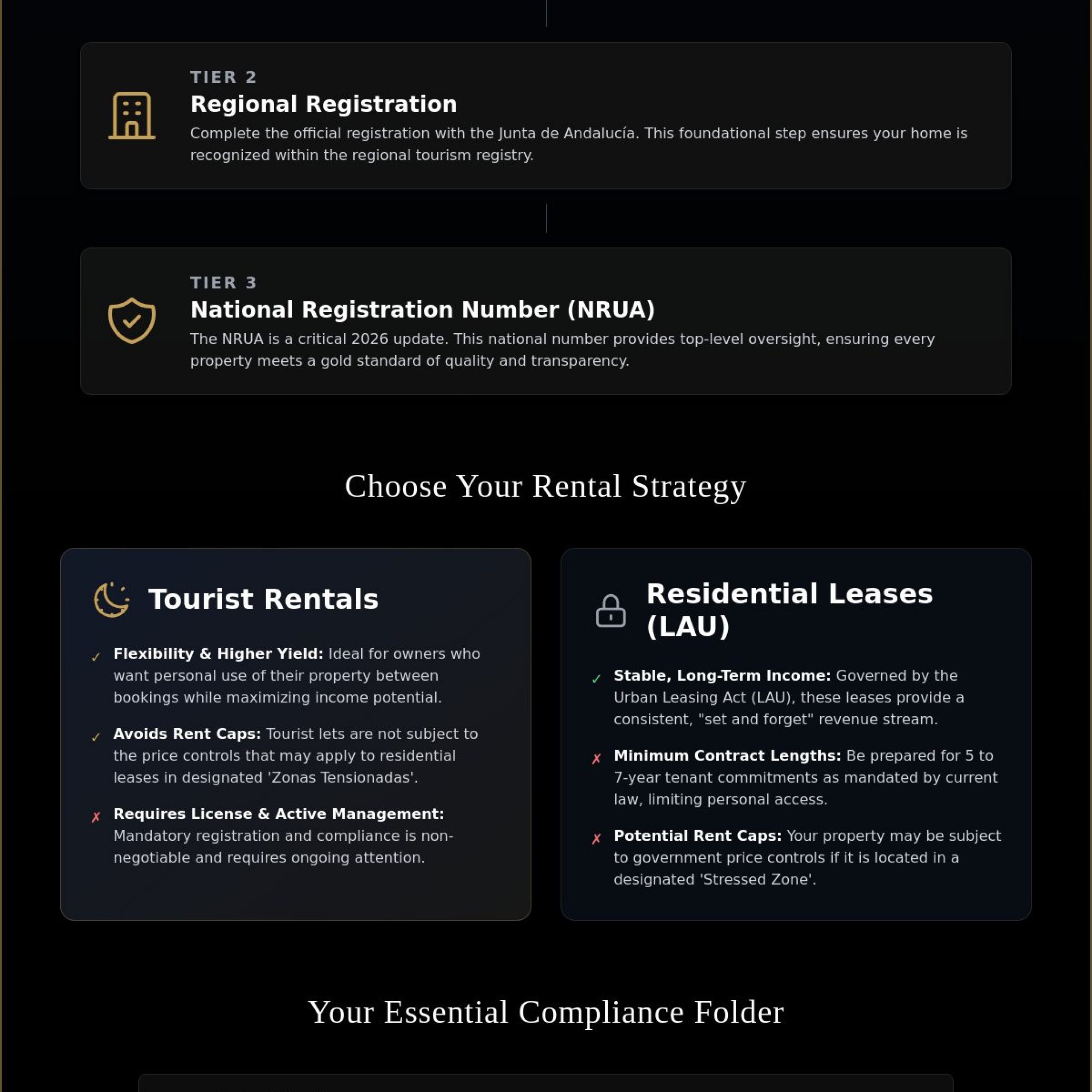
Choosing the right lease structure depends entirely on your personal lifestyle goals and financial objectives. Short-term tourist rentals offer flexibility, but they require you to follow the correct path for getting a tourist licence for your property on the Costa del Sol. Residential leases, governed by the Urban Leasing Act (LAU), offer more stability but less personal access to the home.
The emergence of Zonas Tensionadas, or Stressed Zones, is a defining feature of the 2026 rental market. These areas allow municipalities to cap rent increases on long-term residential contracts to protect local housing accessibility. If your property is located in a designated stressed zone, a tourist licence might offer a more dynamic path to profitability without the constraints of residential price controls.
Ultimately, your choice should reflect how often you wish to enjoy the property yourself. Holiday lets allow for frequent personal use between bookings, keeping the spirit of your Mediterranean home alive. Long-term leases provide a “set and forget” income stream, provided you are comfortable with the five to seven-year minimum contract lengths mandated by current law.
Essential Documentation and Licensing for Compliance
Securing your investment begins with a meticulous legal foundation. Curating a complete legal folder isn’t merely a bureaucratic chore; it’s a strategic advantage that accelerates guest onboarding and simplifies your administrative life. This organized approach reassures both authorities and high-caliber tenants of your property’s prestige.
The cornerstone of this folder is the Nota Simple. This document provides an up-to-date snapshot of the Property Registry, confirming you hold clear title and highlighting any existing charges. Unlike older title deeds, a fresh Nota Simple proves your current standing and is essential for any official audit.
Transparent utility contracts are equally vital for the 2026 audit season and the mandatory Annual Informative Return. Keeping water and electricity accounts active and in your name provides clear evidence of a property’s operational status. For those seeking bespoke legal assistance, the path to compliance becomes a refined experience rather than a hurdle.
When getting a tourist licence for your property on the Costa del Sol, you must first complete the official registration for tourist properties through the Junta de Andalucía. This foundational step ensures your home is recognized within the regional tourism registry, a prerequisite for all subsequent legal milestones.
The Energy Efficiency Certificate (CEE)
The Energy Efficiency Certificate (CEE) is now a non-negotiable requirement for all Spanish rentals in 2026. This document ranks your home’s energy consumption on a scale from A to G, reflecting its environmental footprint. A high rating does more than satisfy the law; it appeals to the growing segment of eco-conscious, premium travelers.
Displaying this rating is mandatory in all property advertisements. Failure to include the certificate’s details can result in significant financial penalties during routine inspections. It’s a small but powerful detail that enhances your property’s marketability and demonstrates your commitment to quality standards.
Habitation Licenses and the NRUA Number
Safety and habitability are certified through the Cédula de Habitabilidad or the Licencia de Primera Ocupación. This document proves the property meets the essential technical requirements for human residence. Without it, getting a tourist licence for your property on the Costa del Sol is virtually impossible.
A critical update for 2026 is the mandatory use of the NRUA (National Registration Number), a system active since July 2025. You must display this unique number on all online platforms like Airbnb and Booking.com to remain visible. Navigating these regional and national nuances often requires a steady hand and local expertise.
Engaging a professional guide ensures that your specific municipality’s requirements, such as Fuengirola’s €200 municipal fee, are handled correctly. This proactive approach gives you the freedom to enjoy the rewards of your investment with absolute peace of mind.
Drafting Robust Rental Contracts Under the LAU
The Urban Leasing Act, known locally as the LAU, serves as the legal heartbeat of the Spanish rental market. Even if your primary focus is short-term stays, understanding this framework is crucial for any owner looking to maximize their property’s potential. A precisely drafted contract transforms a simple transaction into a secure, professional arrangement.
Relying on informal verbal understandings is a risk that sophisticated investors simply don’t take. A written agreement provides the definitive record of expectations, protecting your interests and your home. It’s the essential bridge between a casual let and a high-end boutique experience.
While getting a tourist licence for your property on the Costa del Sol is the primary goal for many, a robust contract remains your ultimate security. High-quality imagery is your best ally when it comes to asset preservation. We recommend attaching a comprehensive inventory list, supported by professional photographs, to every contract.
This practice ensures that the pristine condition of your villa or penthouse is documented and respected by every guest. It sets a standard of excellence from the very beginning of the relationship. Clear documentation prevents disputes and maintains the prestige of your Mediterranean sanctuary.
Key Clauses to Protect Your Investment
Modern lease agreements must account for the five-year minimum duration for individual landlords. If you anticipate needing the property for yourself or a close family member, the right to reclaim clause must be explicitly included. Without this specific wording, you may find your personal access restricted regardless of your circumstances.
In 2026, the emergence of Zonas Tensionadas adds another layer to contract preparation. If your property falls within these stressed zones, rent increases are subject to specific caps that must be reflected in the lease terms. Navigating these nuances is just as vital as getting a tourist licence for your property on the Costa del Sol.
Clear financial boundaries prevent future friction. Your contract should specify exactly how utilities, community fees, and the IBI are distributed. For those who value absolute certainty, seeking bespoke legal assistance ensures your contracts are both compliant and protective.
Tax Obligations for Resident and Non-Resident Landlords
Financial stewardship is the quiet guardian of your Spanish investment. While the sun and sea provide the allure, a robust tax strategy ensures your peace of mind remains undisturbed. In Spain, your tax regime depends entirely on your residency status, creating two distinct paths for owners.
Residents contribute via IRPF, while international owners are governed by IRNR. Both paths require a proactive approach to maintain your standing with the Spanish Tax Agency. Achieving full fiscal transparency is a cornerstone of getting a tourist licence for your property on the Costa del Sol.
Tax compliance is more than a legal hurdle; it’s a prerequisite for long-term security. It protects your asset’s value and smoothens the path for any future sales or legacy transitions. Filing deadlines have shifted recently to offer more streamlined reporting for international property owners.
Non-resident owners now file their Modelo 210 annually by January 20th, a significant change from the previous quarterly requirement. Professional fiscal guidance is a necessity for optimizing your position in this evolving market. If you need expert legal assistance to navigate these waters, our team is ready to provide a bespoke solution.
Declaring Income and Deductible Expenses
Maximizing your yield involves a deep understanding of what you can legally offset against your earnings. Common deductible expenses include mortgage interest, property insurance, and essential maintenance costs that keep your home in pristine condition. These deductions are vital for maintaining a healthy bottom line.
EU and EEA residents currently enjoy a 19% tax rate on net rental income, allowing for these significant deductions. In contrast, non-EU residents are taxed at 24% on gross income without the ability to offset operating costs. This distinction makes professional advice essential for international investors from outside the Union.
For those considering long-term leases, the 2026 landscape offers attractive tax reductions that reward stability. These incentives are designed to support the local housing market while providing owners with a reliable income stream. Staying compliant ensures that the journey of getting a tourist licence for your property on the Costa del Sol remains a rewarding experience.
The Role of Professional Property Management
Professional management acts as the vital bridge between the abstract world of legal theory and the tangible reality of a successful rental. While the paperwork provides the foundation, it is the daily stewardship that transforms a property into a sanctuary for discerning guests. A boutique agency ensures that every detail is managed with the same level of care you’d provide yourself.
Local expertise is particularly valuable when regional updates occur, as a team on the ground can pivot more efficiently than a remote owner. Getting a tourist licence for your property on the Costa del Sol is just the beginning of a much larger journey. Rigorous tenant vetting serves as your first line of defense, preventing legal disputes before they ever have the chance to start.
Trusting your keys to a dedicated professional means your investment is never left to chance. This relationship-driven approach prioritizes the long-term health of your asset over short-term gains. It’s the difference between a simple rental and a professionally curated hospitality experience.
Maintenance and Key Holding as Asset Protection
Regular property maintenance is more than just an aesthetic choice; it’s a legal obligation under Spanish law to provide a habitable and safe home. Consistent care ensures that your villa or penthouse remains in peak condition, preserving its long-term market value. Professional oversight identifies minor issues before they become costly repairs, protecting your capital investment.
Key holding services offer indispensable peace of mind for international owners who can’t be present for every check-in or emergency. Knowing that a trusted advisor is nearby to handle guest requests or property inspections allows you to enjoy the benefits of ownership without the stress. This level of service is what defines the boutique experience for high-end investors.
How KEYS property group Supports Your Journey
With 20 years of experience in facilitating life-changing property transitions, we understand the nuances of the Mediterranean market. Our end-to-end support covers everything from specialized legal assistance for getting a tourist licence for your property on the Costa del Sol to meticulous property maintenance. We act as your essential bridge to the local landscape, ensuring every transaction is seamless.
We invite you to explore the vibrant culture and things to do in malaga city spain to better understand the lifestyle your guests will enjoy. This insight helps you position your property within the premium market, attracting visitors who value quality and authenticity. Your success is our priority, and we’re dedicated to ensuring your investment remains a source of pride and profit.
Embracing the Future of Costa del Sol Rentals
Navigating the 2026 rental landscape requires a blend of local passion and rigorous legal precision. By mastering the three-tier licensing system and ensuring absolute tax transparency, you transform your Mediterranean home into a secure, high-yield asset. These essential steps protect the prestige of your property while providing the peace of mind you deserve.
Getting a tourist licence for your property on the Costa del Sol marks the start of a rewarding journey into the heart of Spanish hospitality. With robust contracts and meticulous property maintenance, your investment becomes a legacy that stands the test of time and regulation. You don’t have to walk this path alone.
With over 20 years of local expertise, we provide a boutique service tailored specifically to the needs of international investors. From end-to-end legal assistance to specialized key holding and maintenance, we act as your trusted guide on the coast. Secure your investment with professional Spanish property management today.
Your dream of a successful, compliant rental is within reach. We look forward to helping you unlock the full potential of your home in the sun.
Frequently Asked Questions
Do I need a special license to rent out my property in Spain?
Yes, any property offered for short-term holiday stays must be registered with the Tourism Registry of Andalusia to receive a VFT license. Since July 2025, you also need a National Registration Number (NRUA) to advertise on digital platforms like Airbnb or Booking.com.
This dual-layered approach ensures your property meets regional safety standards and national transparency requirements. Long-term residential rentals don’t require these specific tourist permits but must follow the Urban Leasing Act (LAU).
What is the difference between short-term and long-term rental laws?
Short-term rentals are typically defined as stays under 60 days and require getting a tourist licence for your property on the Costa del Sol. These are governed by regional tourism decrees that mandate specific furniture and cooling standards.
Long-term rentals are residential in nature and fall under the LAU, which provides tenants with a minimum of five to seven years of stability. These contracts don’t require tourist registration but are subject to different tax incentives and potential rent caps in stressed zones.
How much tax do non-residents pay on rental income in Spain?
Non-residents from the EU or EEA pay a flat rate of 19% on their net rental income. This allows you to deduct eligible expenses like maintenance and insurance to lower your overall liability.
International owners from outside the EU are taxed at 24% on their gross income without the possibility of deducting costs. It’s essential to file your Modelo 210 annually by the January 20th deadline to remain in good standing.
Can I evict a tenant if they stop paying rent?
You can initiate an eviction process, known as desahucio, if a tenant breaches the contract by failing to pay. This process must be handled through the Spanish court system rather than through personal action.
Having a robust, written contract is your best defense in these situations. It provides the legal evidence needed to protect your property rights and expedite the court’s decision in your favor.
Is the Energy Efficiency Certificate mandatory for all rentals?
Yes, the Energy Efficiency Certificate (CEE) is a mandatory requirement for all properties listed for rent in 2026. This document ranks your home’s energy consumption from A to G and must be valid for ten years.
You are legally required to display the energy rating in all advertisements and marketing materials. Failure to provide this certificate can result in significant fines during routine inspections by regional authorities.
What expenses can I deduct from my rental income tax?
EU and EEA residents can deduct a wide range of costs, including mortgage interest, property management fees, and essential repairs. You can also offset the costs of utilities, community fees, and IBI property taxes.
Non-EU residents generally aren’t permitted to make these deductions and must pay tax on the total amount of rent received. This makes professional fiscal advice vital for international investors looking to optimize their returns.
What happens if I rent out my property without a license?
Renting without the proper permits exposes you to heavy financial penalties that can reach up to €600,000 for serious infractions. Getting a tourist licence for your property on the Costa del Sol is the only way to ensure your business remains legal.
Major booking platforms now verify NRUA numbers and will automatically remove unverified listings from their sites. Operating outside the law risks your reputation and the long-term security of your Mediterranean investment.
How has the 2026 legislation changed for Spanish landlords?
The most significant change is the full integration of the three-tier licensing system, which requires regional, national, and guest registration. Landlords must also file an Annual Informative Return detailing all rental activity from the previous year.
Additionally, community owners now have more power to restrict new tourist rentals within their buildings through a 3/5 majority vote. These updates reflect a broader national move toward professionalizing the short-term rental market and ensuring sustainable tourism.
Properties in Getting a Tourist Licence for Your Property on the Costa del Sol: A 2026 Guide