
Ongoing Costs of Owning Property in Spain: A Complete 2026 Guide
Did you know that the annual IBI tax for a Spanish home can vary by as much as 0.8 percent depending solely on which municipality you choose? It’s natural to feel a sense of unease about hidden taxes or the complexities of managing the ongoing costs of owning property in Spain from thousands of miles away.
Many owners worry that unexpected special levies or shifting utility rates might disrupt their Mediterranean dream. This 2026 guide provides a definitive breakdown of ownership expenses, ensuring you can master your budget with total professional confidence.
We remove the guesswork by detailing the latest 19 percent non-resident tax rates and updated waste management fees. You will also learn how proactive maintenance and professional oversight protect your investment value while you are away.
Key Takeaways
- Navigate the complexities of local and state taxes with a clear breakdown of IBI and non-resident obligations.
- Build a reliable financial plan by mastering the ongoing costs of owning property in Spain, including the latest 2026 utility and community fee structures.
- Protect your asset’s long-term value through strategic maintenance schedules and comprehensive insurance coverage tailored to the Spanish market.
- Simplify your administrative burden by understanding the role of professional fiscal representation and specialized banking services.
- Gain peace of mind with a realistic budgeting framework that accounts for the unique operational needs of villas, townhouses, and apartments.
Recurring Taxes for Spanish Property Owners
Understanding the fiscal landscape is essential for any homeowner. Spanish property taxes are divided between municipal and state authorities; this creates a dual-layer obligation for owners.
Your residency status determines which specific forms you’ll file. While residents pay income tax on global earnings, non-residents face specific levies on their Spanish assets that must be managed annually.
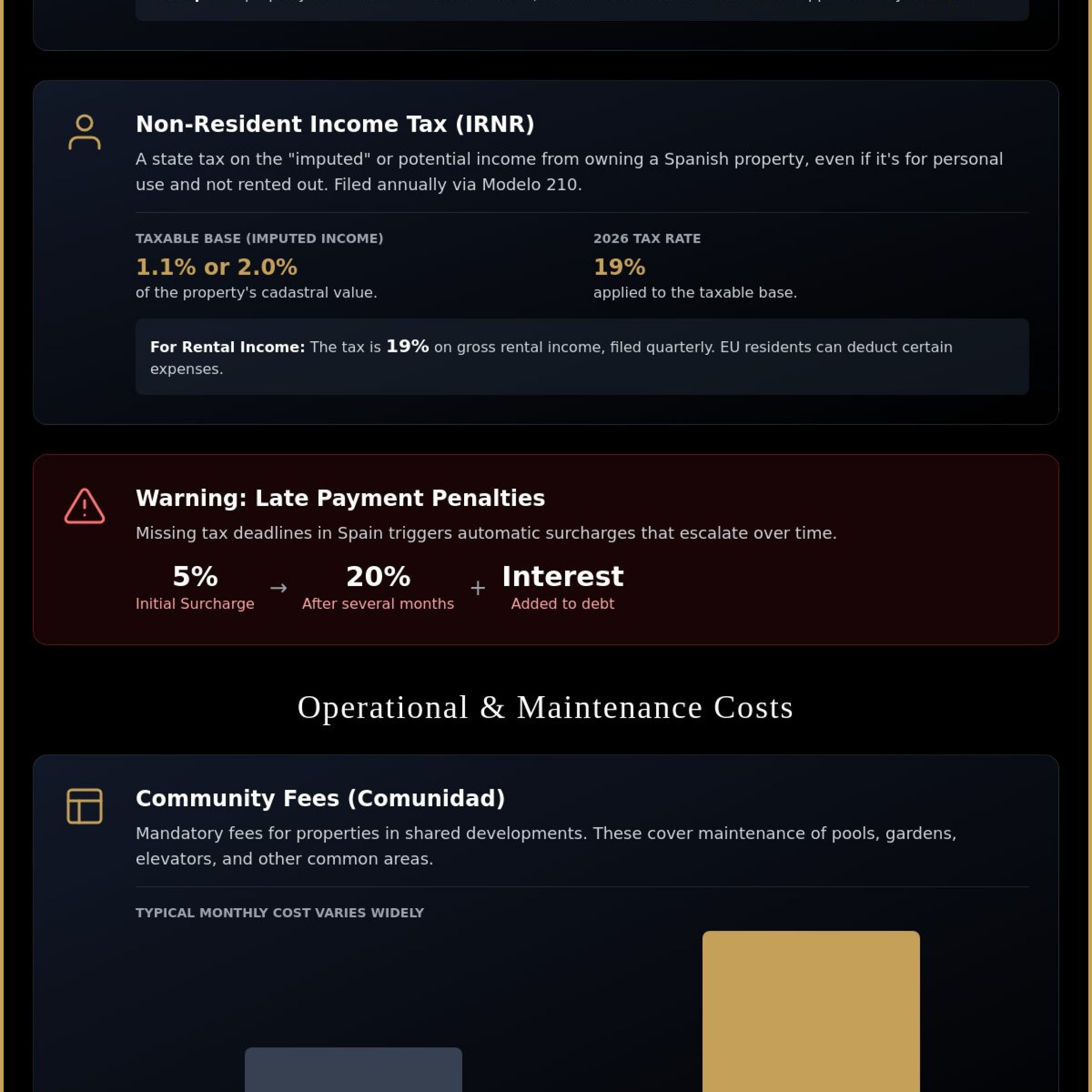
Missing a tax deadline isn’t just a minor oversight. Late payments trigger immediate surcharges starting at 5 percent, which can climb to 20 percent plus interest if the debt remains unaddressed for several months.
Proactive budgeting for these payments is the most effective way to manage Spanish property taxes and the total ongoing costs of owning property in Spain. It ensures your investment remains legally compliant and free of unexpected liens.
Local Property Tax (IBI)
IBI (Impuesto sobre Bienes Inmuebles) is the most consistent annual expense you’ll encounter. It is a municipal tax paid by every property owner regardless of where they officially reside.
This amount is calculated using the valor catastral. This is an administrative value set by the local town hall that is usually significantly lower than the actual market price of your home.
Expect rates to range between 0.3 percent and 1.1 percent depending on your specific municipality’s policies. Most town halls issue these bills between September and November each year, and many offer small discounts for setting up a direct debit.
For a property with a cadastral value of €120,000, the annual IBI could be around €720. This varies by region, so it’s vital to check the specific rate for your town hall before finalizing your budget.
Non-Resident Income Tax (Modelo 210)
Non-residents must also account for the Impuesto sobre la Renta de no Residentes (IRNR). This state tax applies even if your property sits empty for part of the year or is only for personal use.
The Spanish government taxes you on a “fictitious” benefit derived from owning a second home. This imputed income is typically calculated as 1.1 percent or 2 percent of the property’s valor catastral.
In 2026, the tax rate applied to this amount is 19 percent for both EU and non-EU residents. You must file this return, known as Modelo 210, by December 31st for the preceding calendar year.
If you choose to rent out your home, the tax structure changes to reflect actual earnings. You’ll pay 19 percent on gross rental income, filed quarterly, though EU residents may deduct certain property-related expenses to reduce their liability.
Navigating these requirements can feel daunting from abroad. Securing professional Legal assistance ensures you remain compliant while enjoying your new Mediterranean lifestyle.
Clear financial planning prevents small administrative errors from turning into costly legal hurdles. Staying informed about these ongoing costs of owning property in Spain is the key to long-term investment security.
Operational Costs: Community Fees and Utilities
Beyond the annual property taxes in Spain discussed previously, owners must account for the daily operational requirements of their home. These ongoing costs of owning property in Spain blend fixed monthly commitments with variable consumption rates that require careful oversight.
Managing these expenses efficiently ensures your Mediterranean retreat remains a source of joy rather than a financial burden. Understanding the difference between mandatory community contributions and flexible utility usage is the first step toward a balanced budget.
Understanding Community of Owners (Comunidad)
If your home is part of a shared development, apartment block, or gated complex, you’ll be part of a Comunidad de Propietarios. These mandatory fees fund the maintenance of shared infrastructure like swimming pools, elevators, and manicured gardens.
The cost is determined by your “cuota,” which is a participation coefficient based on your property’s size relative to the entire complex. Monthly fees vary significantly, typically ranging from €40 for basic buildings to over €450 for elite luxury resorts with extensive amenities.
Owners are legally required to pay these fees regardless of how often they use the property. It’s also wise to budget an extra 10 percent for a “derrama,” which is a special levy voted on by the community for unexpected major repairs or improvements.
Utility Connections and Consumption
Utility bills in Spain typically consist of a fixed standing charge, known as the potencia, plus your actual consumption. For electricity, the Spanish government reinstated the full 21 percent VAT in 2026, which has led to a noticeable increase in monthly energy bills.
Water bills are often issued quarterly and include a small fixed fee to maintain the connection even when the taps aren’t running. You should also budget for the Tasa de Basura, a municipal waste collection fee that now averages between €120 and €180 per year following recent updates to Law 7/2022.
For luxury villas, this waste tax can sometimes exceed €400 depending on the specific municipality. Most owners also find that high-speed fiber internet and a monitored security alarm are standard monthly outgoings that provide essential peace of mind while away.
If you’re currently browsing new developments in Spain, remember to ask for a breakdown of projected community fees to help finalize your annual budget. Managing these ongoing costs of owning property in Spain through a local bank account is the most reliable way to ensure all payments are made on time.
Staying informed about these operational shifts allows you to enjoy the lifestyle benefits of Spanish ownership without any administrative surprises. Clear financial oversight is the hallmark of a well-managed international property investment.
Protecting Your Investment: Maintenance and Insurance
Maintaining a property in the Mediterranean climate requires a proactive approach. While mandatory taxes provide the legal framework for ownership, consistent physical upkeep acts as the heartbeat of your investment’s health.
Regular attention ensures that minor environmental wear doesn’t transform into a significant financial burden. This strategic oversight is a defining element of the ongoing costs of owning property in Spain.
Essential Property Maintenance Services
Technical systems in Spanish homes work hard throughout the year. Annual servicing for air conditioning and boiler units is a small investment that prevents total system failure during extreme seasonal shifts.
If you own a villa or a townhouse, your exterior spaces demand specialized care. Garden and pool maintenance costs fluctuate based on the size of your plot and the specific flora you choose to cultivate.
Professional property maintenance is particularly valuable for non-resident owners. A dedicated key holding service ensures someone is on hand to inspect the property after heavy rains or to grant access for necessary repairs.
This expert presence acts as an early warning system for issues like dampness or pest activity that can thrive in closed properties. It provides the peace of mind that your sanctuary is being looked after by local specialists who understand Spanish construction.
Home and Civil Liability Insurance
Securing a comprehensive insurance policy is a non-negotiable step for protecting your equity. Multi-risk home insurance offers a broad shield against fire, flood, and theft, which are critical considerations for vacant second homes.
Civil liability coverage is a vital component of these policies. It safeguards you against legal and financial fallout if an accident occurs on your premises, covering both guests and third-party workers.
This protection is especially relevant if you plan to offer your property for short-term holiday rentals where liability risks are naturally higher. Your annual premium will reflect the property’s replacement value and its geographic location.
High-end security features, such as monitored alarms and reinforced entry points, often help reduce these recurring expenses. Many Spanish insurers provide discounts for homes located within gated communities with security patrols.
Budgeting for high-quality insurance ensures you aren’t left vulnerable to the unpredictable. It is a cornerstone of the ongoing costs of owning property in Spain that supports a stress-free lifestyle.
Administrative and Professional Representation Fees
Managing an international asset involves more than just paying the bills; it requires administrative diligence. Professional oversight acts as a vital buffer against shifting local regulations and complex Spanish bureaucracy.
These administrative elements are subtle but essential ongoing costs of owning property in Spain. They ensure your ownership status remains untarnished by errors while providing you with the quiet confidence of a well-managed investment.
Fiscal Representation and Legal Support
A fiscal representative serves as your local liaison with the Spanish Tax Agency. They handle your annual tax filings and monitor your electronic mailbox for official government notifications that might otherwise go unseen.
This service is particularly important for non-residents who don’t reside in Spain year-round. Understanding the property buying process in Spain helps clarify how these legal roles evolve from the initial purchase into long-term support.
Without this expert oversight, small tax debts can accumulate interest or even lead to administrative bank account freezes. A dedicated representative ensures every obligation is met well before the December 31st deadline, protecting your peace of mind.
Banking and Currency Exchange Considerations
Spanish banks utilize specific fee structures that may differ from your home country. Non-resident accounts often incur quarterly maintenance charges that can be significantly higher than those in other European nations.
Currency fluctuations represent a hidden variable for owners from outside the Eurozone. A sudden shift in exchange rates can quietly increase the real-world cost of your mortgage payments or annual maintenance fees.
Utilizing a specialized currency exchange service instead of a standard bank transfer can save substantial sums over time. These specialists offer more competitive rates and lower fees for the regular movement of funds required for property upkeep.
Planning for these international transfer fees is a sophisticated way to manage your budget. It prevents small “leakages” from your capital while ensuring your Spanish bills are always settled in the local currency without delay.
If you need help managing these administrative obligations, our team provides expert Legal assistance to keep your investment on track and compliant.
Securing professional representation is a hallmark of the successful international owner. It transforms a complex administrative burden into a streamlined, professional process that supports your new Mediterranean lifestyle.
Budgeting for Your Spanish Lifestyle in 2026
Creating a comprehensive financial plan is the final step in securing your Mediterranean future. A well-structured budget prevents surprises during the Spanish tax season and ensures your investment remains a source of relaxation.
While previous sections detailed specific levies and fees, viewing these expenses as a unified percentage helps simplify your long-term planning. This holistic approach allows you to focus on the lifestyle benefits of ownership rather than administrative details.
Estimating Your Total Annual Outgoings
Your budget consists of fixed obligations and variable consumption costs. Fixed expenses include the IBI tax, home insurance, and the standing charges required to keep your utility connections active while you’re away.
Variable costs fluctuate based on your property usage, community “derrama” repairs, and professional management fees. Generally, the total ongoing costs of owning property in Spain typically range between 1 percent and 3 percent of the property’s value each year.
Standalone villas usually sit at the higher end of this scale due to private pool and garden maintenance. Conversely, modern apartments often benefit from shared infrastructure costs, making them a more predictable option for lock-up-and-go owners.
Optimizing Costs for Long-Term Ownership
Strategic upgrades can significantly lower your monthly operational expenses. With the reinstatement of the full 21 percent VAT on electricity in 2026, investing in energy-efficient climate control or solar solutions provides a high return on investment.
Professional key holding is another essential tool for cost optimization. Regular property checks prevent minor leaks or maintenance issues from escalating into expensive emergency repairs that could disrupt your budget.
It’s also beneficial to compare different property styles to see how their architectural features impact recurring fees. You can review our latest listings to analyze how apartments, townhouses, and villas differ in their projected annual requirements.
Refining these estimates with local experts ensures your financial roadmap is as accurate as possible. Mastering the ongoing costs of owning property in Spain allows you to enjoy every sunset with the confidence that your investment is secure and well-managed.
Take Command of Your Spanish Investment
Mastering the ongoing costs of owning property in Spain is the final step in turning an aspirational dream into a sustainable reality. You now have a clear roadmap for managing municipal taxes, community obligations, and essential maintenance schedules with total confidence.
Realizing the full potential of your Mediterranean lifestyle relies on balancing these mandatory expenses with proactive, professional care. This disciplined approach ensures your property remains both a high-performing asset and a stress-free sanctuary for years to come.
Our team brings over 20 years of local real estate experience to your side, offering independent expert advice on Spanish property law. We specialize in comprehensive post-sale maintenance and key holding to ensure your home is perfectly preserved throughout every season.
Contact KEYS property group for expert property management support and let us streamline your ownership experience. Your journey toward a rewarding Spanish lifestyle is well within reach, and we’re here to bridge the gap between your goals and practical success.
Frequently Asked Questions
How much is the annual property tax (IBI) in Spain for 2026?
IBI rates range from 0.3 percent to 1.1 percent of the cadastral value as set by your local municipality. For a property with a cadastral value of €120,000, you can expect an annual bill of approximately €720.
This tax is typically due between September and November each year. Town halls often apply a 5 percent surcharge immediately for any late payments, which can eventually increase to 20 percent.
Do I have to pay taxes in Spain if I do not rent out my property?
Yes, non-resident owners must pay an imputed income tax even if the property is for personal use only. This is one of the essential ongoing costs of owning property in Spain.
The tax is calculated as 19 percent of a small percentage of the cadastral value. It must be filed by December 31st each year for the preceding year using the Modelo 210 form.
What are the average community fees for an apartment in Spain?
Average fees vary significantly based on amenities, ranging from €40 for basic buildings to €450 for luxury resorts. An apartment with a shared pool and gardens typically costs between €80 and €150 per month.
These fees cover essential services like communal lighting and elevator maintenance. They also fund professional landscaping to ensure the complex remains in peak condition for all residents and guests.
Is it mandatory to have a fiscal representative as a non-resident owner?
No, it is not legally mandatory for all owners, but appointing a fiscal representative is the most reliable way to ensure compliance. They act as a local point of contact for the tax authorities.
This service provides peace of mind by preventing late payment surcharges. It also ensures you receive all official government notifications promptly to avoid administrative complications or bank account freezes.
How much should I budget for home insurance in Spain?
Budget between €180 and €300 per year for a standard apartment policy covering basic risks. Multi-risk policies for larger villas typically range from €500 to €1,200 annually depending on the specific coverage limits.
These policies are vital for managing the ongoing costs of owning property in Spain. They protect your equity against fire, flood, or theft incidents while providing essential civil liability coverage for your guests.
Can I pay my Spanish property taxes from a foreign bank account?
While technically possible via international transfer, it is highly recommended to use a Spanish bank account for all property-related payments. Most utility companies require a local IBAN for automated direct debits.
This setup prevents service disconnections and ensures all mandatory deadlines are met. It removes the need for manual bank transfers and ensures all tax bills are settled before surcharges are applied.
What happens if I fail to pay my community fees?
Unpaid fees can lead to a formal legal claim and a lien being placed against your property by the Community of Owners. Spanish law grants communities significant power to recover debts from owners.
This process can eventually result in a court-ordered public auction of the property to settle the debt. Keeping these payments current is essential for maintaining your legal standing and investment security.
Are utility costs in Spain higher than in the UK or Northern Europe?
Utility costs in Spain are generally competitive, although the reinstatement of the full 21 percent VAT on electricity in 2026 has increased bills. Standing charges are often lower than in the UK.
Heavy use of air conditioning during summer months can lead to higher seasonal consumption. Investing in energy-efficient climate control systems is the best way to manage these variable operational expenses.
Properties in Ongoing Costs of Owning Property in Spain: A Complete 2026 Guide