
IBI Tax for Non-Residents Explained: A 2026 Guide to Spanish Property Ownership
Your Spanish sanctuary is more than just an escape; it’s a curated investment that thrives on the local infrastructure your contributions sustain. You likely prioritize the peace of mind that comes with a legally secure home, yet the nuances of Spanish bureaucracy can feel like a shadow over your Mediterranean lifestyle. This is why having the IBI tax for non-residents explained is the first step toward safeguarding your slice of paradise.
We’ve designed this 2026 guide to offer a sophisticated overview of Spain’s local property tax, ensuring your international portfolio remains compliant and your lifestyle stays uninterrupted. Our bespoke approach aims to replace confusion with total clarity, providing you with the confidence that your sanctuary is fully protected from municipal penalties or bank embargos.
We’ll walk you through current municipal rates, provide a roadmap for seamless payments, and clarify the vital differences between local levies and national income taxes. You’ll discover how to navigate these obligations with the same elegance you bring to your property’s design, ensuring your investment remains a source of joy rather than a bureaucratic burden.
Key Takeaways
- Understand the mandatory nature of the Impuesto sobre Bienes Inmuebles (IBI) for all property owners, regardless of residency status.
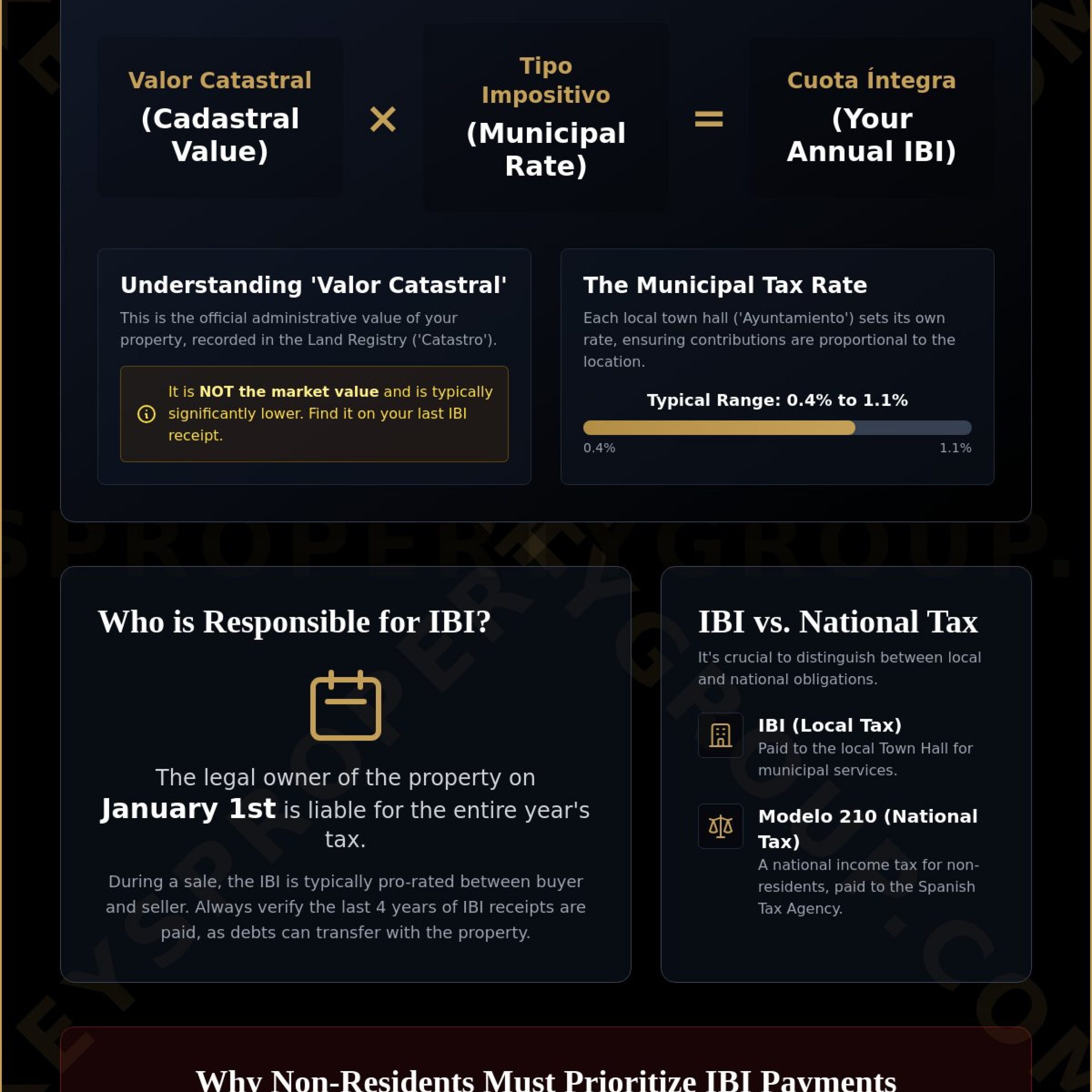
- Learn how your local municipality uses the ‘Valor Catastral’ to determine your annual contribution, typically ranging from 0.4% to 1.1%.
- Distinguish between local IBI and national income taxes like Modelo 210 to ensure your Spanish sanctuary remains fully compliant.
- Having the IBI tax for non-residents explained allows you to master the payment calendar and avoid municipal penalties through seamless direct debits.
- Discover how bespoke property maintenance and legal assistance can transform complex bureaucracy into a worry-free ownership experience.
Understanding IBI: The Essential Local Property Tax in Spain
Owning a villa or a penthouse in Spain is an invitation to a refined lifestyle, yet it comes with specific civic duties that ensure your surroundings remain pristine. The Impuesto sobre Bienes Inmuebles (IBI) serves as the cornerstone of these obligations. It’s the primary local tax levied on all property owners, regardless of whether you call Spain your permanent home or a seasonal retreat.
Think of this contribution as more than just a fiscal requirement; it’s an investment in the local infrastructure that preserves your property’s value. These funds directly support public safety, manicured local parks, and the seamless maintenance of the streets leading to your front door. Having the IBI tax for non-residents explained helps you see it as a curated way to sustain the sanctuary you’ve built.
By contributing to the municipal budget, you’re actively participating in the preservation of the local charm and high standards that likely drew you to the region initially. This tax is mandatory for everyone, ensuring that the burden of maintaining the community is shared equitably among all who benefit from its beauty. It’s a small price to pay for the unparalleled quality of life found in Spain’s most exclusive enclaves.
Who is Responsible for IBI Payments?
In the eyes of the Spanish administration, the legal responsibility rests with the individual who holds the title on the first day of the calendar year. If you own the property on January 1st, you’re technically liable for the full annual amount in the eyes of the town hall. This clarity is essential for those acquiring new assets mid-year, as it sets a clear baseline for financial expectations.
During a property transfer, it’s standard practice to pro-rate the tax between the buyer and the seller based on the months of ownership. Our legal assistance team ensures that every cent is accounted for during the completion process, protecting your interests from the start. We always verify that no historical debts linger, as these liabilities often follow the property rather than the previous owner.
Failing to verify these records can lead to unpleasant surprises after you’ve already moved in. A thorough check of the last four years of receipts is standard protocol for a secure investment. This ensures your transition into Spanish property ownership is as smooth and sophisticated as the property itself.
Why Non-Residents Must Prioritize This Tax
Neglecting this local duty can lead to complications that disrupt the tranquility of your international lifestyle. The Spanish Tax Agency has increased enforcement, and unpaid local taxes can trigger surcharges that escalate quickly. In more severe cases, municipalities have the authority to place embargos on Spanish bank accounts to recover outstanding balances, which can be a distressing experience from abroad.
A clean tax record is also a prerequisite for a seamless transition when the time comes to sell or pass on your legacy. Prospective buyers and legal professionals will scrutinize your payment history to ensure the asset is legally secure and free of encumbrances. By staying current, you ensure your Spanish investment remains a source of pride and a stable pillar of your global portfolio.
Consistent payments demonstrate your commitment to the local community and simplify your annual tax filing process. It’s about more than just avoiding penalties; it’s about maintaining the integrity of your sanctuary. This proactive approach allows you to focus on the sensory experiences of Spanish living, from the vibrant sunsets to the calm coastal breeze.
Calculating Your Commitment: How IBI Tax is Determined
Determining your annual contribution is a precise exercise that relies on the administrative foundation of your Spanish home. The calculation is rooted in the ‘Valor Catastral,’ which is the official value recorded in the Spanish Land Registry. Having the IBI tax for non-residents explained requires understanding that this figure is distinct from the market price you paid for your villa or penthouse.
Each municipality across Spain possesses the autonomy to set its own specific tax rate. These rates generally fluctuate between 0.4% and 1.1% of the cadastral value. Because this administrative value is typically much lower than the actual market value, the resulting tax remains a manageable and predictable aspect of your luxury lifestyle.
This tiered system ensures that your contribution remains proportional to the scale and location of your investment. It allows local councils to maintain the high standards of service that define Spain’s most sought after residential areas. Understanding this math is key to ensuring your sanctuary remains a source of effortless joy.
Finding Your Property’s Cadastral Value
Locating this essential figure is a straightforward process for the discerning homeowner. You can find the exact amount on your most recent IBI receipt or by visiting the local Catastro office. It’s a vital piece of data for creating a bespoke financial plan that ensures your investment remains secure and transparent.
The government periodically updates these values to reflect the evolving urban landscape and regional developments. Staying informed about these shifts allows you to anticipate any minor adjustments in your annual obligations. It’s the first step in maintaining the seamless ownership experience you expect from a premium property portfolio.
Factors That Influence Your Annual Bill
Several physical and legal attributes define the final amount on your tax notification. The total square footage of the build, the size of your plot, and the specific classification of the land are all primary drivers. Even the prestige of your neighborhood can play a role if the municipality decides to reassess local values based on recent growth.
Local infrastructure improvements, such as new coastal promenades or refined public spaces, can occasionally trigger a reassessment of the cadastral value. However, many regions offer incentives like modest discounts for setting up direct debit payments or completing eco-friendly upgrades to your residence. If you’re looking for bespoke legal assistance to review your tax status, our team is ready to guide you through every detail.
IBI vs. Modelo 210: Clarifying the Non-Resident Tax Landscape
Owning a prestige villa or a coastal penthouse in Spain brings immense joy, but the tax landscape requires a discerning eye to navigate correctly. It’s a common misconception among international owners that paying your local IBI covers all your property-related obligations. While your IBI is a municipal levy, Modelo 210 represents your national commitment as a non-resident property owner.
The distinction lies in who receives the funds and what they represent for your investment. IBI is billed directly by your local Town Hall to maintain the immediate environment around your home. In contrast, Modelo 210 is a self-assessment filed with the central Spanish Tax Agency, known as Hacienda. Understanding this duality is essential for having the IBI tax for non-residents explained within the broader context of Spanish law.
Both taxes are vital pillars that support your status as a compliant and responsible property owner. Ignoring one while paying the other can lead to unexpected administrative hurdles that disrupt the peace of your Mediterranean sanctuary. The following table provides a clear comparison to help you distinguish between these two essential requirements.
| Feature | IBI Tax | Modelo 210 (IRNR) |
|---|---|---|
| Authority | Local Town Hall | Central Tax Agency (Hacienda) |
| Type | Municipal Property Tax | National Non-Resident Income Tax |
| Payment Method | Direct Debit or Bank Payment | Self-Assessment Filing |
The Role of Modelo 210 (IRNR)
This tax is paid annually by non-residents who don’t rent out their property, representing what is known as “imputed income.” Even if your home sits empty while you’re away, the Spanish state views the potential benefit of ownership as a taxable asset. Modelo 210 is calculated as a percentage of the property’s cadastral value.
If you choose to share your retreat with guests for a fee, the filing requirements become more frequent. In these instances, you must file Modelo 210 quarterly to declare that specific rental income and ensure full compliance. This proactive management keeps your investment secure and your lifestyle uninterrupted by fiscal inquiries.
Why You Cannot Ignore Either Tax
The Spanish Tax Agency and local Town Halls operate as independent guardians of the public purse, each with their own enforcement powers. Paying your local bill doesn’t satisfy the national requirement; they’re distinct legal pillars of property ownership. A curated approach to your property management ensures both are tracked and paid with unparalleled precision.
Failing to address both can lead to complications during future transactions, such as selling your property or arranging an inheritance. Maintaining a flawless tax record is the key to preserving the long-term value of your Spanish sanctuary. Our legal assistance team specializes in these nuances, ensuring every detail of your tax profile is managed with the sophistication it deserves.
Navigating the Calendar: Filing Deadlines and Payment Protocols
Managing a global property portfolio requires precision and an intimate understanding of local rhythms. While national taxes follow a rigid federal schedule, IBI payment windows are determined by individual municipalities, typically falling between August and November each year. This localized approach means that your specific deadline depends entirely on where your villa or penthouse is situated.
Having the IBI tax for non-residents explained means acknowledging that local councils still rely heavily on traditional communication methods. They often send a physical notification to your Spanish property address, which can be easily missed if you are currently residing in London, Dubai, or the Cayman Islands. Relying on the post is a risk that sophisticated investors don’t need to take.
A missed letter should never be the reason your Mediterranean sanctuary faces administrative scrutiny or unnecessary penalties. The most elegant solution is to move beyond physical mail and embrace a more automated, reliable system. This ensures your focus remains on the lifestyle benefits of ownership rather than the logistics of local bureaucracy.
Automating Your Local Tax Payments
The most seamless way to handle these obligations is through a domiciliación bancaria, or direct debit. You can arrange this through your Spanish bank or directly at the local tax collection office, ensuring the municipality withdraws the funds automatically during the voluntary payment period. This method provides the ultimate peace of mind, allowing you to enjoy your home without tracking calendar dates.
To maintain this effortless flow, you simply need to ensure your Spanish account is sufficiently funded before the autumn window opens. This proactive step prevents technical failures and keeps your tax record pristine. It is the gold standard for international owners who value both their time and their property’s legal standing.
What Happens if You Miss a Deadline?
Precision is paramount because late payments trigger an immediate and automatic surcharge that grows the longer the debt remains outstanding. These penalties are designed to encourage promptness, but they can feel like an unnecessary burden on a well-managed investment. If a debt remains unaddressed, the local authority may escalate the matter by issuing a formal apremio.
An apremio is a notification of the government’s intent to seize funds directly from your Spanish bank accounts to cover the debt and associated costs. These complications are entirely avoidable with the right local partner overseeing your interests while you are away. Our bespoke property maintenance and key holding services act as your local eyes and ears, ensuring every notification is caught and every obligation is met with unparalleled precision.
By entrusting these details to experts, you bridge the gap between your global lifestyle and the specific requirements of Spanish law. This allows your sanctuary to remain a place of pure relaxation, free from the noise of municipal paperwork. Your investment deserves the same level of care and sophistication that you applied to its selection.
Seamless Ownership: Managing Your Spanish Tax Obligations with Confidence
Owning a prestige villa or a coastal penthouse in Spain is a dream realized, a personal sanctuary where the rhythm of life slows down. It shouldn’t be defined by the weight of administrative paperwork or the stress of municipal deadlines. Having the IBI tax for non-residents explained allows you to step back from the details and focus on the lifestyle you’ve earned.
At KEYS property group, we believe your international investment should remain a source of pure enrichment. Our bespoke management services handle the complexities of local taxes, from IBI to waste collection fees, with unparalleled precision. We bring 20 years of local expertise to your doorstep, ensuring your home is managed to the highest global standards.
Trusting a specialist ensures your investment is protected from the nuances of local bureaucracy. This proactive approach transforms property ownership from a list of tasks into a seamless experience. We’re dedicated to preserving the integrity of your sanctuary while you’re away, providing the peace of mind you deserve.
The Value of Boutique Property Management
We act as your dedicated eyes and ears on the ground, serving as a trusted advisor for every municipal obligation. Our boutique approach means you don’t need to be present to ensure your legal and fiscal standing remains flawless. From professional property maintenance to secure key holding, we curate an environment where your only task is to enjoy the view.
While we manage the fine details of your estate, you’re free to explore the vibrant culture and history of the region. You might choose to uncover the best things to do in malaga city spain during your next visit. This freedom is the true luxury of a well-managed property, allowing you to immerse yourself in the local lifestyle without distraction.
Our team understands that high-net-worth clients require a higher level of service and discretion. We provide a bridge between your global standards and the local requirements of the Spanish authorities. This ensures that every interaction with the town hall is handled with the sophistication your portfolio requires.
Your Next Steps for a Secure Investment
Securing your investment for the future starts with a clear understanding of your current standing. We recommend a thorough audit of your tax status to ensure both IBI and Modelo 210 obligations are fully met for the 2026 calendar year. A professional review provides the long-term peace of mind that your sanctuary is legally and fiscally secure.
Our legal assistance and property management teams are ready to provide a comprehensive analysis of your property’s health. We identify potential efficiencies and ensure that all records at the Land Registry and Catastro are perfectly aligned. This attention to detail is what sets a property managed by our team apart from the rest of the market.
Contact us today to discover how our curated services can simplify your property ownership journey. We’re here to unlock the potential of your Spanish home, providing the keys to a worry-free international lifestyle. Let us handle the bureaucracy so you can fully embrace the sanctuary you’ve created.
Securing Your Spanish Legacy with Confidence
Mastering your local tax obligations is the key to preserving the serenity of your Mediterranean sanctuary. Having the IBI tax for non-residents explained ensures you can distinguish between municipal duties and national requirements like Modelo 210 with absolute precision.
By automating your payments and understanding the cadastral foundation of your investment, you protect your villa or penthouse from the friction of local bureaucracy. This proactive stance allows you to focus on the sensory joys of coastal living rather than the logistics of tax calendars and physical notifications.
With over 20 years of local real estate expertise, we provide comprehensive support ranging from legal aid and currency exchange to bespoke key holding. Discover how KEYS property group can manage your Spanish investment with unparalleled care.
Your journey in Spain should be defined by the sunsets you witness and the memories you create. We’re here to ensure the foundation of your lifestyle remains as solid and enduring as the land itself.
Frequently Asked Questions
Is IBI tax the same as Council Tax in the UK?
IBI serves as the Spanish equivalent of UK Council Tax, acting as the primary source of funding for local municipal services. While the purpose is identical, the calculation differs because IBI is based on a property’s administrative value rather than the fixed valuation bands used in the United Kingdom.
Can I pay my IBI tax online if I am not in Spain?
You can easily manage your payments from abroad using online banking or dedicated municipal payment portals. Having the IBI tax for non-residents explained means recognizing that a direct debit is the most sophisticated way to ensure your obligations are met without needing to be physically present.
What is the difference between IBI and the ‘Basura’ (rubbish) tax?
IBI is a general tax on the ownership of the property itself, while the Basura tax is a specific fee for waste collection and treatment services. These are separate legal charges, though some municipalities may choose to issue them on a single, consolidated invoice for your convenience.
How much is IBI tax for a typical non-resident apartment?
The cost varies by location, as each town hall sets a rate between 0.4% and 1.1% of the property’s cadastral value. For a high-end apartment in a desirable coastal region, you might expect an annual bill ranging from €400 to €900, depending on the specific local municipality’s budget requirements.
What happens to the IBI tax if I sell my property mid-year?
The legal responsibility for the full year’s tax lies with whoever owns the property on January 1st. In practice, our legal assistance team ensures the cost is pro-rated between the buyer and seller during the completion process, so each party only pays for their period of ownership.
Do I still have to pay IBI if my property is empty for most of the year?
You must pay the full IBI amount regardless of whether your Spanish sanctuary is occupied or sits empty. Since this is a tax on the asset rather than a service charge based on usage, your residency status or the frequency of your visits won’t exempt you from the annual payment.
Can the cadastral value of my property change over time?
The government periodically revises these administrative values to reflect changes in the local urban environment or the broader real estate market. Additionally, if you undertake significant renovations or structural improvements to your villa, the local Catastro office may reassess and increase your property’s recorded value.
Is there a discount for paying IBI early in Spain?
Many local councils offer a small incentive, typically between 3% and 5%, for owners who settle their bill during the initial voluntary period. Setting up a direct debit is often the easiest way to secure these modest savings while ensuring your investment remains in perfect standing with the local authorities.
Properties in IBI Tax for Non-Residents Explained: A 2026 Guide to Spanish Property Ownership