
How to Open a Spanish Bank Account as a Non-Resident in 2026
What if the keys to your Mediterranean retreat were held back only by a few pages of misunderstood paperwork? You’ve likely felt the frustration of navigating complex bureaucracy or the unease of high-street banks that don’t quite speak your language.
It’s a common challenge for those seeking a boutique lifestyle in Spain, but learning how to open a Spanish bank account as a non-resident doesn’t have to be a burden. We believe your financial journey should be as seamless and refined as the property you intend to purchase.
This guide simplifies the process by detailing the essential documentation and the latest 2026 regulations you’ll need to navigate with confidence. You’ll discover how to secure a digital IBAN, manage international transfer fees, and avoid the monthly maintenance costs that often surprise the unprepared investor.
By the end of this article, you’ll have a clear path to a banking solution that treats your international transition with the prestige it deserves. We’ll explore everything from the €9.84 NIE assignment fee to the new legal requirements for instant euro transfers in the Spanish market.
Key Takeaways
- Understand the 183-day rule to define your tax residency and ensure you select the most advantageous account for your international lifestyle.
- Learn exactly how to open a Spanish bank account as a non-resident by preparing the precise financial and identity documents required by modern institutions.
- Evaluate the refined efficiency of digital “passport” accounts against the bespoke, face-to-face service found in traditional Spanish banking branches.
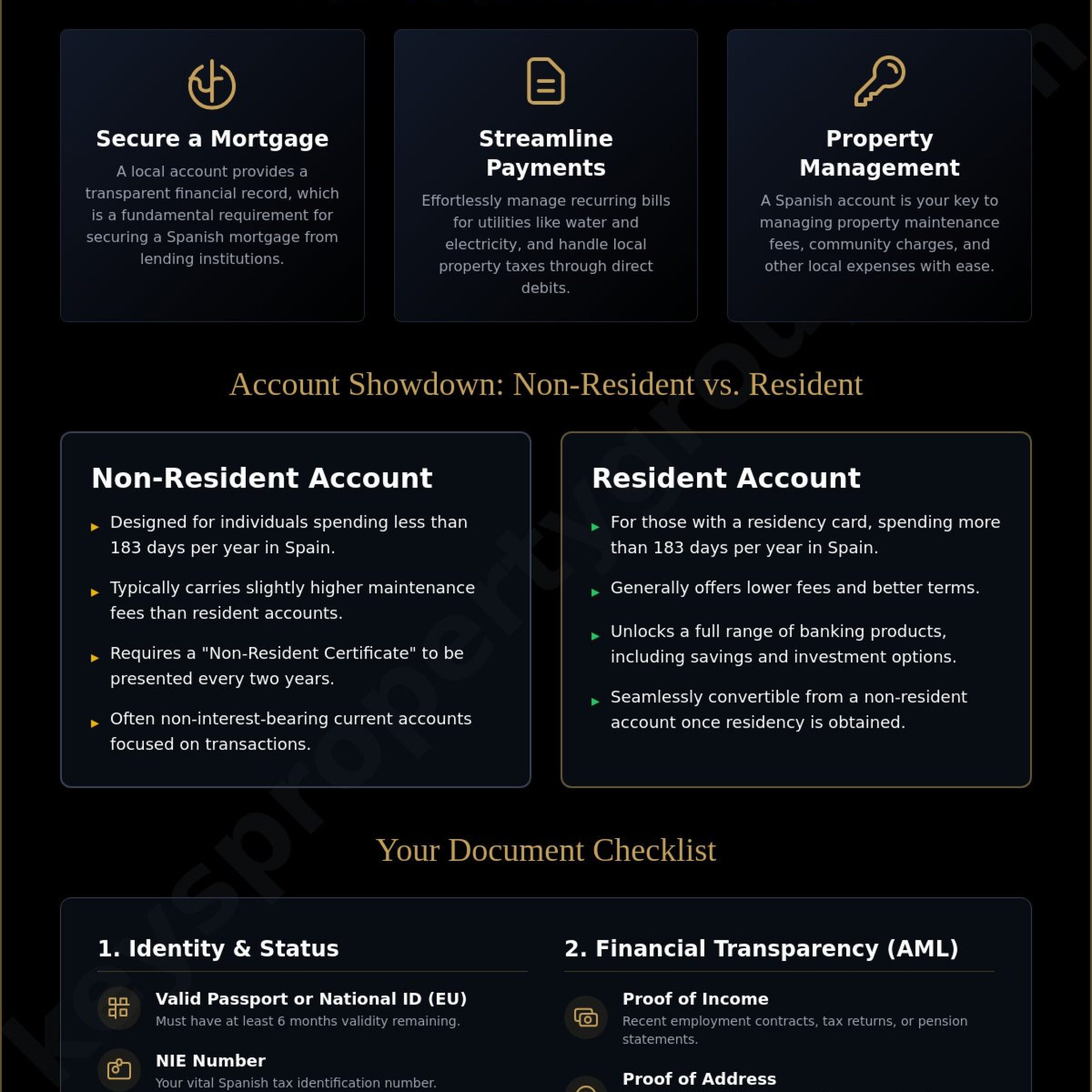
- Discover how your new account acts as the essential foundation for securing a Spanish mortgage and streamlining your property maintenance payments.
- Gain insights into the 2026 regulatory landscape to avoid hidden fees and enjoy the benefits of instant, cost-effective euro transfers.
Understanding the Essentials of Non-Resident Banking in Spain
A non-resident account is a specialized financial instrument designed for individuals who appreciate the Spanish lifestyle without making the country their permanent home. This type of account is typically a non-interest-bearing current account, serving as a secure gateway for managing your international capital and local expenses.
The primary factor that defines your status is the 183-day rule. If you spend fewer than 183 days within a calendar year in Spain, you are legally classified as a non-resident for tax purposes. Understanding this distinction is the first step in learning how to open a Spanish bank account as a non-resident while maintaining your global tax efficiency.
These specific accounts fall under the rigorous oversight of the Banco de España, the nation’s central bank. This regulatory framework ensures that your assets are protected by the same high standards applied to any major European financial institution.
The Strategic Role of a Local IBAN
While the Single Euro Payments Area (SEPA) aims to harmonize cross-border banking, many Spanish utility providers still require a local IBAN for direct debits. Without a Spanish account, settling recurring bills for water, electricity, or property taxes can become a complex administrative burden.
Beyond daily utilities, a local account is a fundamental requirement for those seeking to secure Spanish mortgages. It provides a transparent record of your financial commitment to the region, which is highly valued by lending institutions. Having these facilities in place ensures you can fully enjoy the Malaga lifestyle experience without the stress of manual payment management.
Non-Resident vs. Resident Accounts
Non-resident accounts offer the flexibility needed for international visitors, though they often carry slightly higher maintenance fees than resident versions. You can explore the various fee structures offered by major institutions by consulting a list of Spanish banks to find the one that aligns with your financial profile.
To maintain a non-resident status, you must provide a non-resident certificate to your bank every two years. Most boutique firms and high-end banks will handle this bureaucratic detail on your behalf for a nominal fee of approximately €15.
If your journey leads you to spend more time in Spain, converting your account is a seamless process. Once you obtain your residency card, your bank can transition your account to a resident status, often unlocking lower fees and additional savings products. This evolution reflects your growing connection to the local community and the Spanish property market.
Documentation Requirements for International Applicants
Secure your financial footing with the right papers. A valid passport is the universal requirement for all nationalities, serving as the gold standard for identity verification. EU citizens have the added flexibility of using national ID cards for certain digital applications, such as the Santander Non-Resident Online Account.
Beyond identity, the NIE (Número de Identidad de Extranjero) is your most vital tool. Understanding how to open a Spanish bank account as a non-resident starts with this tax identification number. While some banks let you start with a passport, they’ll require this number shortly after to maintain the account and comply with national tax reporting.
Anti-Money Laundering (AML) laws have become significantly stricter following the 2026 royal decree. You must prove your economic activity to satisfy these regulations, as banks are now required to report all accounts to the tax office regardless of the balance. This ensures your transition into the Spanish market is transparent and legally sound.
Primary Identity and Residency Documents
Ensure your passport has at least six months of validity remaining. High-quality digital scans are essential for remote setups. If you aren’t in the country, a Power of Attorney (POA) allows your legal assistance team to act on your behalf.
You’ll also need a “Certificado de No Residente.” This document confirms you don’t reside in Spain for more than 183 days a year. Banks often obtain this from the police station for a fee of approximately €15, saving you a trip to the local authorities.
Financial Transparency and Proof of Income
Banks require clear evidence of where your wealth originates to prevent split payments and tax evasion. Acceptable documents include recent employment contracts, tax returns, or pension statements that clearly show your annual earnings. These must be current and provide a comprehensive picture of your financial standing to the bank’s compliance officer.
If your documents aren’t in Spanish, you’ll likely need a sworn translation from an official provider. This is a common step for international investors from outside the Spanish-speaking world. It guarantees that the bank’s compliance department can verify every detail without delay or misunderstanding.
When purchasing property, be prepared to explain the specific source of funds. Whether it’s from a property sale elsewhere or an inheritance, transparency is non-negotiable. This level of detail is a standard part of how to open a Spanish bank account as a non-resident in today’s regulated environment.
Comparing Digital vs. Traditional Spanish Bank Accounts
Deciding between a nimble digital interface and a grand, marble-clad branch is more than a financial choice; it’s a lifestyle preference. For the modern traveler, the priority might be speed, while the serious investor often seeks the reassurance of a dedicated professional.
Both avenues provide the necessary tools to manage your Spanish assets, but they cater to different speeds of life. Learning how to open a Spanish bank account as a non-resident requires balancing this need for efficiency with the requirement for long-term reliability.
The Rise of Online-Only Passport Accounts
Digital-first banks have revolutionized the onboarding experience by using sophisticated video identification technology. This allows you to secure an IBAN from your home office in London or New York without ever stepping onto a plane.
You’ll often receive a virtual debit card instantly, enabling immediate payments for property deposits or local services. However, these platforms typically lack high-touch amenities like safety deposit boxes or in-person notary support for complex transactions.
Advantages of Established National Banks
Traditional institutions offer a level of personalized hospitality that digital apps simply cannot replicate. Having a named account manager who understands the nuances of the local market is invaluable when navigating large-scale property acquisitions.
Many prestigious banks offer premium packages designed specifically for the international elite. These often include complimentary translation services and specialized insurance products, as detailed in the Banco Sabadell non-resident account requirements for their global clientele.
Fee structures vary significantly between these two models. While Santander offers a non-resident account with €0 maintenance fees for online users, traditional high-street accounts like Sabadell’s Key Account may charge roughly €13.33 per month.
International transfer fees also differ, with traditional banks often charging between €15 and €40 for non-euro movements. For those moving significant capital, the per-transaction cost is often a small price to pay for the security and expert oversight provided by an established firm.
English-speaking support is a non-negotiable standard for our discerning clientele. Whether through a sleek app or a boutique branch in the heart of the city, ensuring your financial advisor speaks your language is the ultimate luxury in a foreign market.
Step-by-Step Process to Opening Your Account in 2026
The journey to financial integration in Spain is a structured path designed for the discerning investor. Following a clear sequence ensures your focus remains on the allure of the region rather than administrative hurdles. Each stage is an opportunity to align your financial setup with your broader lifestyle aspirations.
Learning how to open a Spanish bank account as a non-resident requires a methodical approach to satisfy both local customs and modern security. This process has been refined by 2026 regulations to offer a blend of high-tech verification and traditional reliability. We recommend following these five essential steps to secure your standing.
- Step 1: Select an institution that aligns with your specific property goals, whether you are eyeing coastal villas or urban penthouses.
- Step 2: Compile your identity and financial records, ensuring all non-Spanish documents have been handled by a sworn translator.
- Step 3: Submit your formal application through a secure digital portal or during a scheduled visit to a local boutique branch.
- Step 4: Complete the mandatory biometric check or video identification call to verify your identity against global security databases.
- Step 5: Activate your facilities with an initial deposit and configure your mobile banking for seamless international access.
Navigating the Online Application
Modern banking portals are sophisticated, yet they often require a nuanced approach for international users. If you don’t have a Spanish mobile number, look for institutions that permit international prefixes for two-factor authentication. This small detail prevents significant delays during the initial setup phase.
During the video verification call, ensure you are in a well-lit environment and have your original passport ready for the camera. The software will analyze the holographic features of your document in real-time. Securely uploading your sensitive financial documents to the bank’s encrypted portal is the final hurdle in the digital journey.
Finalizing the Process and Activation
Once your application is submitted, the approval window typically spans from 48 hours to 5 business days. This period allows the bank’s compliance team to review your documentation against the 2026 reporting standards. You’ll receive a notification once your Spanish IBAN is fully operational and ready for use.
You can often arrange to have your physical debit card delivered to your primary international address. This provides you with immediate access to funds before you even set foot in the country. Setting up the mobile app is the final touch, giving you the power to manage currency exchange and property expenses from anywhere in the world.
Our team provides expert legal assistance to ensure every step of your banking and property journey is handled with absolute precision.
Integrating Your Banking with Property Management and Mortgages
Your Spanish bank account is the heartbeat of a successful property investment. It transforms a simple financial transaction into a well-managed lifestyle asset that serves you even when you’re thousands of miles away. Learning how to open a Spanish bank account as a non-resident is the foundational step toward a worry-free ownership experience.
This integration ensures that every aspect of your home remains in perfect harmony. From the initial mortgage application to the rhythmic monthly upkeep, your local account acts as the central hub for your Mediterranean life. It’s a strategic tool for the discerning investor who values both prestige and practicality.
Securing Your Spanish Mortgage
Local banks typically require a non-resident account to be active before they issue a formal mortgage offer. This account serves as the primary channel for your loan-to-value (LTV) ratios, which for non-residents usually sit between 60% and 70% of the property’s appraised value. It demonstrates your commitment to the local market and provides a clear path for capital flow.
Setting up automated standing orders for your monthly repayments is a mark of financial sophistication. It provides the bank with the reliability they expect while protecting your credit standing within the Spanish financial system. This proactive approach ensures your investment remains secure and your relationship with the lender stays strong.
Managing Post-Sale Finances and Maintenance
The true value of your account emerges after the keys are in your hand. It facilitates the seamless payment of IBI (Property Tax) and community fees through automated direct debits, preventing any administrative oversights or late penalties. This automation allows you to focus on the sensory experience of your home rather than the logistics of bill management.
A local account also supports our dedicated property maintenance and key holding services. These facilities allow us to manage your home with the care it deserves, ensuring it’s always ready for your next visit or for high-end rental guests. It’s the ultimate luxury to know your residence is perfectly maintained through a few simple digital clicks.
At KEYS property group, we act as the essential bridge between your financial institution and your new residence. Our expert team provides the legal assistance and currency exchange guidance needed to ensure your banking aligns perfectly with Spanish property law. We’re here to ensure your transition into the local market is as elegant as it is successful.
Your Path to a Refined Spanish Future
Securing your financial presence in Spain is the final piece of the puzzle for a sophisticated international lifestyle. By mastering the 2026 documentation requirements and selecting a bank that mirrors your personal standards, you ensure your property investment remains a source of joy rather than an administrative burden.
Understanding how to open a Spanish bank account as a non-resident is more than a simple checklist; it’s about building a reliable foundation for your new life. Whether you choose the digital speed of a modern passport account or the bespoke service of a traditional branch, your local IBAN is the key to seamless property management and mortgage success.
With over 20 years of local real estate expertise, we understand that the most exclusive opportunities require expert navigation. Discover how KEYS property group streamlines your Spanish property journey through comprehensive legal facilitation, mortgage support, and dedicated post-sale property maintenance and key holding.
Your Mediterranean dream is within reach, and with the right financial partners, the transition will be as elegant as the home you’ve envisioned. We’re here to ensure every door opens smoothly for you.
Frequently Asked Questions
Can I open a Spanish bank account online as a non-resident?
Yes, several major institutions now offer a fully digital onboarding process for international clients. You can complete the setup using video identification technology from your home country, provided you have a valid passport and a stable internet connection.
This modern approach allows you to secure your Spanish IBAN before you even begin viewing properties. It’s an excellent way to prepare for the fast-paced nature of the high-end real estate market.
Do I need an NIE number before I can open a bank account in Spain?
While some banks allow you to initiate the process with just a passport, they’ll almost always require an NIE shortly after the account is opened. This tax identification number is essential for the bank to comply with national reporting and tax regulations.
Securing your NIE early is a wise strategic move that prevents any future restrictions on your banking facilities. Most investors find that having this number ready makes learning how to open a Spanish bank account as a non-resident much more straightforward.
What are the typical fees for a non-resident bank account?
Maintenance fees vary significantly, ranging from €0 for specific online accounts to approximately €13.33 per month for premium non-resident packages. Traditional high-street banks often charge these monthly or quarterly fees to cover the cost of international support services.
You should also factor in international transfer fees, which typically fall between €15 and €40 for non-euro transactions. Digital-only accounts often offer lower per-transaction costs but may lack the personalized oversight of a dedicated branch manager.
How long does the process of opening a bank account in Spain usually take?
The approval window typically spans from 48 hours to 5 business days once all your documentation has been successfully submitted. This timeframe allow the bank’s compliance team to conduct the necessary anti-money laundering checks required by 2026 regulations.
Digital applications tend to be at the faster end of this spectrum due to automated verification systems. If you’re visiting a physical branch, the process is often completed within a single appointment, though the account activation may take a few days.
Is my money protected by a guarantee fund in Spanish banks?
Yes, all licensed Spanish banks are members of the Fondo de Garantía de Depósitos, which protects your capital. This fund guarantees up to €100,000 per account holder, per institution, providing peace of mind for your international assets.
This protection aligns with broader European standards, ensuring that your investment is held within a secure and regulated financial environment. It’s a vital safety net for anyone managing significant property-related funds.
Can I open an account in a currency other than Euros?
Most non-resident accounts are denominated in Euros, but some international banks offer multi-currency options for major global currencies. These specialized accounts can be highly beneficial for investors who frequently move capital between different international markets.
If your primary goal is property management, a Euro-denominated account is usually the most practical choice for settling local utilities and taxes. You can use integrated currency exchange services to manage the transition of funds from your home country efficiently.
What happens to my account if I eventually become a Spanish resident?
Once you obtain your residency card, you can request that your bank convert your non-resident account into a resident one. This transition is usually seamless and often results in lower maintenance fees and access to a broader suite of financial products.
Becoming a tax resident also changes your reporting requirements, so it’s essential to update your bank as soon as your status changes. This ensures your financial setup remains perfectly aligned with your new lifestyle in Spain.
Can a real estate agent help me open a bank account in Spain?
A professional real estate partner acts as an essential bridge, introducing you to trusted banking professionals who understand the needs of international buyers. This personalized guidance is a core part of learning how to open a Spanish bank account as a non-resident with complete confidence.
Expert advisors can help you navigate the documentation requirements and ensure your account is perfectly positioned for your property purchase. This boutique level of support turns a bureaucratic necessity into a smooth and prestigious experience.
Properties in How to Open a Spanish Bank Account as a Non-Resident in 2026