
Selling a Property in Spain as a Non-Resident: The Comprehensive 2026 Guide
Did you know that in 2026, there are approximately seven eager buyers for every single home currently available on the Spanish market? Selling a property in Spain as a non-resident should feel like a rewarding celebration of your investment’s growth.
You likely understand that managing a high-value sale from another country involves more than just finding the right buyer. The 3% tax retention and intricate Spanish notary systems often create unexpected hurdles for international owners.
We’re here to help you master these legal complexities and tax obligations with professional ease. You’ll gain a clear financial roadmap to ensure your capital is repatriated efficiently and with minimal loss.
This guide explores the latest 2026 market trends and every essential step for a successful transition. We’ll preview everything from Plusvalía calculations to the logistical benefits of expert property maintenance and legal assistance.
Key Takeaways
- Learn how the 183-day rule defines your fiscal status and why securing a valid NIE is the foundational first step for any international seller.
- Navigate the financial complexities of selling a property in Spain as a non-resident, from the 3% tax retention to modern Capital Gains requirements.
- Discover how to manage your sale remotely using a Power of Attorney and professional key holding to keep your property impeccably presented for every viewing.
- Master the essential documentation needed for a sophisticated exit, including the mandatory Energy Efficiency Certificate and local tax declarations.
- Gain a clear roadmap for the successful repatriation of your funds through strategic legal assistance and professional currency exchange services.
Defining Your Status: Selling Property in Spain as a Non-Resident
Your journey toward a successful sale begins with a clear understanding of your fiscal identity. Status isn’t just an administrative label; it’s the very foundation upon which your entire transaction is built.
Selling a property in Spain as a non-resident involves understanding a specific set of rules that apply regardless of your nationality. Whether you are from the UK, the US, or the EU, your residency status determines the financial structure of your exit.
The 183-Day Rule and Tax Residency
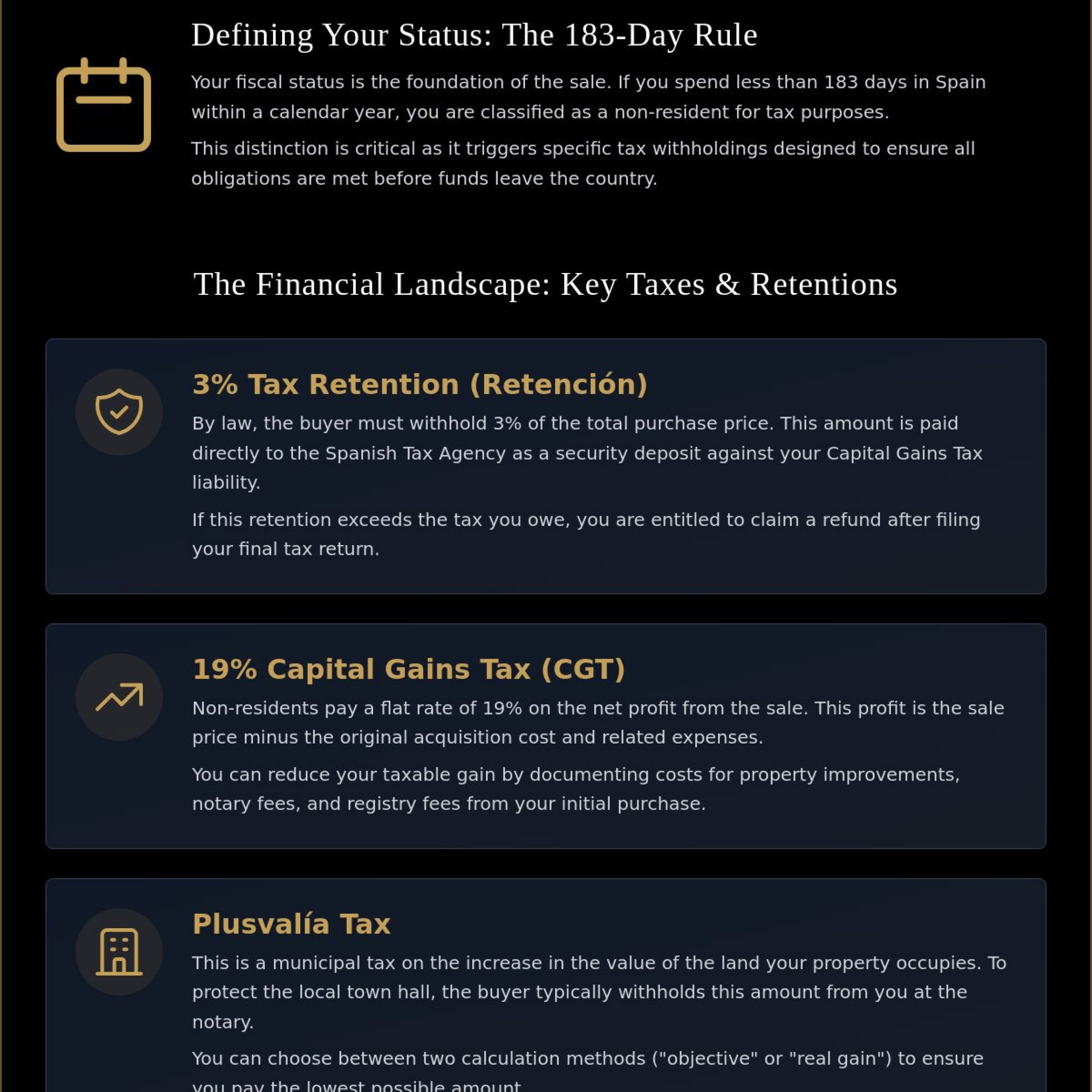
The Spanish Tax Agency, or Agencia Tributaria, uses a temporal threshold to define where you belong for tax purposes. If you spend more than 183 days in Spain during a single calendar year, you are generally considered a resident.
These days don’t have to be consecutive, which makes keeping a detailed travel log quite important for international owners. Understanding Taxation in Spain for non-residents is crucial because the “center of vital interests” rule can also apply.
If your spouse and children reside in Spain, or if your primary professional activities are based here, you might be classified as a resident. We often advise clients to secure a formal certificate of tax residency from their home country to avoid any ambiguity during the notary process.
Why Non-Resident Status Changes the Sales Dynamic
For residents, a property sale is often a local transition, but for you, it is a significant international event. The Spanish government views this as an “exit,” requiring specific guarantees that all tax obligations are met before funds leave the country.
This perspective creates a unique withholding requirement where 3% of the total purchase price is retained by the buyer. This amount acts as a security deposit for your Capital Gains Tax, a step that residents don’t typically face at the point of sale.
Managing these nuances from abroad requires a partner who understands the local landscape and global expectations. Our team provides the necessary legal assistance to ensure every document aligns with current Spanish regulations.
You must confirm your status before signing the “Arras” or deposit contract. Identifying yourself correctly at this early stage prevents costly mistakes and ensures a smooth transfer of your villa or apartment when the final deed is signed.
The Financial Landscape: Taxes and Withholding Requirements
Selling a property in Spain as a non-resident requires a meticulous approach to fiscal obligations. The financial structure of the sale is dominated by specific withholdings designed to ensure the Spanish Tax Agency receives its due before funds leave the country.
Understanding these requirements early allows you to calculate your net proceeds with precision. This transparency ensures that your transition from property owner to successful investor is both smooth and predictable.
Understanding the 3% Retention Rule
The most immediate financial impact you’ll encounter at the notary is the 3% Withholding Tax, known locally as the retención. By law, the buyer must withhold 3% of the total purchase price and deposit it with the Spanish Tax Agency using the 211 tax form.
This amount serves as a security deposit against your potential Capital Gains Tax liability. If your sale results in a loss, or if the 3% exceeds the tax actually owed, you can apply for a refund after the transaction is finalized.
You must file a definitive tax return within four months of the sale to settle your accounts. Reclaiming these funds can take several months, so having organized records of your original purchase costs is essential for a successful claim.
Capital Gains Tax (CGT) for Non-Residents
Non-Resident Capital Gains Tax is currently applied at a flat rate of 19% on the net profit for all non-residents. Profit is defined as the difference between the final sale price and the original acquisition cost, adjusted for inflation and specific expenses.
It is vital to stay informed about the latest developments in Spanish property tax to ensure your financial planning remains accurate. You can reduce your tax burden by presenting official invoices for structural improvements and renovations made during your ownership.
Every fee paid during the initial purchase, including notary and registry costs, can also be used to offset the gain. Professional legal assistance is often the best way to ensure every eligible expense is correctly accounted for in your final calculation.
The Plusvalía Tax Nuance
The Plusvalía is a municipal tax based on the increase in the value of the urban land where your property sits. For non-resident sellers, the buyer is technically liable for this payment to protect the local town hall from unpaid debts once you leave the country.
In practice, the buyer usually deducts the estimated Plusvalía amount from the final payment at the notary’s office. You now have the right to choose between the “objective” method or the “real gain” method, allowing you to select the formula that results in the lowest tax bill.
Secondary costs such as notary fees and land registry updates typically range between €600 and €1,200. Ensuring these figures are calculated before entering negotiations will help you maintain a position of strength and clarity throughout the sale.
Navigating the Legal Requirements and Necessary Documentation
Success when selling a property in Spain as a non-resident depends on your administrative readiness. This phase of the sale is less about negotiation and more about the precise assembly of a legal dossier that satisfies the high standards of the Spanish registry.
Your Foreigner Identification Number (NIE) acts as the primary key for the entire transaction. It’s the unique identifier that allows the tax authorities and the notary to recognize you as a legitimate participant in the Spanish economy.
The Essential Document Checklist
The Escritura, or original title deed, is the most critical document in your possession. It proves your legal right to sell and provides the historical context of the property’s acquisition for the buyer’s legal team.
You must also present the most recent IBI (Impuesto sobre Bienes Inmuebles) receipt. This property tax payment confirms that you’ve fulfilled your annual obligations to the local municipality, clearing the path for a clean transfer.
A Nota Simple obtained from the Land Registry within the last 90 days is indispensable for transparency. This document confirms the property is free of encumbrances, mortgages, or legal disputes that could otherwise derail the closing process.
Gathering your most recent utility bills for water, electricity, and gas is a thoughtful touch that simplifies the transition. It allows the buyer’s representative to facilitate the change of contract names without service interruptions.
Technical and Community Compliance
The Energy Efficiency Certificate (CEE) is a mandatory requirement that must be in place before you list your home on the market. This certificate provides an official rating of the property’s energy consumption and is a key piece of data for discerning buyers.
The Cédula de Habitabilidad, or Occupancy Certificate, is equally important as it verifies the property meets regional living standards. Secure this document early, as it’s often a prerequisite for the buyer to obtain a mortgage from their chosen bank.
If your villa or apartment is part of a managed community, you’ll need a Certificado de estar al corriente. This certificate, issued by the community administrator, proves you have no outstanding debts regarding shared maintenance or communal facilities.
The Role of the Spanish Notary
The Notary is a public official who oversees the signing of the final deeds to ensure every legal formality is met. While they verify the identities of all parties and the validity of the documents, they do not act as your personal advisor.
Because the Notary maintains a position of neutrality, securing independent legal assistance is a vital step for any non-resident seller. Your lawyer will review the draft Escritura to ensure the terms align perfectly with your expectations before the final signature.
This professional oversight provides peace of mind, especially when managing the sale from abroad. It ensures that the transition of your asset is handled with the same level of care and prestige that defined your period of ownership.
Strategic Logistics for a Remote Property Sale
Distance should never be a barrier to achieving a premium result for your investment. Selling a property in Spain as a non-resident requires a reliable bridge between your current location and the Spanish notary’s office, ensuring every detail is handled with precision.
Managing a high-value asset from abroad involves a combination of legal delegation and physical oversight. By establishing a robust logistical framework, you can navigate the entire sales process without the need for frequent international travel.
Executing the Sale via Power of Attorney
The Escritura de Poder, or Power of Attorney, is the most effective tool for remote sellers. This legal document allows a trusted representative to sign the final deed and manage tax obligations on your behalf, providing you with total flexibility.
You can easily set up this authority through a Spanish consulate in your home country or via a local notary. If you choose a local notary outside of Spain, the document must carry the Hague Apostille to be recognized by Spanish authorities.
Your representative will need specific powers to cancel utility contracts and settle community debts. This ensures that the transition of your villa or penthouse is seamless, leaving no lingering administrative ties to the property.
Currency Management and Fund Repatriation
Repatriating your sale proceeds is the final, most rewarding step of the journey. Traditional high-street banks often apply significant exchange rate spreads that can quietly erode your hard-earned profit during the transfer.
Specialized currency exchange services offer a more sophisticated and cost-effective alternative. These experts provide competitive rates and strategic tools that allow you to time your transfer for the most favorable market conditions.
Spanish property closings traditionally utilize the Cheque Bancario, or Banker’s Draft, for the final payment. Coordinating the deposit of this draft with a professional broker ensures that large sums move across international borders with speed and security.
Maintaining Your Asset from Afar
A vacant property requires consistent care to maintain its market appeal. Professional key holding services ensure that your home is always ready for viewings, providing access to agents and inspectors at a moment’s notice.
Ongoing property maintenance is equally vital for preserving your home’s value until the day of completion. From garden landscaping to pool upkeep, keeping your property in peak condition justifies your asking price and reassures potential buyers of the home’s quality.
Our team acts as your local eyes and ears, providing a boutique experience that prioritizes your peace of mind. Contact us today to learn how our comprehensive legal assistance and logistical support can simplify your international sale.
Ensuring a Sophisticated Exit with Professional Guidance
Transitioning your asset back into liquid capital is a significant milestone in your investment journey. Selling a property in Spain as a non-resident requires more than just a buyer; it demands a partner who understands the nuances of a high-end exit.
KEYS property group serves as the essential bridge between your international standards and the specificities of Spanish law. We ensure that every detail, from the first viewing to the final signature, reflects the prestige and quality of your investment.
The Value of Comprehensive Management
A vacant villa or penthouse requires constant attention to remain in peak condition. Our dedicated property maintenance team ensures your home stays “show-ready” at all times, protecting its market value until the moment of completion.
For non-resident owners, professional key holding offers invaluable peace of mind. We provide the local expertise needed to navigate national regulations, acting as your trusted advisor on the ground to prioritize your interests over the mere transaction.
Your Next Steps in the Spanish Market
Success in the 2026 market begins with a personalized strategy. We invite you to book a consultation for a detailed valuation and a precise tax estimate tailored to your specific fiscal situation.
Even after your sale is complete, your connection to this vibrant region doesn’t have to end. There are always wonderful things to do in Malaga city Spain for returning visitors and lifelong friends of the coast.
Let us manage the complexities of legal assistance and currency exchange while you focus on your next life-changing transition. Reach out to KEYS property group today to initiate your sales process with the care and sophistication of a boutique specialist.
Mastering Your Spanish Property Exit
Navigating the financial landscape and complex legal nuances ensures that your investment’s legacy remains intact. You now possess the strategic roadmap needed to manage the 3% tax retention and logistical hurdles with total professional confidence.
Selling a property in Spain as a non-resident shouldn’t be a source of international stress when you have a dedicated partner on the ground. Our boutique approach prioritizes your specific lifestyle needs, ensuring every detail of the sale aligns perfectly with your high global standards.
With over 20 years of local expertise, we provide comprehensive end-to-end management services designed to simplify your transition. Secure a sophisticated exit for your Spanish property with KEYS property group and experience the reliability of a true boutique specialist.
Your next chapter is waiting just beyond the horizon. We’re here to ensure you reach it with the ease, elegance, and financial success you’ve worked so hard to achieve.
Frequently Asked Questions
Do I need to be in Spain to sell my property as a non-resident?
You don’t need to be physically present in Spain to finalize your sale. A Power of Attorney allows your chosen representative to sign the final deed and handle all necessary tax filings while you remain in your home country.
What is the 3% withholding tax (retention) and can I get it back?
The 3% retention is a mandatory advance payment of your Capital Gains Tax that the buyer pays directly to the tax agency. You can reclaim this amount if the tax actually owed is lower than the retention or if the property was sold at a loss.
What taxes do I pay if I sell my Spanish property at a loss?
If you sell at a loss, you won’t owe Capital Gains Tax or Plusvalía tax, though a declaration must still be filed. You’ll still face the initial 3% retention at the notary, but you can file for a full refund of this amount after the transaction.
How long does it take to receive the 3% tax refund from the Spanish authorities?
The timeline for receiving a tax refund can take several months after you file your tax return. This duration depends on the specific workload of your local tax office and the accuracy of your submitted financial records.
Do I still have to pay the Plusvalía tax if I am a non-resident?
Non-residents are liable for the Plusvalía tax, which is a local tax on the increase in the value of the land. Usually, the buyer will withhold this estimated amount from the final sale price to pay the local town hall on your behalf.
Can I sell my property in Spain if my NIE has expired?
Selling a property in Spain as a non-resident requires a valid and active NIE that’s correctly registered with the tax authorities. If your NIE is expired or inactive, the notary will be unable to sign the final public deed of sale.
What are the specific tax rates for non-residents in 2026?
For the 2026 tax year, the Capital Gains Tax rate for selling a property in Spain as a non-resident is a flat 19% on the profit. This rate applies to all non-residents regardless of whether they are from the EU or a non-EU country like the UK.
Do I need to report the sale of my Spanish property in my home country?
Most sellers must report the transaction in their home country to comply with their local fiscal laws. Double taxation treaties usually prevent you from paying tax on the same gain twice, allowing you to credit the Spanish tax already paid.
Properties in Selling a Property in Spain as a Non-Resident: The Comprehensive 2026 Guide