
Common Structural Problems in Spanish Houses: A 2026 Buyer’s Guide
That dream of a sun-drenched terrace can quickly fade if the foundation beneath your feet isn’t as solid as the Mediterranean view. It’s natural to feel a sense of hesitation when touring properties, especially when you’re worried about uncovering common structural problems in Spanish houses that stay hidden behind a fresh coat of paint. You deserve a home that offers a lifetime of peace, not a series of unexpected financial burdens.
We’re here to provide the professional assurance you need to navigate this significant life transition with total ease. By understanding the latest 2026 technical regulations and legal safeguards, you’ll learn how to identify critical risks and protect your Spanish property investment effectively.
This guide provides a clear checklist of structural red flags and explains how decennial insurance coverage works for newer builds. You’ll finish this article with the expert insights required to make an offer with absolute confidence.
Key Takeaways
- Understand how Spanish construction has evolved from traditional walls to modern concrete frames to better assess property durability.
- Learn to identify common structural problems in Spanish houses by distinguishing between cosmetic surface issues and latent defects like rising damp.
- Gain clarity on the Spanish three-tier warranty system and the specific protections provided by mandatory ten-year structural insurance.
- Master a practical five-step viewing framework to inspect roofs and façades before you commit to a professional surveyor.
- Discover how proactive maintenance and terrace waterproofing preserve the long-term value of your Mediterranean investment.
Understanding the Landscape of Spanish Property Construction
Building a home in Spain requires a deep understanding of local environmental conditions and engineering standards. The varied terrain and intense climate create unique challenges for maintaining structural integrity principles across different regions. Whether you’re looking at a rustic inland finca or a sleek coastal villa, the way a property interacts with its environment determines its long-term health.
Safety and quality are governed by the Spanish Technical Building Code (Código Técnico de la Edificación or CTE). Updated as recently as July 6, 2026, this code ensures that all modern constructions meet rigorous standards for stability, fire safety, and energy efficiency. It serves as the national benchmark for preventing common structural problems in Spanish houses by mandating precise engineering calculations for every new project.
Traditional vs. Modern Building Techniques
Older properties often utilize the muro de carga system, where thick, load-bearing walls support the weight of the entire roof. These structures provide excellent thermal mass but can be susceptible to movement if the ground shifts. They’re most common in traditional village houses and older rural estates.
In contrast, modern apartments and villas favor the estructura de hormigón, or reinforced concrete frame. This system offers greater flexibility and allows for the large, open-plan layouts that define contemporary Mediterranean living. Understanding these differences is a vital part of the property buying process in Spain.
The Impact of Spanish Geology on Foundations
The soil beneath a house is just as important as the materials used to build it. Many regions in Spain feature expansive clay soils that swell and shrink with seasonal moisture changes. This natural movement often leads to asentamiento, or minor settlement, which usually appears as small, harmless hairline cracks.
However, if drainage is poor or the foundation is inadequate, it can escalate into dangerous subsidence. Professional oversight ensures that foundation designs account for these geological stressors, protecting your investment from the ground up. Understanding these geological nuances is the first step in identifying potential common structural problems in Spanish houses before they become costly repairs.
Spain’s climate is a primary driver for lifestyle changes, yet it acts as a relentless structural stressor. Intense UV radiation can degrade exterior renders, while seasonal humidity cycles cause building materials to expand and contract. Without proper expansion joints and high-quality waterproofing, these environmental factors can compromise the building’s core.
Key structural stressors in the Spanish environment include:
- High thermal loads from intense summer heat.
- Salt-air corrosion in coastal areas.
- Significant variations in seasonal groundwater levels.
By recognizing these factors early, you can differentiate between expected wear and tear and genuine structural failure. A grounded, informed approach ensures that your transition to a new lifestyle remains a positive and secure experience.
Identifying the Most Frequent Structural Defects
Spotting common structural problems in Spanish houses requires a trained eye that looks beyond the aesthetic charm of a property. We categorize these defects into visible issues, which are immediately apparent during a walkthrough, and latent issues that may only surface after a season of heavy rain or intense heat.
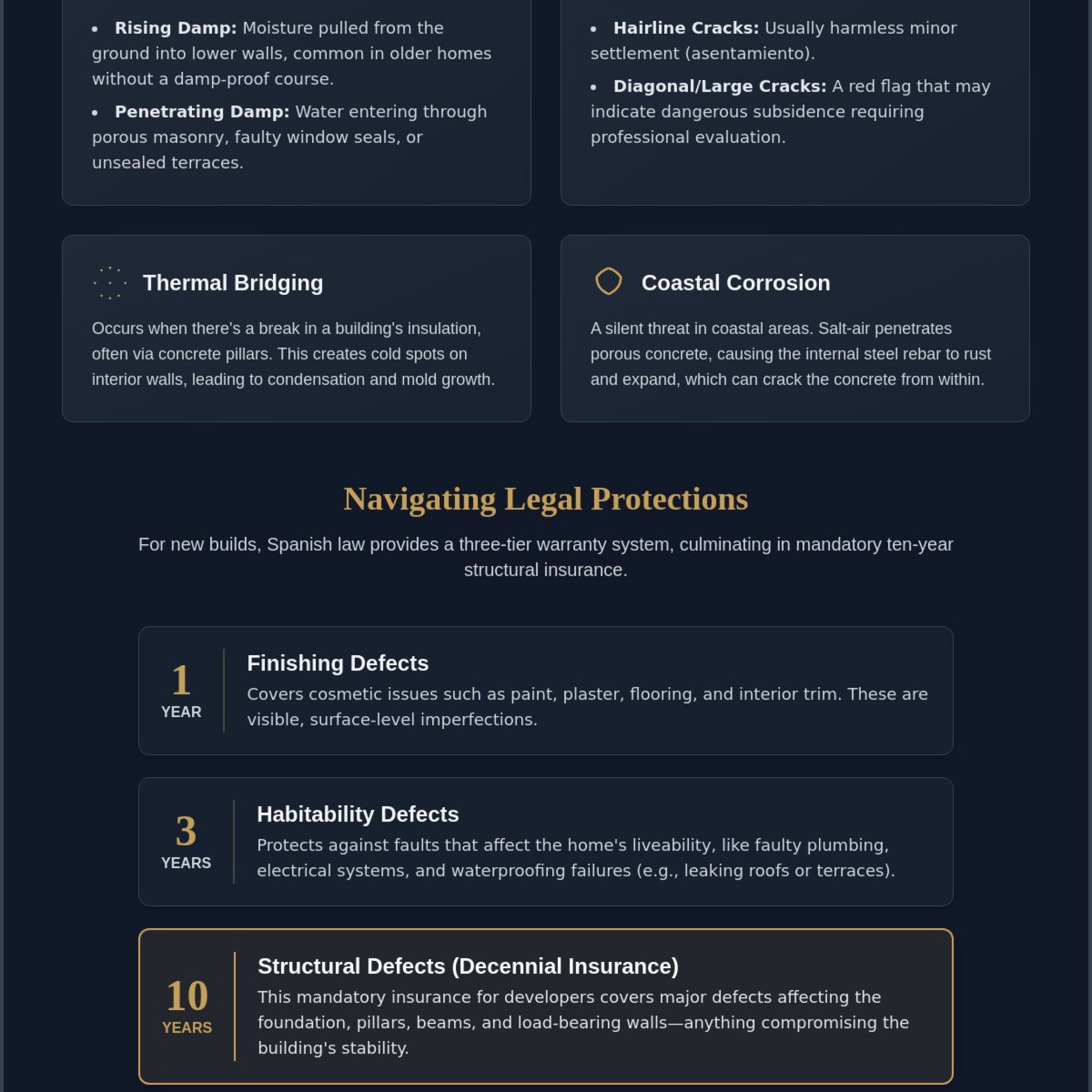
Dampness remains the most frequent complaint among homeowners in Spain. Penetrating damp often enters through porous masonry or faulty terrace seals, while rising damp pulls moisture from the ground into the lower walls. This is particularly prevalent in older villas where original damp-proof courses were either absent or have failed over time.
Thermal bridging is another technical challenge where a building’s insulation is interrupted, often by concrete pillars. This creates cold spots that lead to condensation and mold on interior finishes. In coastal areas, salt-air corrosion is a silent threat to reinforced concrete, as salt penetrates the material and causes the internal steel rebar to rust and expand.
All modern repairs and new builds must adhere to the Spanish building code (Código Técnico de la Edificación). This provides the technical framework necessary for preventing these failures and ensuring long-term safety. If you’re unsure about a specific property’s condition, our team can help you find villas with verified histories in our current property listings.
Cracks and Fissures: When to Worry
Not every crack indicates a disaster. Surface-level fisuras are often just the plaster reacting to heat, but deep grietas suggest significant structural movement. A key indicator is the 45-degree rule, where diagonal cracks starting from the corners of doors or windows point toward foundation settlement.
You can monitor these openings using glass tell-tales or digital gauges to see if the movement is active or historical. If a crack continues to widen over several months, it’s a clear sign that professional intervention is required to stabilize the structure.
Concrete Decay and Aluminosis
If you’re exploring properties built between 1950 and 1970, you must be aware of Aluminosis. This condition involves the use of high-alumina cement which, under heat and humidity, loses its strength and becomes dangerously porous. It’s a specific risk in older apartment blocks and some coastal villas.
Look for signs of spalling, where concrete flakes away to reveal rusted steel underneath. This process is often accelerated by carbonatación, where the concrete loses its protective alkaline nature. Identifying these signs early can save you from a complex and expensive structural renovation later.
Navigating Legal Protections and Building Insurance
Spain provides a robust legal framework to protect buyers from common structural problems in Spanish houses. The cornerstone of this protection is the Ley de Ordenación de la Edificación (LOE). This law establishes clear liabilities for developers, builders, and architects to ensure your investment remains secure for years to come.
Understanding these regulations ensures your transition to Mediterranean living is backed by more than just a handshake. The law mandates a tiered warranty system that grows in significance over time. This structure is designed to catch everything from minor aesthetic flaws to major engineering failures.
The 1-3-10 Rule of Spanish Building Warranties
For the first year after a property is completed, the developer is liable for any cosmetic or finishing defects. If you find a cracked tile or a sticking door during this period, the builder is legally required to rectify it.
The three-year warranty covers habitability issues. This includes defects like penetrating damp or poor acoustic insulation that significantly affect your quality of life inside the home.
The ten-year warranty is the most critical for long-term safety. It covers fundamental structural stability and foundation failure, providing a safety net against the most severe common structural problems in Spanish houses.
Verifying Structural Health During Conveyancing
During the property buying process in Spain, your legal representative should request the Libro del Edificio. This “Building Book” contains the technical history, maintenance logs, and insurance certificates for the property. It acts as a comprehensive health record for the structure.
For properties older than 30 to 50 years, an Inspección Técnica de Edificios (ITE) is mandatory. This technical survey is often overseen by members of Spain’s official architectural professional body. It ensures the building meets modern safety standards before it can be legally sold.
One area where buyers must exercise caution is Autopromoción or self-build properties. In these cases, the original owner may have legally waived the Seguro Decenal (10-year insurance) if they built the home for personal use. If you buy such a property within ten years of its construction, ensure the insurance has been retroactively applied.
As of the July 6, 2026 update to the Technical Building Code, new regulations emphasize the link between structural health and energy efficiency. Modern surveys now include lifecycle assessments to ensure your home isn’t just stable, but also sustainable. Always check the Nota Simple for any recorded building-related liabilities or outstanding urbanistic infractions before signing an offer.
A Practical Inspection Framework for Property Buyers
Walking through a potential new home is an emotional experience, but it’s vital to maintain a methodical perspective. You can often spot the early warning signs of common structural problems in Spanish houses yourself before committing to a professional survey fee. We recommend focusing your attention on the building’s “envelope” to ensure the core structure remains sound and dry.
Begin by testing the basic alignment of the property. Open and close every window and door to see if they glide smoothly or stick in their frames. If you notice significant resistance or visible gaps in the frames, it may suggest the building has experienced historical or active movement that has skewed the openings.
Pay close attention to recent aesthetic upgrades. While a fresh coat of paint is common, a single wall that looks suspiciously newer than the rest of the room can be a red flag. Sellers sometimes use “patch-up” paint jobs to temporarily hide recurring damp or salt efflorescence before a viewing.
External and Internal Red Flags
Step 1: Stand back from the property and inspect the roofline for any sagging or missing tejas (tiles). A wavy ridge or uneven tile placement often points to underlying timber decay or a lack of proper support in the roof structure.
Step 2: Scan the interior corners and areas behind large furniture for humedades (damp patches). These spots are prone to condensation and penetrating damp, especially in Mediterranean climates where ventilation can be an issue in older builds.
Step 3: Examine the exterior façade for bulging or “blown” render. When the decorative coating pulls away from the brickwork, it creates a cavity where water can collect, eventually leading to serious masonry degradation.
The Critical Role of a Technical Survey
It’s a frequent misconception that a bank valuation serves as a structural check. In reality, a valuation is a brief assessment for the lender’s financial risk and rarely dives into engineering details. You need a dedicated structural survey to gain a true understanding of the property’s health.
A professional Surveyor’s Report provides a deep technical analysis, whereas an Architect’s Certificate is often a simpler statement of compliance. Both have their place, but for older villas or complex builds, the former is indispensable. If you need assistance finding a qualified expert, contact professional advisors for a referral to our network of trusted local specialists.
Taking these practical steps ensures that your transition to a new lifestyle is built on a solid foundation. By identifying red flags early, you can negotiate from a position of strength or walk away from a property that doesn’t meet your standards for quality and safety.
Long-term Asset Care and Professional Oversight
Securing a property is just the beginning of your journey in Spain. Ongoing vigilance is the most effective way to prevent common structural problems in Spanish houses from developing into expensive repairs. In the Mediterranean climate, even small oversights can lead to significant issues if left unaddressed over several seasons.
Water management is particularly critical for structural longevity. Regular gutter clearing prevents overflow that can saturate exterior masonry, while maintaining the tela asfáltica (waterproofing layer) on your terrace ensures that moisture doesn’t seep into the concrete slabs below. These simple steps protect the building’s core integrity and your financial investment.
Preventative Maintenance and Key Holding
For owners who aren’t in Spain year-round, professional oversight is essential. Our Property Maintenance and Key Holding services provide regular inspections that catch silent issues like internal pipe bursts or hairline cracks before they compromise concrete beams. This proactive approach ensures your home remains a sanctuary rather than a source of stress.
When searching for your next home, it’s helpful to view existing property listings with an eye for these well-maintained details. A house that has been professionally managed often retains its value better and presents far fewer surprises during the technical survey. We act as your dedicated local specialist, bridging the gap between ownership and expert care.
Preserving Value in the Costa del Sol Market
Investing in high-quality structural repairs offers a much higher return on investment than purely cosmetic upgrades. A clean structural bill of health is a powerful asset when it comes time to sell, often speeding up the resale process significantly. Buyers in today’s market prioritize the peace of mind that comes from a documented history of professional oversight.
Choosing KEYS property group as your partner means you’re never navigating the complexities of Spanish property ownership alone. We provide the grounded, reliable presence you need to enjoy your new lifestyle with absolute confidence. Our comprehensive management approach ensures that your home stays as solid and inviting as the day you first stepped through the door.
Securing Your Mediterranean Future
Buying a property in Spain is an inspiring step toward a new lifestyle, and it deserves the highest level of professional oversight. By understanding the technical landscape and legal warranties, you’ve taken the most important step toward a secure investment.
Identifying common structural problems in Spanish houses early ensures that your experience is defined by comfort rather than unexpected repairs. Our team brings over 20 years of local expertise to every relationship, offering comprehensive post-sale support and legal facilitation.
We provide dedicated key holding and property maintenance services to monitor your home’s health year-round. This grounded approach allows you to focus on your new life while we manage the technical details of your asset.
Protect your investment with our professional property management and maintenance services.
Your journey toward a new life in Spain should be filled with optimism and absolute peace of mind. We look forward to being your trusted partner at every stage of this exciting transition.
Frequently Asked Questions
What are the most common signs of structural failure in a Spanish villa?
The most frequent indicators include diagonal cracks near window corners, sagging roof ridges, and doors that no longer close smoothly in their frames. These signs often point toward foundation settlement or significant movement in the property’s reinforced concrete structure.
You should also look for “blown” exterior render or large patches of flaking paint. These issues often hide masonry degradation caused by the intense Mediterranean climate and seasonal ground shifts.
Does a standard bank valuation in Spain include a structural survey?
No, a bank valuation is strictly a financial assessment used to determine the property’s market value for mortgage lending purposes. It does not provide a technical analysis of the building’s engineering or identify hidden defects.
To ensure your investment is safe, you must commission an independent structural survey from a qualified professional. This provides the technical depth needed to uncover common structural problems in Spanish houses before you commit to a purchase.
What is Aluminosis and is it still a problem in 2026?
Aluminosis is a structural condition where concrete loses its strength due to the use of high-alumina cement, which was common in builds between 1950 and 1970. It remains a significant concern in 2026, particularly for older apartment blocks and coastal villas exposed to high humidity.
The chemical change makes the concrete porous and brittle, eventually leading to the collapse of floor joists or beams. If you’re considering a property from this era, a specialized technical test is essential to verify the concrete’s integrity.
How much does a professional structural survey cost in Spain?
In 2026, a standard villa survey typically costs between €800 and €1,500 depending on the property’s size and location. For smaller apartments, a visual “snagging” survey is usually priced between €400 and €700.
If you’re buying a large or historic estate, a full structural survey can cost upwards of €3,000. These fees are a vital investment in your peace of mind and can often be used as leverage during price negotiations.
Is decennial insurance mandatory for all properties in Spain?
Decennial insurance is mandatory for all professional developers building residential properties for sale. This policy provides a ten-year warranty against major structural defects and foundation failures that compromise the building’s stability.
However, an individual building a single home for their own use, known as an autopromotor, can choose to waive this insurance. If they decide to sell that home within ten years, they’re legally required to obtain the insurance for the new buyer.
Can I sue a developer for structural defects found after five years?
Yes, you’re protected by the ten-year structural warranty established under the Ley de Ordenación de la Edificación. This legal safeguard covers fundamental defects in foundations, beams, and load-bearing walls for a full decade after the building’s completion.
It’s important to act quickly once a defect is discovered, as there are specific legal timeframes for filing a claim. Your legal representative can help you navigate this process to ensure the developer or their insurance covers the necessary repairs.
How do I know if a crack in my wall is dangerous or just cosmetic?
Cosmetic cracks, or fisuras, are generally thin hairline openings in the plaster caused by the building’s natural reaction to heat and cold. They’re usually horizontal or vertical and don’t extend into the underlying masonry.
Dangerous cracks, known as grietas, are typically wider than 2mm and often run diagonally across a wall. If you notice a crack that is widening over time or appearing on both sides of a wall, it’s a clear sign of active structural movement.
What should I do if I find rising damp in a property I want to buy?
You should immediately request a specialist damp survey to determine the source of the moisture and the estimated cost of repair. Rising damp can lead to common structural problems in Spanish houses by weakening the mortar and causing salt damage to the bricks.
Once you have a professional quote for the repairs, you can ask the seller to fix the issue before completion or reduce the asking price accordingly. Modern injection systems and damp-proof membranes are highly effective at resolving these issues when installed correctly.
Properties in Common Structural Problems in Spanish Houses: A 2026 Buyer’s Guide