
Apartment vs Villa for a Spanish Holiday Home: The 2026 Buyer’s Guide
Would you rather own a private paradise that demands your constant attention, or a streamlined retreat that lets you relax the moment you land? Choosing between an apartment vs villa for a Spanish holiday home is more than just a matter of square footage. It’s a fundamental decision about how you want to live your Mediterranean dream and manage your future assets.
We understand that the fear of hidden maintenance costs and evolving rental laws, such as the 2025 community approval regulations, can make this transition feel daunting. You deserve a clear path forward that balances your lifestyle aspirations with sound financial logic and professional security.
In this 2026 guide, you’ll discover the critical differences in lifestyle, costs, and management requirements for each property type. We provide a detailed financial comparison and an honest look at the management commitments needed to help you choose the perfect Spanish retreat with total confidence.
Key Takeaways
- Understand how the “Community of Owners” structure manages shared amenities and property security on your behalf while you are away.
- Discover the unique lifestyle benefits of private outdoor space and the specific autonomy offered by detached villa ownership.
- Evaluate the long-term financial commitments of an apartment vs villa for a Spanish holiday home using our updated 2026 cost framework.
- Learn how to identify and mitigate hidden maintenance headaches before they impact your property’s long-term investment potential.
- See why townhouses and penthouses are emerging as the preferred “hybrid” solution for buyers seeking both space and simplicity.
Deciding Between an Apartment and a Villa in Spain
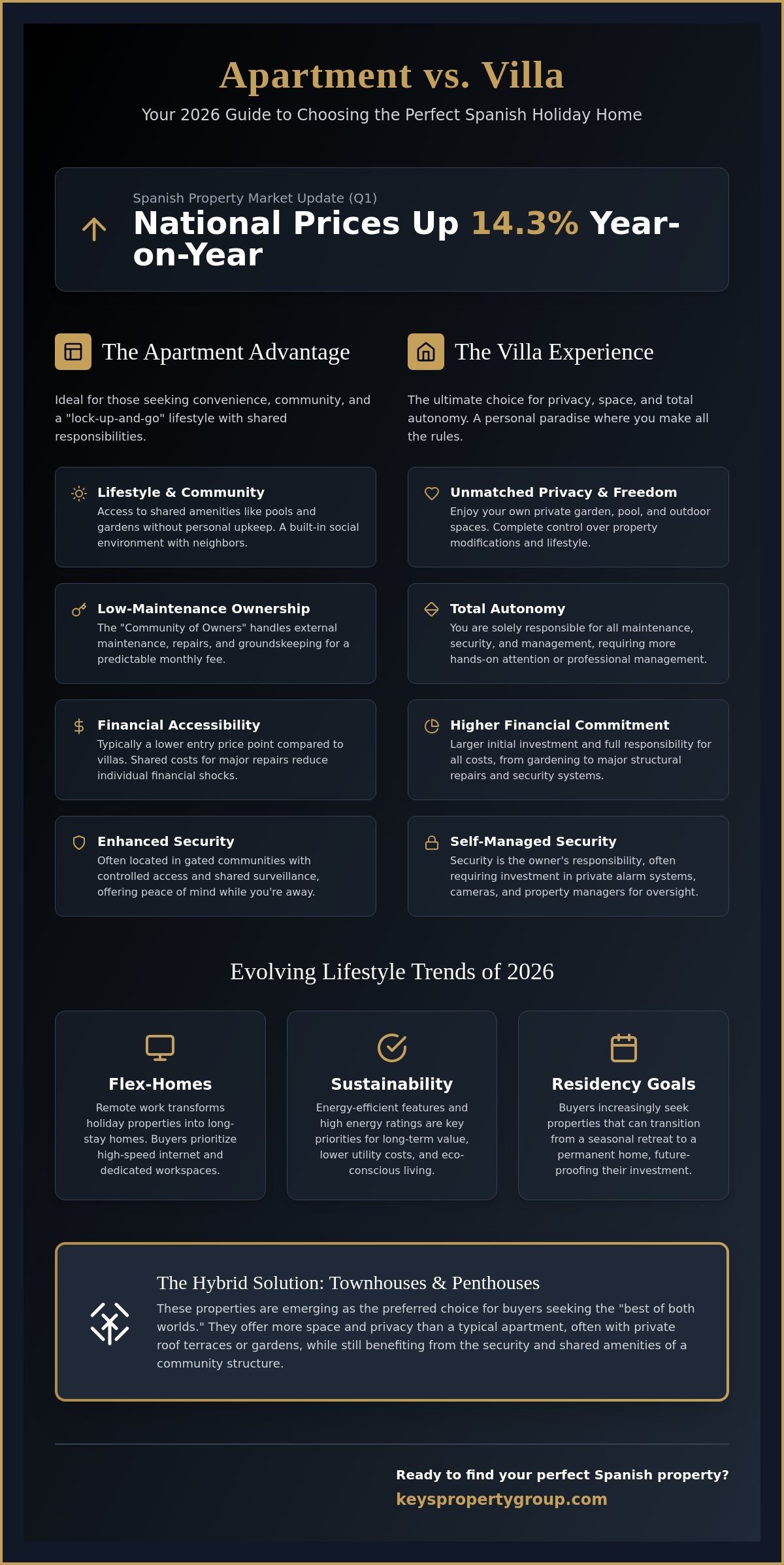
The Spanish property market in 2026 is vibrant, with national prices rising by 14.3% year-on-year in the first quarter. This growth reflects the enduring appeal of Tourism in Spain, which remains a primary driver for international buyers seeking a slice of the Mediterranean.
Choosing an apartment vs villa for a Spanish holiday home is a decision that defines your daily life and your long-term financial commitments. While a villa offers total autonomy and private grounds, an apartment provides a sense of community and shared responsibility through a structured owners’ association.
Buying a Mediterranean sanctuary is a significant emotional milestone. It’s about finding a space that aligns with your vision of relaxation, security, and lifestyle fulfillment. We’ve designed this guide to provide a grounded, professional comparison of these two distinct ownership paths.
The Evolving Lifestyle Trends of 2026
Remote work has transformed holiday homes into “flex-homes.” Buyers now look for high-speed connectivity and dedicated workspaces alongside sun-drenched terraces. This flexibility allows for longer stays that blend professional productivity with vacation-style living.
Sustainability is no longer a luxury. Energy-efficient features and eco-friendly materials are high on the priority list for 2026 investors. Properties with high energy ratings often see better long-term value retention and lower monthly utility costs.
Many buyers now balance immediate holiday use with long-term residency goals. This shift requires properties that can transition from a seasonal vacation spot to a permanent home. It’s a strategic move for future-proofing your investment in an appreciating market.
Initial Considerations for International Buyers
A “lock-up-and-go” lifestyle is often the deciding factor for non-residents. Apartments usually offer easier security and maintenance management while you’re away. This provides peace of mind for those who can’t visit their property every month.
Location is about more than proximity to the sand. For instance, exploring the things to do in malaga city spain reveals how urban culture and history add depth to a holiday investment. Cities offer year-round vibrancy that some coastal resorts might lack during the winter months.
Think about your proximity to international airports and high-quality medical services. These practicalities ensure your investment remains accessible and safe as your needs evolve over time. A well-located property is always easier to manage and simpler to sell later.
Every buyer’s journey is unique and deeply personal. Whether you prioritize a private garden or a communal pool, understanding these initial factors is the first step toward a successful Spanish property acquisition.
The Apartment Advantage: Convenience and Security
For many, the dream of owning a home in Spain starts with a high-end apartment or a sleek penthouse overlooking the Mediterranean. This choice often represents the most practical path when weighing an apartment vs villa for a Spanish holiday home. You gain immediate access to luxury without the burden of managing extensive grounds yourself.
Ownership is governed by the Comunidad de Propietarios, or Community of Owners. This legal structure ensures that shared spaces like infinity pools and manicured gardens are maintained to a high standard. You contribute a monthly fee, and the community handles the logistical heavy lifting.
Apartments are the ultimate low-maintenance investment for the modern buyer. They allow you to enjoy your holiday the moment you arrive rather than spending the first few days coordinating repairs. It’s a “lock-up-and-leave” solution that fits a busy international lifestyle.
Security and Peace of Mind
Safety is a primary concern for those who don’t live in Spain year-round. Most modern apartment complexes are situated within gated communities with controlled access points. This inherent layout provides a natural layer of protection that is harder to achieve with a standalone property.
Community-funded security services often include 24-hour surveillance and on-site staff. These professionals act as a constant presence, deterring intruders and monitoring the premises while you’re away. You can travel back to your primary residence knowing your Spanish retreat is being watched.
This shared security model is particularly beneficial for owners who spend several months away at a time. It removes the stress of property security from your shoulders. Your neighbors and the community staff provide an informal network of oversight.
Financial and Social Benefits
Entering the market through an apartment often requires a lower initial investment compared to a detached villa. For instance, according to June 2026 data, the average price in Murcia is €1,515 per square meter, making it a very accessible entry point. Even in premium areas like the Costa Blanca, prices average around €2,500 per square meter for high-quality units.
Shared costs are another significant financial advantage of this property type. Major expenses, such as roof repairs or building insurance, are split among all owners. This collective responsibility makes the financial realities of ownership much more predictable and manageable.
Before committing to a purchase, it’s wise to review the official guidance on buying property in Spain to understand your legal obligations. Living in a community also offers a built-in social network of fellow expatriates. This environment makes it easier to build friendships and integrate into the local lifestyle.
If you’re ready to see what’s available, you can browse our current Spanish property listings to compare different styles and locations. Finding the right balance of amenities and price is the key to a successful investment.
The Villa Experience: Unmatched Privacy and Freedom
Owning a detached villa represents the pinnacle of Mediterranean living. It offers a level of seclusion that is simply not possible in higher-density developments. When weighing an apartment vs villa for a Spanish holiday home, the villa stands out as a sanctuary of total independence.
Private outdoor space is the true currency of the Spanish lifestyle. Your own garden, terrace, and pool area become the heart of the home. This allows for seamless indoor-outdoor living without the presence of neighbors or shared amenities.
You possess complete autonomy over your property’s aesthetics and structural improvements. Unlike the community-governed apartments discussed earlier, you don’t need a majority vote to change your facade or landscape. This freedom allows you to tailor the environment to your exact tastes.
Villas also serve as vital multi-generational assets. They provide the space required for extended families to gather comfortably under one roof. It’s a legacy investment that grows with your family over the decades.
Privacy and Personal Space
The absence of shared walls means you are free from communal noise and foot traffic. This creates a tranquil atmosphere that is essential for a true holiday retreat. You control the rhythm of your day without external interruptions.
Creating a bespoke outdoor living area is a key advantage of this property type. You can design a private pool and kitchen area that perfectly suits your hosting style. It provides a more authentic “home away from home” feel compared to standardized resort units.
When comparing villas and apartments, the sense of ownership and personal expression is significantly higher in a villa. It is a canvas for your lifestyle rather than a pre-defined space.
Investment Potential and Customization
Historically, villas in prime locations have shown strong capital appreciation. While initial costs are higher, the scarcity of large plots in coastal areas often drives long-term value. You are investing in land as much as the structure itself.
You have the unique ability to add value through renovations and extensions. Whether it’s adding a guest suite or modernizing the kitchen, these improvements directly enhance your equity. You aren’t limited by the collective decisions of a homeowner association.
Controlling your own energy solutions is a major benefit in 2026. You can install solar panels or advanced heat pumps to create a sustainable, low-cost environment. This independence from rising utility costs adds another layer of financial security to your investment.
Financial Realities: Comparing Costs and Management
Understanding the long-term financial commitment is essential for a secure investment. When evaluating an apartment vs villa for a Spanish holiday home, you must look beyond the initial purchase price to the total cost of ownership. A clear financial strategy ensures your Mediterranean retreat remains a source of joy rather than a source of stress.
Hidden maintenance headaches are the most common concern for international buyers. A villa requires a dedicated personal budget for pool care, gardening, and exterior upkeep. Conversely, apartments distribute these costs through community fees, providing a more predictable monthly expenditure.
Professional management is the cornerstone of a successful 2026 investment. Relying on professional key holding and property maintenance services ensures your home is monitored and cared for throughout the year. This oversight is particularly critical for non-resident owners who cannot manage day-to-day issues in person.
Ongoing Maintenance and Key Holding
Community fees in apartments offer a structured way to handle shared infrastructure and security. For villa owners, upkeep is entirely private and requires managing individual contractors for landscaping and structural repairs. This autonomy offers control but demands more active management of your property’s condition.
Professional key holding services act as your local eyes and ears. These specialists perform regular inspections to prevent minor leaks or security lapses from escalating into costly disasters. It’s a small investment that provides immense peace of mind while you’re back in your primary residence.
Legal and Financial Frameworks
Navigating the property buying process in Spain involves specific tax obligations that vary significantly by region. For example, resale properties in Andalusia currently attract a flat 7% Property Transfer Tax (ITP). In the Valencian Community, the general ITP rate was reduced to 9% as of June 2026.
Financing options also shift based on the property’s value and location. While mortgages are widely available for both types, luxury villas often require more complex legal aid and specialized currency exchange services. These tools help manage large capital transfers efficiently and protect you from market volatility.
ROI in 2026 remains strong, with national gross rental yields averaging approximately 5.4%. Areas with high demand, like Benidorm, can offer yields up to 8% due to year-round tourism. Villas often see higher capital appreciation over time, while apartments tend to offer more consistent short-term rental cash flow.
Securing your investment requires expert local knowledge and reliable support. We invite you to contact our team for a personalized assessment of your property management and acquisition goals.
Finalizing Your Spanish Property Strategy
Choosing between an apartment vs villa for a Spanish holiday home ultimately depends on your lifestyle priorities and management capacity. If ease of use and community security are your primary goals, an apartment is the most logical choice for a stress-free retreat.
If you desire complete privacy and the freedom to customize your surroundings, a villa offers the ultimate Mediterranean experience. Both paths represent a significant life transition that requires careful professional planning and a clear understanding of your long-term goals.
Many buyers find that a hybrid approach offers the best of both worlds. Townhouses and large penthouses often provide the generous space of a villa with the managed convenience and shared maintenance costs of a community complex. These options are increasingly popular for those seeking a balance of autonomy and simplicity.
Expert Guidance with KEYS property group
We provide comprehensive support throughout your entire journey, from initial legal assistance to securing competitive mortgages. Our team also manages specialized services like currency exchange to ensure your capital transfers are handled with precision and security.
Our dedicated property maintenance and key holding services protect your asset while you are away from Spain. We leverage 20 years of local expertise to ensure every technical and administrative detail of your home is managed to the highest professional standards.
Working with a dedicated local specialist provides a sense of security through every stage of the process. We act as a knowledgeable bridge between your lifestyle goals and the practical steps needed to reach them, ensuring your investment is both safe and fulfilling.
Your Next Steps to Ownership
Starting your search is an exciting process that begins with exploring the diverse options currently on the market. You can browse our current property listings to see the latest apartments, villas, and townhouses available across Spain’s most sought-after regions.
Once you have identified potential properties, we recommend scheduling a consultation to discuss your specific requirements. This allows us to align our deep market knowledge with your financial objectives and residency goals for 2026 and beyond.
We invite you to contact our team today to begin building your personalized Spanish property portfolio. Your new lifestyle in the sun is within reach, and we are here to provide the expert oversight you need to move forward with total confidence.
Your Mediterranean Future Awaits
Deciding between an apartment vs villa for a Spanish holiday home is the final step in securing your Mediterranean sanctuary. Whether you prioritize the streamlined convenience of a penthouse or the expansive freedom of a private villa, your choice should reflect your unique vision for relaxation and security.
Our team brings over 20 years of local real estate experience to every transaction. We provide end-to-end legal and mortgage support to ensure your purchase is as smooth as the lifestyle you’re pursuing.
Beyond the sale, we offer comprehensive property maintenance and key holding services to keep your asset protected. This professional oversight allows you to enjoy your home with total peace of mind throughout the year. We understand the emotional weight of this transition and remain committed to your long-term success.
View our exclusive portfolio of Spanish apartments and villas to find your perfect match. We look forward to helping you turn these possibilities into a permanent reality under the Spanish sun.
Frequently Asked Questions
Is it easier to get a mortgage for an apartment or a villa in Spain?
Lenders generally offer mortgages for both property types, but apartments in established developments often see a more streamlined valuation process. High-end villas may require more extensive appraisals due to their unique architectural features and higher price points. Banks primarily focus on your personal financial profile and the property’s legal status regardless of the building style.
Establishing a relationship with a local lender early in your search can help clarify your borrowing capacity. This preparation ensures you can move quickly when you find the right property in a competitive market.
How much are typical community fees for a Spanish apartment in 2026?
Community fees vary significantly based on the level of amenities such as 24-hour security, heated pools, and elevator maintenance. These monthly costs cover the collective upkeep of shared infrastructure and insurance for the building’s exterior. It’s essential to review the community’s financial records during the purchase process to understand the specific fee structure for your unit.
Properties with fewer communal facilities naturally attract lower fees. We recommend requesting a copy of the latest annual general meeting minutes to check for any planned future expenses or “derramas” for major repairs.
Do I need a car if I buy a villa in a Spanish coastal area?
Most villas are located in quieter residential outskirts, making a car essential for daily errands and accessing local beaches. While some apartments are situated in pedestrian-friendly urban centers, villas prioritize privacy and space which often places them further from public transport links. Owning a vehicle ensures you can fully explore the surrounding region at your own pace.
If you prefer to avoid driving, look for villas in established urbanizations that offer shuttle services or are within walking distance of local amenities. However, for most villa owners, a car is a fundamental part of the Mediterranean lifestyle.
Which property type has better resale value in the current market?
Both property types are performing well, but villas often hold higher long-term capital appreciation due to the scarcity of large coastal plots. Apartments tend to offer higher liquidity because their lower price points appeal to a broader segment of the market. The choice of location remains the most significant driver of resale value in the 2026 market.
Villas in prime areas like the Costa del Sol continue to see strong demand from high-net-worth investors. Conversely, apartments in vibrant city centers benefit from consistent demand from both holiday buyers and local professionals.
Can I rent out my apartment or villa as a holiday rental easily?
Your ability to rent out an apartment vs villa for a Spanish holiday home depends heavily on local municipal licenses and community rules. A 2025 law allows homeowners’ associations to restrict short-term rentals with a three-fifths majority vote. Villas often face fewer communal restrictions but still require a valid tourist license and registration in the National Registry of Urban Accommodation.
It is vital to verify the rental status of a property before committing to a purchase. Our legal team can help you navigate these regional regulations to ensure your investment meets all compliance standards.
What are the main taxes associated with owning a holiday home in Spain?
Owners must account for Property Transfer Tax (ITP) on resales or VAT (IVA) on new builds, alongside annual local property taxes known as IBI. Non-resident owners are also liable for Non-Resident Income Tax (IRNR) even if the property is not rented out. These rates vary by region, with Andalusia currently maintaining a flat 7% ITP for resale properties.
Understanding these obligations early prevents any financial surprises after your purchase. Working with a professional tax advisor ensures you remain compliant with both local and national tax laws.
Is property management necessary if I only visit my home twice a year?
Professional property management is highly recommended if you only visit your home twice a year. Regular inspections prevent minor maintenance issues from developing into major structural damage while you are away. Services like key holding also ensure your property remains secure and ready for your arrival at any time.
A local manager can also handle emergency repairs or coordinate with utility companies on your behalf. This professional oversight provides peace of mind and protects the long-term value of your investment.
How does the NIE number process differ for apartments vs villas?
The process for obtaining a NIE number is identical whether you are buying an apartment or a luxury villa. This tax identification number is a mandatory requirement for all foreign nationals conducting financial transactions in Spain. It’s a standard administrative step that our legal team manages for all international clients during the acquisition phase.
You will need this number to open a bank account, sign your title deeds, and arrange utility contracts. It is one of the first steps we help you complete to ensure a smooth buying process.
Properties in Apartment vs Villa for a Spanish Holiday Home: The 2026 Buyer’s Guide