
Investing in Excellence: The Comprehensive Cost of Buying a Villa in Spain 2026
What if the true price of your Mediterranean sanctuary has less to do with the listing price and everything to do with the shifting regulatory tides of the next twenty four months? You’ve likely realized that calculating the cost of buying a villa in Spain 2026 requires more than a simple Euro conversion or a glance at a brochure. It’s a nuanced dance between the 17 autonomous regions’ tax variations and evolving market conditions that demands a sophisticated perspective.
We understand that the allure of a sun-drenched terrace or a bespoke estate across Spain is often clouded by the complexity of Spanish fiscal policies. You deserve an unparalleled, curated path that replaces uncertainty with the confidence of a well-informed investor.
This guide provides a comprehensive breakdown of the financial landscape you’ll encounter in 2026. We’ll explore the intricate tax structures across the 17 regions, manage currency volatility expectations, and reveal the essential investment components that serve as the key to securing your Spanish sanctuary with absolute clarity.
Key Takeaways
- Master the sophisticated “12% Rule” to accurately benchmark the total acquisition costs beyond the initial asking price of your Spanish sanctuary.
- Navigate the nuances of the Spanish tax landscape by differentiating between resale ITP and new-build VAT for a more precise financial forecast.
- Secure your investment by understanding the essential roles of independent legal counsel and notaries in finalizing the cost of buying a villa in Spain 2026.
- Identify recurring ownership costs and currency variables to ensure your Mediterranean retreat remains a seamless and well-planned financial asset.
- Discover how bespoke professional guidance from KEYS property group unlocks a curated buying experience, providing the bridge to your new life in paradise.
The True Investment: Defining the Total Cost of Buying a Villa in Spain 2026
Why Budgeting Beyond the Asking Price is Essential
The Emotional and Financial Logic of a Spanish Sanctuary
Primary Transaction Taxes: Navigating ITP, VAT, and Stamp Duty
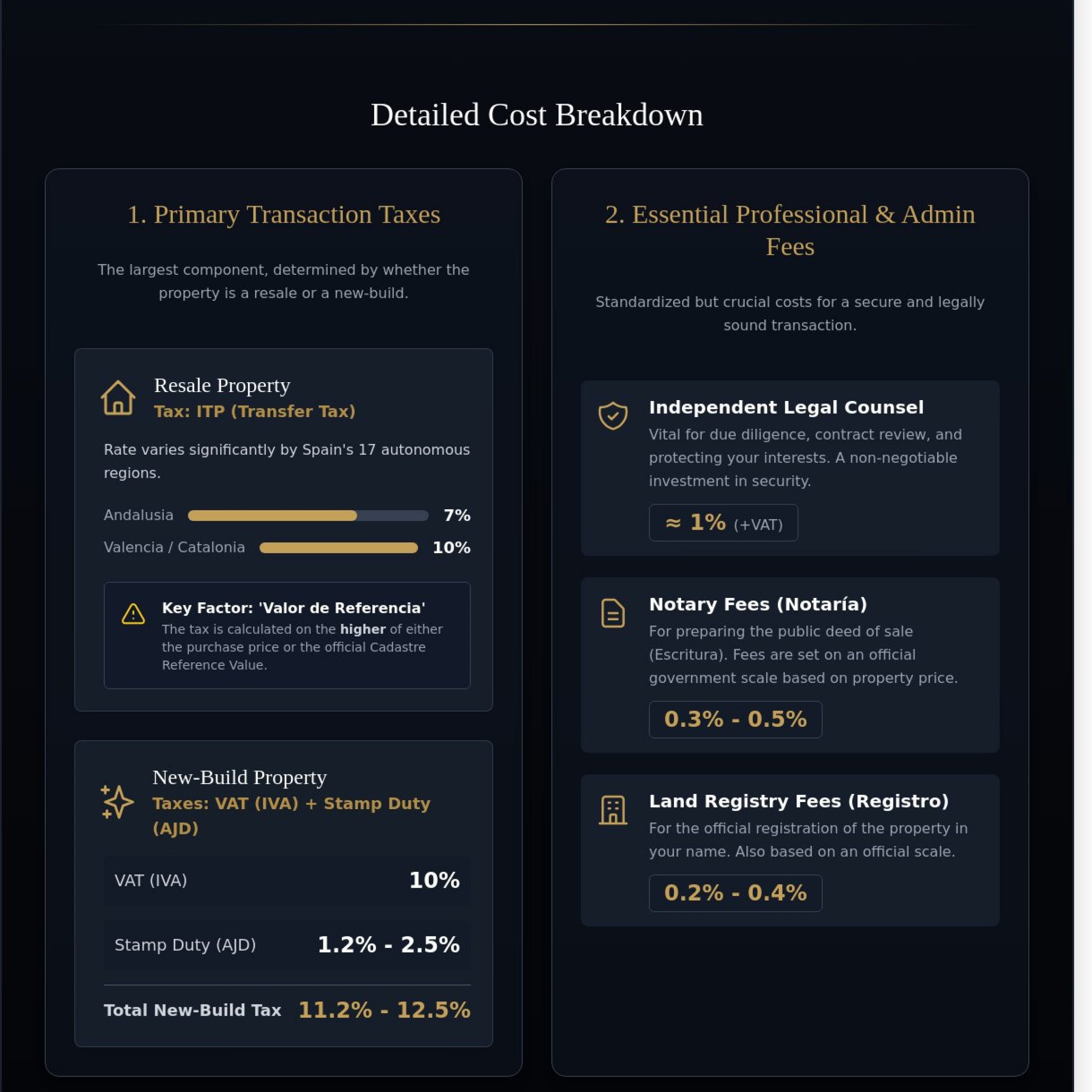
Securing a Mediterranean sanctuary involves more than the initial sticker price. The tax framework in Spain is sophisticated, requiring a discerning eye to navigate with precision. Whether you’re eyeing a contemporary masterpiece in Marbella or a historic estate in Mallorca, the fiscal path depends entirely on the property’s history. These costs represent a significant portion of the total cost of buying a villa in Spain 2026, often adding between 10% and 13% to your final investment.
Resale Properties and the Transfer Tax (ITP)
Purchasing a pre-owned villa triggers the Impuesto sobre Transmisiones Patrimoniales (ITP). This tax is managed by autonomous communities, creating a varied landscape across the country. In 2026, standard rates typically fluctuate between 7% and 10%. For instance, Andalusia maintains a competitive flat rate of 7%, while regions like Catalonia or Valencia often reach the 10% threshold for luxury assets.
A critical factor for the cost of buying a villa in Spain 2026 is the Valor de Referencia. This value is determined by the Spanish Cadastre and acts as the minimum tax base. If the purchase price is lower than this official figure, the tax is calculated on the higher reference value. It’s a measure designed to ensure transparency, yet it requires buyers to perform due diligence before the notary appointment. Some regions offer reduced ITP rates, sometimes as low as 3% or 5%, for buyers who intend to use the villa as a primary residence or for those under the age of 35, depending on specific local wealth caps.
New-Build Villas: VAT (IVA) and Stamp Duty (AJD)
New-build residences represent the pinnacle of modern luxury and follow a distinct fiscal trajectory. Instead of ITP, buyers pay Impuesto sobre el Valor Añadido (VAT or IVA). In 2026, the standard residential rate for new properties remains fixed at 10% of the purchase price. This amount is typically paid in installments that mirror construction milestones, culminating in the final payment at the signing of the public deed.
In addition to VAT, new properties incur Actos Jurídicos Documentados (AJD), commonly known as Stamp Duty. This tax covers the legal formalization of public documents. Rates vary by community, generally falling between 0.5% and 1.5%. For example, Madrid often sits at the lower end of this scale at 0.75%, while other coastal regions may charge the full 1.5%. Because these taxes are calculated on the deed value, they form a non-negotiable part of your acquisition capital.
Understanding these nuances ensures your transition into Spanish life remains seamless and rewarding. Partnering with a bespoke property advisor allows you to model these costs accurately, ensuring your investment aligns perfectly with your lifestyle goals.
The Essential Professional Fees: Notaries, Legal Counsel, and Registry
Securing a luxury residence in the Mediterranean requires more than just a signature. It demands a curated team of professionals who act as the gatekeepers of your financial security. These experts ensure that your transition into Spanish life is as smooth as the coastal breeze. When calculating the total cost of buying a villa in Spain 2026, budgeting for this administrative backbone is the first step toward a successful investment.
The Notary and Land Registry: Securing Your Title
The Notary serves as the state’s guarantor of legal certainty. They don’t just witness a signing; they verify that the contract complies with Spanish law and that the parties understand their obligations. Notary fees are strictly regulated by the government under Royal Decree 1426/1989. This creates a predictable sliding scale based on the property value, ensuring transparency for every buyer.
Once the Notary seals the deed, the Land Registry (Registro de la Propiedad) becomes your primary defense. Registering your title is the only way to protect your rights against third-party claims or future disputes. Combined, these official fees usually amount to 1% to 1.5% of the purchase price. This is a small price for the absolute certainty that your sanctuary is legally yours.
Bespoke Legal Assistance and its ROI
Independent legal counsel is the most valuable asset in your portfolio. While some might see a lawyer as an additional expense, the return on investment is undeniable. Paying a 1% fee for a specialized solicitor often saves you 10% or more in potential legal complications, hidden debts, or structural issues. It’s the ultimate insurance policy for high-net-worth individuals.
Your lawyer performs vital due diligence that goes beyond the surface. They investigate the Nota Simple to ensure there are no outstanding mortgages or tax liens attached to the property. They also verify planning permissions, ensuring that the stunning terrace or guest house was built with full municipal approval. This prevents costly demolition orders or fines years down the line.
A dedicated legal team also handles the logistical nuances of international relocation. They facilitate the seamless acquisition of your NIE (Tax Identification Number) and assist with opening local bank accounts. This level of service transforms a complex cross-border transaction into a refined, stress-free experience. Their presence ensures the cost of buying a villa in Spain 2026 remains a logical investment rather than a financial risk.
After the keys are in your hand, the Gestoria steps in to finalize the process. These administrative specialists handle the post-completion paperwork that many international owners find daunting. They ensure that the Transfer Tax (ITP) or VAT (IVA) is paid via Form 600 within the strict 30-day deadline required by Spanish tax authorities. Their expertise prevents late-payment penalties and ensures your title is filed correctly at the Land Registry.
Choosing the right professionals is about more than just checking boxes. It’s about building a relationship with experts who value your investment as much as you do. By surrounding yourself with a sophisticated legal and administrative team, you unlock the door to a lifestyle defined by security and prestige.
Post-Purchase and Hidden Costs: Budgeting for Your Sanctuary
Owning a prestige property in the Mediterranean represents a significant lifestyle shift. Beyond the initial acquisition, the ongoing cost of buying a villa in Spain 2026 requires a nuanced understanding of fiscal logistics. These secondary expenses ensure your investment remains a pristine sanctuary rather than a source of unexpected stress.
Currency Exchange and Financial Logistics
For international buyers outside the Eurozone, exchange rate volatility is a silent variable. A shift of just 2% on a €3,000,000 transaction alters the final price by €60,000. Traditional banks often apply spreads that erode your purchasing power. We recommend utilizing specialized currency brokers to secure fixed rates and seamless transfers.
If you’re financing your villa, expect mortgage arrangement fees to range between 1% and 1.5% of the loan value. These upfront costs, combined with valuation fees of approximately €500 to €2,000, are essential components of your 2026 financial roadmap. Selecting a bespoke lender can often mitigate these initial hurdles.
Maintaining the Sanctuary: Annual Running Costs
Your villa demands consistent care to retain its market value and aesthetic appeal. The primary recurring tax is the IBI (Impuesto sobre Bienes Inmuebles). Calculated based on the property’s cadastral value, this municipal tax typically falls between 0.4% and 1.1% annually. Non-residents must also budget for the Non-Resident Income Tax, an annual filing based on a percentage of the property value.
Luxury living involves more than just taxes. Professional property maintenance and key-holding services are vital for peace of mind when you’re away. This includes:
- Weekly pool cleaning and chemical balancing to ensure year-round clarity.
- Landscaping for manicured Mediterranean gardens and irrigation management.
- Advanced security system monitoring and rapid response protocols.
Embracing this lifestyle also means enjoying the vibrant culture surrounding your home. Whether you’re dining at exclusive beach clubs or exploring things to do in malaga city spain, these experiences define the true value of your investment. A well-managed property allows you to focus on the experience rather than the upkeep.
Initial utility connections for electricity, water, and high-speed fiber-optic internet often carry administrative fees totaling €800 to €1,200 in 2026. Comprehensive insurance premiums have also seen adjustments. High-value villa coverage now starts around €1,500 annually to protect against unforeseen environmental factors and protect your curated interiors.
Our team provides the expert guidance needed to navigate these complexities with confidence and clarity. Contact our advisors today to secure your future in Spain and unlock the door to your new life.
Strategic Financial Planning: How KEYS property group Unlocks Your Investment
Securing a luxury residence in the Mediterranean requires a strategy that transcends simple price tags. As you evaluate the cost of buying a villa in Spain 2026, the most significant asset in your portfolio will be the expertise you choose to align with. KEYS property group serves as your sophisticated guide, transforming a complex international acquisition into a curated, stress-free journey.
Our role is to provide a bridge between your vision and the reality of the Spanish market. We manage the intricate details, from initial legal facilitation to strategic currency exchange. By coordinating these moving parts, we ensure your investment is protected from the start, allowing you to focus on the lifestyle that awaits you.
Bespoke Services for the Discerning Buyer
With over 20 years of experience in high-end real estate, we offer an unparalleled advantage to our clients. We’ve spent two decades cultivating a network of elite legal and financial partners. These specialists ensure every transaction is seamless, handling everything from tax optimization to compliance with the latest 2026 Spanish property regulations.
Our commitment doesn’t end when the contracts are signed. We provide a boutique approach to property management that treats your villa as a sanctuary. Whether it’s meticulous maintenance or secure key holding, our post-sale expertise ensures your asset remains in peak condition. This long-term care is essential for preserving the value of your Spanish retreat.
Your Key to the Spanish Market
The cost of buying a villa in Spain 2026 includes many variables, but a trusted advisor is the one investment that pays dividends in peace of mind. Understanding local nuances requires more than just data; it requires the intuition of a partner who understands the soul of the region. We’re here to help you define your 2026 roadmap through a personalized consultation tailored to your unique goals.
We invite you to explore our exclusive selection of properties, each chosen for its exceptional quality and investment potential. Your journey toward a new life in Spain begins with a single, decisive step toward excellence. We look forward to unlocking the door to your future sanctuary.
Discover our bespoke villa collection and start your journey with KEYS property group today.
Secure Your Legacy in the Mediterranean
Owning a piece of the Spanish coast is a transformative journey that begins with absolute financial clarity. You’ve now explored how primary transaction taxes like ITP and VAT, combined with essential legal fees, define the true capital requirement for your luxury sanctuary. Navigating these intricacies demands a precise strategy and an eye for detail to ensure your transition is as smooth as the coastal breeze.
Success in this market requires a proactive approach to budgeting for both visible and hidden expenses. Mastering the total cost of buying a villa in Spain 2026 allows you to move from the initial search to a seamless closing with absolute certainty. By aligning your financial planning with current market regulations, you protect your investment and your peace of mind.
At KEYS property group, we act as your trusted advisor through every stage of this sophisticated process. Our team brings over 20 years of local expertise to the table, offering a curated portfolio of luxury villas and plots alongside bespoke end-to-end management and legal support. We don’t just facilitate transactions; we provide the essential bridge to your new lifestyle in paradise.
Unlock your dream lifestyle: Contact KEYS property group for a curated villa consultation
Your future under the Spanish sun is waiting, and we’re ready to help you unlock the door to excellence.
Frequently Asked Questions
What is the total percentage I should budget on top of the villa price in 2026?
You should budget between 12% and 15% of the purchase price to cover all associated acquisition costs. This comprehensive margin accounts for the 10% VAT or Property Transfer Tax, alongside notary fees and land registry charges. Planning for these expenses ensures the cost of buying a villa in Spain 2026 remains transparent and manageable from the very first viewing.
Is it more expensive to buy a new-build villa or a resale property in Spain?
New-build villas generally involve a higher tax burden compared to resale properties. Buyers of new homes pay 10% VAT plus a Stamp Duty that typically ranges from 0.5% to 1.5% depending on the region. Resale properties avoid VAT, instead attracting a Property Transfer Tax between 6% and 10%. This difference makes the initial investment for a bespoke modern sanctuary slightly higher than for a pre-owned estate.
Do I need a Spanish bank account and NIE number to buy a villa?
Securing a Spanish bank account and a NIE tax identification number is a mandatory requirement for any property transaction. The NIE is essential for signing the deed and paying your taxes to the Spanish Treasury. A local bank account ensures that utility payments and future tax obligations are handled through a seamless, automated process. Our expert guides often facilitate these steps to ensure your journey is effortless.
What are the hidden costs of currency exchange when buying property in Spain?
Currency exchange often hides significant costs within the spread between the buy and sell rates offered by traditional banks. These margins can consume up to 3% of your total capital, which equates to 30,000 Euro on a 1,000,000 Euro transaction. Utilizing a specialist currency broker provides a more curated approach. This strategy protects your investment from market volatility and secures a more favorable rate for your international transfer.
How much are the annual taxes for a non-resident villa owner in Spain?
Non-resident owners are responsible for two primary annual taxes: the local IBI and the national IRNR. The IBI is a municipal tax ranging from 0.4% to 1.1% of the property cadastral value. The IRNR is an imputed income tax, usually calculated at 19% for EU residents or 24% for non-EU residents. These costs ensure your Mediterranean sanctuary remains in good standing with local authorities throughout your ownership.
Are real estate agent fees paid by the buyer or the seller in Spain?
Real estate agent fees are traditionally paid by the seller in the Spanish property market. These commissions usually range from 3% to 5% of the final sale price and are typically agreed upon before the property is listed. As a buyer, you benefit from professional expertise and local market knowledge without an additional direct fee. If you are preparing to list a property in the US to fund your Mediterranean move, you may also wish to explore Seller Representation to maximize your return. This structure allows you to focus your resources on the lifestyle elements of your new investment.
What happens if the Valor de Referencia is higher than my purchase price?
If the official Valor de Referencia exceeds your actual purchase price, the Spanish tax authorities will calculate your taxes based on that higher figure. This cadastral value acts as the minimum taxable base for Property Transfer Tax and Inheritance Tax. It’s a vital component to verify during your due diligence process. Understanding this valuation is a key part of calculating the total cost of buying a villa in Spain 2026 with absolute precision.
Can I get a mortgage in Spain as a foreigner in 2026?
Foreign investors can readily access mortgage products in Spain, typically securing a loan-to-value ratio between 60% and 70%. Spanish lenders offer competitive fixed and variable rates to non-residents who meet their refined financial criteria. This leverage provides a sophisticated way to manage your liquidity while investing in a premium lifestyle asset. Our network of specialist lenders provides bespoke financing solutions tailored to your unique global portfolio.
Properties in Investing in Excellence: The Comprehensive Cost of Buying a Villa in Spain 2026