
The Essential Role of a Notary in a Spanish Property Purchase
If you believe your lawyer is the final authority on your Mediterranean villa, you might be overlooking the most powerful figure in the room. While your legal team protects your personal interests, the role of a notary in Spanish property purchase is to act as the ultimate impartial gatekeeper for the state.
It’s understandable to feel a sense of anxiety as the completion ceremony draws near. The transition from browsing sunny terraces to signing complex legal documents in a formal office can feel like a significant leap for any buyer.
You deserve to understand exactly how this official secures your investment and provides the legal peace of mind you need. This article clarifies the notary’s essential functions, explains the mandatory fees you’ll encounter, and prepares you for the moment you finally receive your keys.
We’ll explore why this public official is mandatory for every sale and how they ensure your new home is free of hidden burdens. You’ll gain a clear roadmap of the process, ensuring your transition to a new life in Spain is as smooth as it is secure.
Key Takeaways
- Understand why the Spanish Notary acts as a neutral public official to ensure your property transaction meets every legal requirement.
- Explore the specific role of a notary in Spanish property purchase, including their duty to verify the property’s debt-free status before you sign.
- Prepare for the completion ceremony by learning how the Escritura is finalized and why the Notary must read the document to all parties.
- Learn how notary fees are calculated according to a regulated government scale, providing transparency for your closing costs.
- Discover the critical steps the Notary takes immediately after signing to secure your title in the Land Registry.
Understanding the Notary as the Primary Gatekeeper in Spain
In Spain, the Notario is far more than a simple witness to a signature. They are highly trained legal professionals and public officials who hold a unique position within the Spanish legal framework.
This dual status means they operate as private professionals you hire, yet they remain strictly bound by their duties as civil servants. Their primary objective isn’t to take sides, but to ensure every detail of the transaction aligns perfectly with Spanish law.
The role of a notary in Spanish property purchase is so fundamental that you cannot officially record your ownership in the Land Registry without their intervention. They act as the state’s eyes and ears, verifying that the transfer of property is legitimate and binding.
Choosing a notary is often the final step in the property buying process in Spain. While your lawyer handles the initial negotiations, the notary provides the final stamp of state authority that turns a private agreement into a public fact.
The Crucial Difference Between a Lawyer and a Notary
It’s a common misconception that having a lawyer makes the notary redundant. While your lawyer is your dedicated advocate, the notary represents the law itself and remains strictly impartial between the buyer and seller.
Spain follows the Civil-law notary system, which requires these officials to undergo years of rigorous study. They must pass some of the most difficult competitive exams in the country to earn their title.
This expertise allows them to draft the public deed, or Escritura, with absolute precision. They take a private contract and elevate it into the public domain, making it enforceable against third parties and the state.
The Notary as a Provider of Legal Certainty
The Spanish constitution mandates that notaries provide extra-judicial legal certainty. This means they prevent future legal disputes by ensuring every document they sign is legally watertight from the start.
Their involvement protects everyone involved in the sale. The state receives accurate tax data, the seller receives their payment, and you receive the guarantee that your new home is legally yours.
This high-level professional oversight offers a layer of security that is rare in many other jurisdictions. It transforms the role of a notary in Spanish property purchase from a bureaucratic hurdle into a vital source of peace of mind for international investors.
Core Responsibilities of the Notary During the Purchase
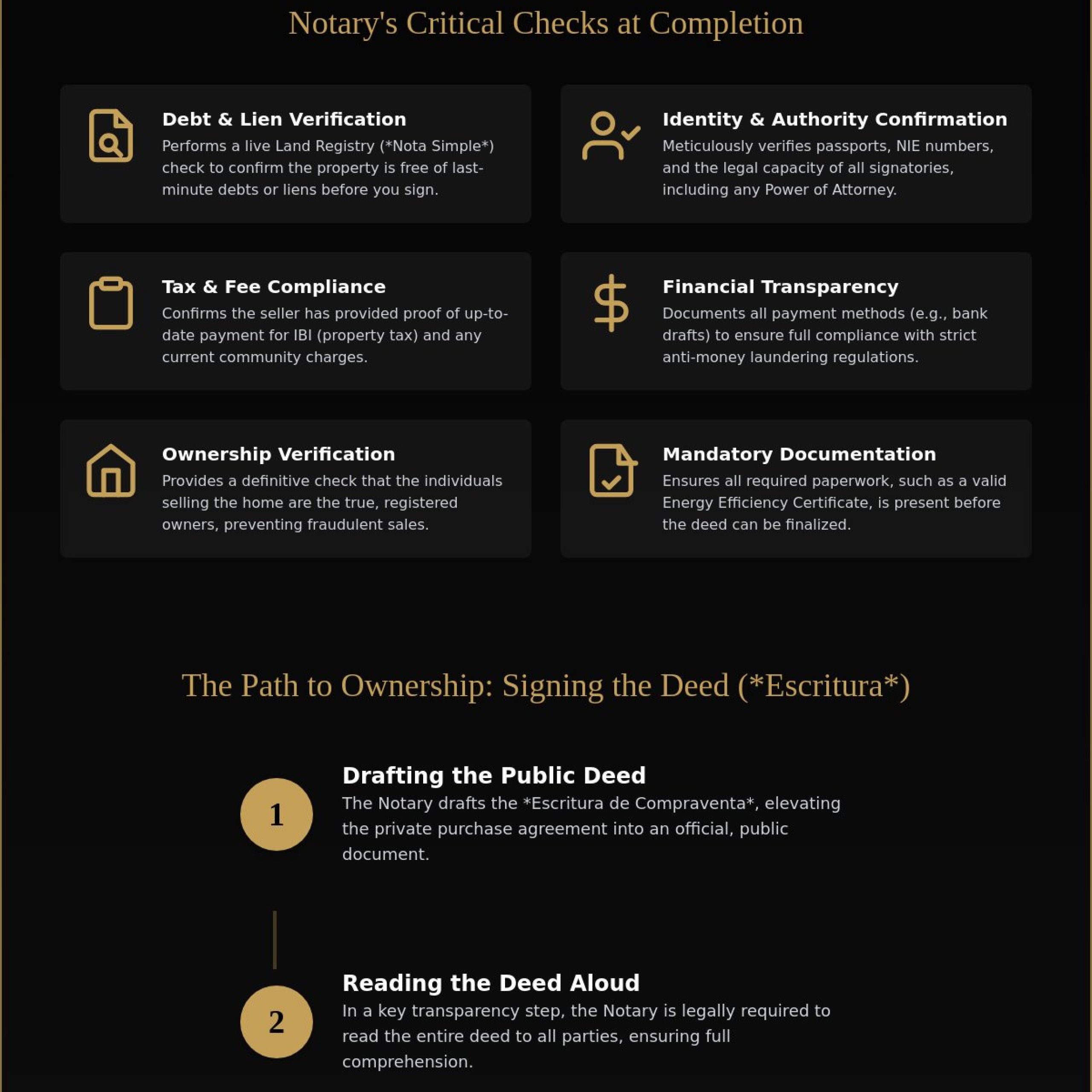
The role of a notary in Spanish property purchase is an active, protective measure rather than a passive signature. They perform a deep-dive audit at the moment of signing to ensure the transaction is beyond reproach and legally sound.
This includes a real-time check of the Nota Simple to confirm no new debts or liens have appeared on the property since your lawyer’s last search. They also verify that the seller has provided proof of payment for the latest IBI tax and current community charges.
Financial transparency is a high priority during this stage. The notary must verify that all payment methods comply with strict anti-money laundering regulations, documenting every bank draft or transfer used in the sale.
If you’re ready to take the next step in your investment journey, our team can guide you through the property buying process in Spain with complete confidence.
Verifying Identity and Legal Authority
For international buyers, the notary meticulously checks valid passports and original NIE numbers. They must ensure that every person signing the document has the full legal capacity to enter into a binding contract under Spanish law.
If you cannot attend the signing in person, the notary will verify the validity of any Power of Attorney. They confirm that the representative has the specific authority required to purchase property on your behalf without any legal ambiguity.
This process includes a definitive check that the individuals selling the home are indeed the registered owners. This step prevents fraudulent sales and ensures the chain of title remains unbroken for your future security.
Real-Time Legal and Financial Compliance
The Official functions of a Spanish Notary also include checking for mandatory documentation like the Energy Efficiency Certificate. These documents must be valid and present for the deed to be finalized in 2026.
Compliance with local urban planning laws is another high priority for the notary. They check that the property isn’t subject to any municipal infractions that could cause future legal headaches or unexpected costs for the new owner.
Finally, the notary witnesses the actual exchange of funds, usually in the form of bank-certified drafts. This provides a secure environment for the largest financial transfer of your purchase, ensuring you can find your dream home among our property listings with peace of mind.
The Completion Ceremony: Signing the Escritura
The signing day is the emotional and legal climax of your property journey. It takes place in the notary’s office, usually around a large boardroom table where all parties gather for the final ceremony.
The role of a notary in Spanish property purchase becomes most visible here as they read the entire “Escritura de Compraventa” aloud. This mandatory step ensures every clause, from the property boundaries to the payment breakdown, is explicitly understood by all parties before the ink touches the paper.
If you aren’t fluent in Spanish, the law requires an official translator to be present. They’ll translate the notary’s words in real-time, confirming you’re fully aware of your rights and obligations before you commit.
Once the reading is finished and any final questions are resolved, the signing begins in a specific order. This is followed immediately by the physical handover of the keys, marking the official moment you become a homeowner in Spain.
What to Expect During the Notary Meeting
You must bring your original passport and NIE certificate to the appointment. If you’ve secured a mortgage, a representative from your bank will also be present to sign the mortgage deed simultaneously.
Real estate agents and lawyers typically attend to ensure the logistics, such as the final utility meter readings, are handled correctly. It’s your final opportunity to verify technical details or confirm the inclusion of specific fixtures before the agreement becomes a permanent public record.
The atmosphere is professional and methodical, designed to give you total confidence in the transaction. You’ll find that the notary’s presence provides a structured environment where every detail is double-checked for accuracy.
The Handover of the Copia Simple
Immediately after the signing, the notary provides you with a “Copia Simple”. This is an unofficial but authorized copy of the deed that serves as your immediate proof of ownership.
This document is different from the final “Escritura Pública”, which takes several weeks to be fully processed and registered. You’ll need the Copia Simple to set up utilities and arrange for property management services.
Store these documents with care in a safe location. They represent the foundation of your legal standing in Spain and will be essential for future tax declarations or if you eventually decide to sell your investment.
Navigating Notary Fees and Selection Logistics
The financial side of the transaction often brings questions about costs and who decides which office to oversee the sale. The role of a notary in Spanish property purchase involves a fee structure that is highly transparent because it’s strictly regulated by the Spanish government.
This regulation ensures that all notaries charge the same amount for the same service, regardless of where their office is located. It provides a level of consumer protection that prevents price gouging and maintains a standard of professional integrity across the country.
A critical detail many buyers overlook is their legal right to choose the specific notary office for the transaction. While sellers or developers might suggest a specific professional, the buyer typically has the final say in who oversees the signing of the deed.
Once you’ve identified an office, you’ll need to coordinate the appointment timing with your legal assistance team. They will ensure all drafts are reviewed and approved before you arrive for the final signing.
Understanding the Calculation of Fees
The government sets a fixed scale based on the property’s declared value. For a property valued at €300,000 in 2026, you should expect notary fees to range between €800 and €900. If your investment is around €500,000, the fee typically reaches approximately €1,000 to €1,200.
Several factors influence the final invoice beyond the purchase price alone. The length of the deed and the number of authorized copies you request will impact the total. If you’re securing a mortgage, keep in mind that the fees for the mortgage deed are separate from the purchase deed itself.
Most buyers find that budgeting between 0.5% and 1% of the purchase price covers these professional fees comfortably. This is a small but vital portion of the overall 10% to 15% you should set aside for total buying costs in Spain.
Exercising Your Right to Choose
Choosing a notary located near the property is often the most practical decision. This local proximity ensures the notary is familiar with specific municipal regulations and can coordinate easily with local town halls for last-minute checks.
Your real estate agent can be an invaluable resource in this selection process. They often work with offices that have extensive experience with international clients and offer multi-lingual staff to ensure a smooth communication flow. This expertise is particularly helpful when navigating the technical language of the Escritura.
Prioritizing an office with a strong professional reputation ensures your completion day remains efficient and stress-free. If you’re ready to find your ideal home and need expert guidance on the logistics, contact us today to start your journey with a dedicated partner.
Post-Completion: From Signing to Secure Ownership
The role of a notary in Spanish property purchase extends beyond the physical signing of the deed. As soon as the ceremony concludes, the notary sends an electronic notification to the Land Registry to block any other entries against the property.
This immediate action protects you from “double selling” or any last-minute liens being registered against your new home. It’s the final layer of state-backed security that ensures your investment is legally ring-fenced from the moment you leave the office.
Once this is done, the notary’s office begins the process of preparing the formal public instrument. This work forms the essential legal foundation for your future property maintenance and key holding needs.
The Transition to the Land Registry
The role of a notary in Spanish property purchase remains vital during the transition to the Land Registry. While the electronic notice is instant, the full registration process typically takes between two and three months to complete in 2026.
A professional “Gestoría” usually handles the administrative heavy lifting during this period. They’re responsible for paying the relevant taxes, such as the Property Transfer Tax (ITP), which must be settled within 30 business days of the signing date.
Once the taxes are paid and the Registrar is satisfied, you’ll receive the original Escritura stamped by the Land Registry. This document is the definitive proof of your title and will be required for any future legal or financial dealings involving the property.
Ensuring Long-Term Investment Security
Holding a clean title deed is the key to a stress-free ownership experience in Spain. It simplifies everything from future sales to inheritance processes, ensuring your asset remains a source of joy rather than a legal burden.
This level of security allows you to focus on enjoying your new lifestyle and the potential of your investment. We invite you to explore our latest property listings to discover the exceptional villas and apartments currently available in the region.
Our commitment to your success continues long after the notary has filed the final paperwork. If you have questions about the next steps or require comprehensive post-sale support, please contact our team for expert guidance.
Your Secure Path to Mediterranean Living
You now understand that the Spanish Notary is the ultimate guarantor of your property’s legal integrity. From the real-time verification of debts to the formal signing ceremony, their presence ensures your transition to a new lifestyle is built on a solid foundation.
Recognizing the role of a notary in Spanish property purchase allows you to approach your completion day with clarity and confidence. This professional oversight, combined with a clear understanding of regulated fees, removes the uncertainty often associated with buying abroad.
With over 20 years of expertise in the Spanish property market, our team provides the comprehensive support you need. We specialize in international buyer requirements, offering everything from initial legal aid to long-term key holding and property maintenance.
Secure your Spanish property investment with our expert guidance. Your dream of a home in the sun is within reach, and we’re here to ensure every step is handled with the care and precision you deserve.
Frequently Asked Questions
Is the involvement of a notary mandatory when buying property in Spain?
Yes, the involvement of a notary is legally mandatory if you wish to register your ownership in the Land Registry. While a private contract between a buyer and seller is valid, only a public deed signed before a notary provides the legal security required for state-level protection.
This official process ensures the transaction is recorded in the public domain. It’s the only way to guarantee your title is enforceable against third parties or future claims.
Can I choose my own notary or does the seller decide?
You have the absolute legal right to choose the notary office for your transaction as the buyer. This is a fundamental part of the role of a notary in Spanish property purchase, ensuring you select an official who provides the efficiency and professional reputation you expect.
While developers or sellers may suggest a specific office, you aren’t obligated to use them. Choosing a notary close to your new property is often the most practical choice for local administrative coordination.
What is the average cost of notary fees for a standard apartment purchase?
Notary fees are regulated by a government scale and depend primarily on the property’s value. For a standard apartment priced at €300,000, the fee typically ranges between €800 and €900. If the property is valued at €500,000, you should budget approximately €1,000 to €1,200.
The final invoice may vary slightly based on the number of pages in the deed or the number of official copies you request. These costs are a standard part of the 10% to 15% additional budget recommended for Spanish property purchases.
Does the notary verify that the property has no hidden structural defects?
No, the notary’s responsibility is strictly limited to legal and administrative verification. They ensure the seller is the rightful owner and the property is free of debt, but they don’t inspect the physical condition of the building.
To protect yourself against structural issues, you must hire a professional surveyor or architect. This physical due diligence should be completed well before you reach the final signing ceremony at the notary office.
What happens if I do not speak Spanish during the notary signing?
If you aren’t fluent in Spanish, the law requires an official translator to be present during the signing ceremony. The notary has a professional obligation to ensure you fully understand every clause of the Escritura before you sign it.
The translator will provide a real-time explanation of the document as the notary reads it aloud. This ensures there’s no ambiguity regarding your rights or the technical details of your new investment.
How long does the completion ceremony at the notary office usually take?
The completion ceremony typically takes between 60 and 90 minutes. This timeframe allows the notary to verify everyone’s identity, read the entire deed aloud, and answer any final technical questions from the parties involved.
If there’s a mortgage involved, the process may take slightly longer as the bank representative must also sign the mortgage deed. Once all signatures are collected, the physical handover of the keys happens immediately.
Is a notary the same as a lawyer in the Spanish system?
No, they are distinct roles with different objectives. Your lawyer is your personal advocate who performs deep due diligence and protects your specific interests throughout the role of a notary in Spanish property purchase.
In contrast, the notary is a neutral public official who represents the law and the Spanish state. They don’t provide private legal advice but instead ensure the entire transaction complies with national regulations and urban planning laws.
When do I actually receive the keys to my new Spanish home?
You receive the keys to your property the moment the final signature is placed on the public deed at the notary’s office. This physical handover is the official conclusion of the sale and signifies the immediate transfer of possession.
Before handing over the keys, the notary will verify that the full payment has been made, usually via bank-certified drafts. From that moment on, you’re the legal owner and can begin your new life in Spain.
Properties in The Essential Role of a Notary in a Spanish Property Purchase