
Setting Up Utilities in a New Spanish Home: A 2026 Guide
What if the most complex part of moving into your Spanish villa isn’t the international relocation, but simply ensuring the lights turn on when you arrive? Managing the intricacies of setting up utilities in a new Spanish home often feels like a masterclass in local bureaucracy and technical jargon. This process requires a delicate balance of local knowledge and professional oversight to avoid unnecessary delays.
It’s understandable to feel overwhelmed by the “potencia” system or the language barriers that often arise with local providers. You deserve a move-in experience that’s defined by elegance and ease rather than administrative hurdles. Our boutique approach ensures that your transition into a high-end residence remains a moment of celebration.
This 2026 guide provides the clarity you need to master Spanish utility connections and ensure your residence is as move-in ready as the Mediterranean horizon. We’ll explore current 2026 tax rates, explain how to avoid IBAN discrimination, and help you select the most reliable providers for your lifestyle. Following these steps will transform a logistical challenge into a seamless start to your new life.
Key Takeaways
- Discover the precise steps for setting up utilities in a new Spanish home to ensure your residence is perfectly prepared for your first night.
- Gain clarity on the “potencia” system and energy tariffs to balance high-end comfort with efficient monthly costs.
- Navigate the localized nuances of water and waste management services that vary across Spain’s prestigious regional markets.
- Compile a comprehensive documentation checklist to navigate Spanish bureaucracy with the confidence of a seasoned local expert.
- Learn how professional property maintenance and key holding can preserve your home’s sanctuary status even when you are abroad.
Navigating Utility Connections for Your New Spanish Residence
Transitioning into a Spanish residence is more than a property transaction; it’s an aspirational milestone. Securing your essential services represents the final, vital step in transforming a beautiful structure into a functional sanctuary.
Spain provides a sophisticated, deregulated market for most services. This openness offers discerning owners significant flexibility when selecting providers that align with their specific lifestyle needs and aesthetic values.
Mastering the process of setting up utilities in a new Spanish home allows you to focus on the joy of your new surroundings from the very first moment. Early preparation ensures your move-in date is met with absolute comfort and refined functionality.
The Importance of Timely Connection
Timing is everything when preparing your residence. Ideally, you should begin the administrative process shortly after signing the “Contrato de Arras”, or the deposit agreement, rather than waiting for the final completion.
Waiting until the final deed is signed at the notary often leads to avoidable delays. A home that’s fully operational upon arrival means you can immediately begin exploring the best things to do in Malaga city Spain without worrying about basic logistics.
The electricity sector in Spain has evolved to be highly efficient, yet bureaucratic timelines remain firm. Proactive planning ensures your climate control and lighting are ready the moment you turn the key for the first time.
Choosing Between New Contracts and Takeovers
Existing properties usually allow for a “Cambio de Titularidad”, or a change of ownership. This method is significantly faster than requesting a brand-new installation, as it maintains the existing connection to the grid and avoids complex re-registration fees.
Taking over an existing contract is the most elegant way of setting up utilities in a new Spanish home. It bypasses the need for technical inspections that are often required for dormant supply points or newly built structures.
It’s essential to verify that no outstanding debts remain from previous owners. Unpaid balances can attach to the property’s supply point, potentially complicating your new contract if not addressed during the due diligence phase of your purchase.
Our experts recommend requesting a “certificado de estar al corriente de pago” from the current owner. This document provides the reassurance that you’re starting your new life on a clean slate, free from the previous occupant’s financial obligations.
Managing Electricity and Gas: Providers and Power Ratings
Setting up utilities in a new Spanish home requires a refined understanding of the local energy landscape. While urban penthouses often utilize natural gas, remote villas frequently rely on propane or sophisticated green energy solutions to maintain their high-end standards.
Modern residences are increasingly adopting sustainable providers to match an eco-conscious lifestyle. This shift ensures your home remains a sanctuary while contributing to the region’s environmental preservation through renewable sources.
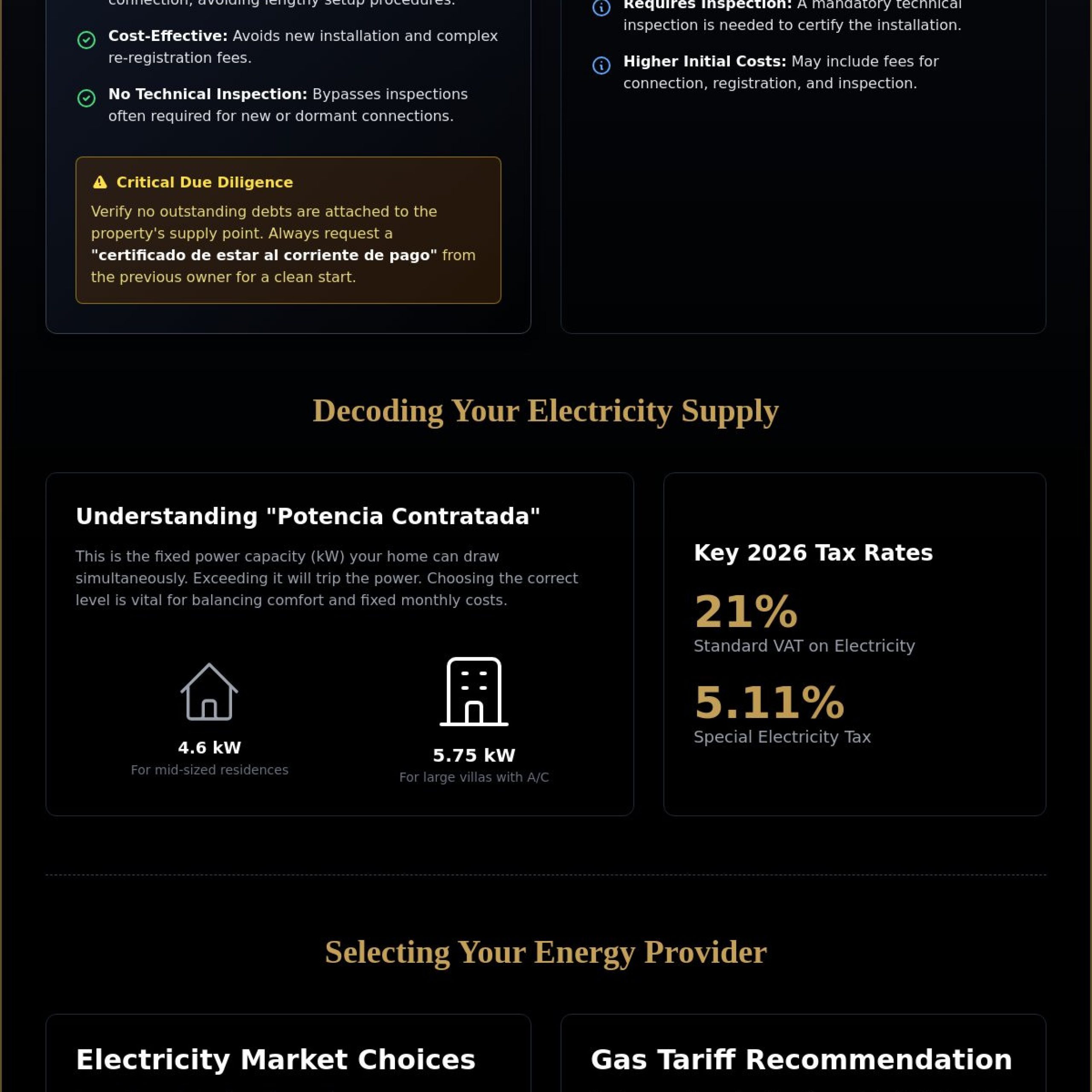
Your monthly bill reflects more than just consumption; it includes fixed charges and updated tax rates. As of June 2026, the standard VAT on electricity is 21%, while the Special Electricity Tax has returned to its standard rate of 5.11%.
Understanding Potencia Contratada
A unique aspect of the Spanish system is “Potencia Contratada,” which represents the fixed power capacity your home can draw simultaneously. If your usage exceeds this limit, the Power Control Switch (ICP) will trip, temporarily halting your supply until the load is reduced.
To calculate the correct power rating for a large villa with air conditioning, you must aggregate the peak wattage of all climate control units and major appliances likely to run at the same time. Selecting a level like 5.75 kW is suitable for larger homes, while 4.6 kW often suffices for mid-sized residences.
Choosing the correct level is vital for managing fixed costs without compromising your daily comfort. This technical detail is a cornerstone of successfully setting up utilities in a new Spanish home, ensuring your lifestyle remains uninterrupted and elegant.
Selecting the Right Energy Provider
You can choose between the regulated market (PVPC) and the free market (Mercado Libre). The PVPC calculation now uses a combination of daily market prices and futures to smooth out volatility, providing more predictable bills for discerning residents.
For gas, the regulated TUR tariff is often the most cost-effective choice for heating and cooking. Current Q2 2026 rates for TUR 2, common for homes with gas heating, include a fixed monthly term of €8.11 alongside consumption charges.
Holiday home owners often find “Time of Use” tariffs particularly beneficial for optimizing costs during high residency periods. For those seeking comprehensive oversight, our property maintenance services provide peace of mind by managing these technical details on your behalf.
Solar energy integration is also rising in new developments, offering a blend of independence and luxury. For more technical details on documentation and provider selection, consult this guide to setting up utilities in Spain.
Essential Water and Waste Management Services
Water is the lifeblood of any residence, particularly for villas featuring lush Mediterranean gardens or private infinity pools. Unlike the energy market, water supply in Spain is a localized service managed by municipal entities or specific private contractors assigned to your district.
Understanding the nuances of your specific province is a key part of setting up utilities in a new Spanish home. Connection processes vary significantly, often reflecting the unique infrastructure and historical water rights of the local landscape. We recommend a professional inspection of your internal plumbing to ensure both pressure and quality meet the standards of a luxury lifestyle.
Billing usually occurs on a quarterly cycle rather than monthly. This invoice is comprehensive, often bundling water consumption with sewage fees and regional environmental levies. It’s a structured system designed to maintain the delicate balance of Spain’s natural resources.
The Municipal Water Contract
You cannot shop around for water providers like you can for electricity. Each municipality has a designated supplier, such as Canal de Isabel II in Madrid or Acosol on the Costa del Sol. For more detail on these administrative steps, this comprehensive guide to setting up utilities offers a deep dive into the specific paperwork required.
Newly built properties require a “Boletín de Agua,” which is a formal plumbing certificate confirming the installation meets current technical regulations. If you are purchasing a pre-owned residence, the process involves a simple transfer of the existing contract to your name. This ensures the supply remains active during your transition.
Quarterly billing cycles help smooth out the seasonal variations in water usage. These bills are typically settled via direct debit from your Spanish bank account. It’s a seamless process that requires minimal oversight once the initial mandate is established.
Waste Collection and Local Taxes
The “Basura” tax is a specific fee that covers the regular collection and processing of household waste. Depending on your municipality, you might pay this directly to the town hall annually or as a smaller line item on your quarterly water bill. It’s important to clarify which system your local “Ayuntamiento” uses to avoid any missed payments.
This service is vital for maintaining the pristine environment of high-end residential areas. It ensures that the streets and communal spaces surrounding your villa remain as manicured and inviting as the property itself. High standards of waste management contribute directly to the long-term value and allure of your neighborhood.
Reliability in these basic services is what allows you to enjoy your Spanish sanctuary without a second thought. Whether you are in a bustling coastal town or a secluded hillside retreat, the local waste management infrastructure is designed to be discreet and efficient. This commitment to local hygiene is a hallmark of Spain’s most prestigious communities.
The Documentation Checklist for a Seamless Setup
Setting up utilities in a new Spanish home is often the final hurdle before your residence is truly alive. Spanish bureaucracy demands a level of precision that can surprise even the most seasoned international investors. Ensuring every document is meticulously prepared is the only way to avoid delays that could stretch into several weeks.
Every piece of paperwork must perfectly match the names listed on your property title deeds. Discrepancies in spelling or middle names often lead to immediate rejection by utility providers. While digital copies are increasingly accepted in 2026, certain municipal offices still require a physical presence or a formal Power of Attorney.
Personal and Financial Identification
Your NIE (Número de Identidad de Extranjero) acts as the administrative cornerstone of your new life in Spain. It’s the primary requirement for every contract, from high-speed fiber optics to basic water supply. You’ll also need to present a valid passport to verify your identity during the initial application process.
A Spanish bank account is equally essential for setting up “domiciliación,” or direct debits. Despite SEPA regulations, many local utility systems still prioritize Spanish IBANs for automatic payments. Having a local account ensures your monthly bills are settled with the elegance and ease your lifestyle demands.
If you prefer to bypass these administrative complexities entirely, our legal assistance team can manage the entire documentation process on your behalf. We specialize in navigating these local requirements to ensure your transition is completely effortless.
Property and Technical Certificates
The “Cédula de Habitabilidad,” or Occupancy Certificate, is a non-negotiable document confirming your home meets all legal living standards. Utility companies are legally prohibited from establishing a new connection without this certificate. You’ll also need to provide the “Escritura” (Title Deed) or a very recent “Nota Simple” to prove your ownership.
Properties older than 20 years frequently require a “Boletín Eléctrico” to verify the internal wiring is safe. This technical certificate ensures your electrical system is compliant with modern codes and can handle your specific power needs. It’s a vital safeguard that protects both your property investment and your daily peace of mind.
Gathering these certificates early in the purchasing process prevents the frustration of a dark home on move-in day. Organizing your technical documentation is a key part of setting up utilities in a new Spanish home with professional confidence. This proactive approach allows you to step into your new sanctuary with everything functioning perfectly from the very first moment.
Professional Support for Long-Term Property Care
Successfully setting up utilities in a new Spanish home is a significant achievement, yet it represents only the beginning of your property’s journey. Maintaining a high-end asset from afar introduces unique challenges that require a local, trusted presence to ensure everything runs smoothly. Many international owners find that managing monthly billing and occasional service interruptions from another country is a source of unnecessary stress.
A boutique approach to property care ensures that your Mediterranean retreat remains a place of relaxation rather than a list of administrative tasks. Entrusting these responsibilities to experts allows you to enjoy the exclusivity of your lifestyle without the burden of local bureaucracy. This long-term oversight is what preserves the sanctuary status of your residence.
The Benefits of Key Holding Services
Our key holding services provide an essential bridge between your residence and the technical experts who maintain it. Having a professional guardian allows utility technicians to access the property for essential repairs or meter upgrades without requiring your physical presence. This eliminates the logistical headache of coordinating international travel for simple maintenance visits.
Regular property inspections are a cornerstone of preventative care. These visits ensure that utility systems are functioning correctly, helping to identify potential leaks or electrical issues before they escalate into costly repairs. It’s a bespoke service designed for those who value their time and the absolute security of their investment.
Comprehensive Property Management
Beyond the initial task of setting up utilities in a new Spanish home, KEYS property group offers ongoing support that spans from legal assistance to routine property maintenance. We act as your local expert, resolving complex billing disputes with providers or managing technical upgrades to your home’s infrastructure. Our team possesses the deep local roots necessary to navigate the Spanish market with confidence.
The personality of our agency is built on a foundation of professional authority and warm hospitality. We treat every transaction as a life-changing transition, ensuring that the practical logic of your investment is matched by the emotional appeal of your dream home. This commitment to relationship-building makes us the essential bridge to your new life in Spain.
Contact KEYS property group to ensure your transition to Spain is handled with professional elegance. We are dedicated to providing a seamless experience that reflects the high standards of our discerning clientele.
Embarking on Your New Life with Confidence
Transitioning into your new residence should be a celebration of your success and the vibrant lifestyle that awaits. By mastering the “potencia” system and preparing your documentation with precision, you ensure that every technical detail aligns with your high standards. Setting up utilities in a new Spanish home is the final step in securing the sanctuary you’ve envisioned.
Our team brings over 20 years of local real estate expertise to every client relationship, offering a boutique approach that prioritizes your peace of mind. We provide comprehensive end-to-end legal and maintenance support to ensure your property remains in pristine condition year-round. Explore our exclusive property management and key holding services to experience a transition defined by professional elegance and local passion.
You’re not just buying a property; you’re starting a life-changing chapter in one of the world’s most desirable locations. We’re here to act as your essential bridge, making every logistical hurdle feel like a seamless part of your journey. Welcome home to a life of ease and sophistication.
Frequently Asked Questions
How long does it take to get utilities connected in Spain?
Meter activation legally takes between 1 to 7 business days once the contract is signed by the provider. Water connections typically follow a similar timeline, though municipal schedules vary significantly by region. Proactive planning ensures your sanctuary is fully functional and inviting the moment you turn the key for the first time.
Can I set up Spanish utilities before I have an NIE number?
You’ll need an NIE or TIE number as the absolute administrative foundation for any utility contract in Spain. Providers require this unique identification to register your fiscal profile and ensure compliance with local tax regulations. It’s impossible to establish a formal connection without this documentation, making early application a priority for discerning international investors.
What is the “Potencia Contratada” and how do I choose the right level?
Potencia Contratada is the maximum power your home can draw at any given time, impacting both your comfort and fixed costs. For a high-end villa with heavy air conditioning use, we recommend a level of at least 5.75 kW to prevent interruptions. Choosing the correct level is a vital part of setting up utilities in a new Spanish home to ensure your lifestyle remains seamless.
Is it possible to manage my Spanish utility bills from another country?
Managing your bills from abroad is entirely feasible through automated direct debits and sophisticated digital portals. Many owners choose a professional key holding service to provide an extra layer of local oversight and security while they are away. This boutique approach ensures your residence is monitored and maintained with the precision and care that a high-end asset requires.
What happens if I buy a property with outstanding utility debts?
Utility debts in Spain are technically attached to the supply point rather than the individual owner. If you acquire a property with arrears, the provider may refuse to transfer the contract until the balance is cleared. We always recommend obtaining a “certificado de estar al corriente de pago” during the due diligence phase to protect your investment and ensure a fresh start.
Do I need a Spanish bank account to pay for my water and electricity?
While EU law prohibits IBAN discrimination, many Spanish utility systems still automatically reject non-Spanish bank accounts for direct debits. Opening an account with a local bank or a neobank that provides a Spanish IBAN is the most reliable solution. This ensures your monthly obligations are met without technical hurdles, maintaining the effortless flow of your Mediterranean lifestyle.
Is the tap water in Spain safe to drink?
Tap water is strictly regulated and entirely safe for consumption across the prestigious regions of Spain. However, the mineral content varies by province, which can affect the taste in certain coastal or high-altitude areas. Discerning residents often choose to install sophisticated filtration systems to ensure the water quality perfectly matches the high standards of their luxury home.
What should I do if my power keeps tripping in my new home?
Frequent tripping usually indicates that your current consumption is exceeding the “potencia contratada” limit defined in your contract. You’ll need to contact your provider to increase your power capacity, which might require a new technical certificate for older properties. This adjustment is a common part of setting up utilities in a new Spanish home to accommodate modern appliances and climate control.
Properties in Setting Up Utilities in a New Spanish Home: A 2026 Guide